

Industrial units and industrial areas are among the entities listed in rule 3(1)(i) of the Solid Waste Management Rules, 2026. A factory that crosses 20,000 sq m of floor area, 40,000 litres of water a day or 100 kg of solid waste a day carries their duties. Those duties cover its solid waste, such as canteen, office and housekeeping waste.
Which waste counts
Rule 2 keeps these out of the rules: industrial waste, hazardous waste, hazardous chemicals, biomedical waste, e-waste, battery waste and radioactive waste. Separate rules under the Environment (Protection) Act, 1986 govern them.
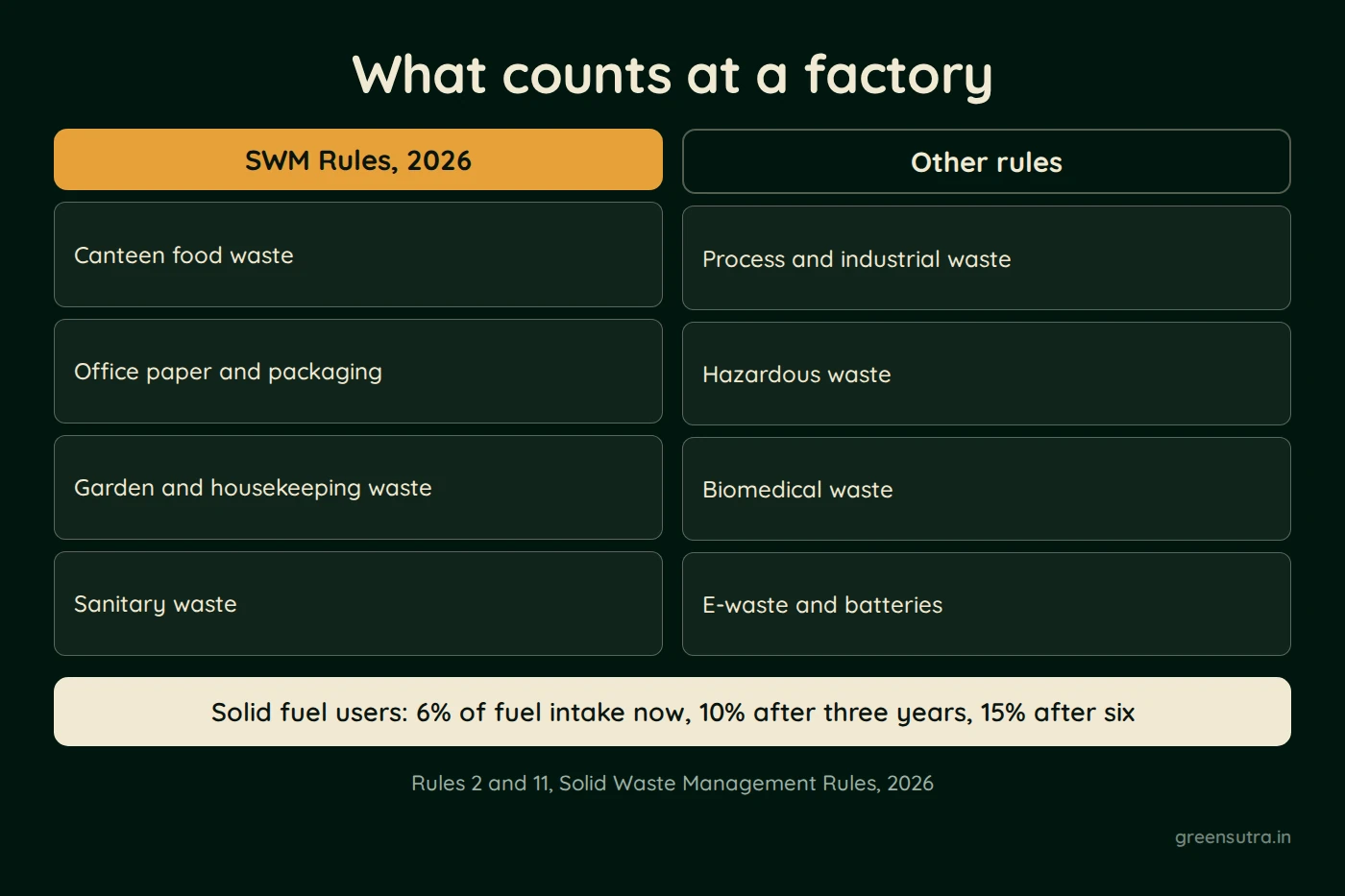
| Waste at a factory | Rules that govern it |
|---|---|
| Canteen, garden, office and housekeeping waste, sanitary waste | Solid Waste Management Rules, 2026 |
| Process waste and hazardous waste | Separate rules under the Environment (Protection) Act, 1986 |
| Biomedical waste, e-waste, batteries | Their own rules |
Example. A plant generates 80 kg a day of canteen and office waste and 400 kg a day of process scrap. Only the 80 kg is solid waste under these rules, so the plant does not pass the waste test. It can still pass on floor area or water.
The water test reads simply “water consumption of 40000 litres per day”, with no carve-out for process water. A plant can therefore cross it even when its canteen and office waste is small.
Industrial areas and parks
Rule 35(2)(xv) tells each State’s urban development department to direct developers of special economic zones, industrial estates and industrial parks. New and existing developers must comply with all the bulk waste generator provisions. The December 2024 draft let an industrial area that treated all its waste skip EBWGR. The final rules dropped that carve-out, so an industrial bulk waste generator follows rule 6 like any other.
A separate fuel duty
Rule 11 adds a duty for industrial units that burn solid fuel, whether or not they are bulk waste generators. Boilers and waste-to-energy plants within 100 km of a solid waste based fuel plant use segregated combustible fraction or agri-residue. Cement kilns within 400 km use refuse-derived fuel. The minimum share of fuel intake rises in three steps:
- at least 6% from 1 April 2026;
- at least 10% after three years;
- at least 15% after six years.
Such units register with the State Pollution Control Board and report their fuel use on the portal by 30 June each year.
Sources: Solid Waste Management Rules, 2026, S.O. 388(E), CPCB centralised portal
The registration steps and dates are in Bulk Waste Generators in 2026. For a plant, GreenSutra’s waste management service maps which streams fall under these rules before registration.