

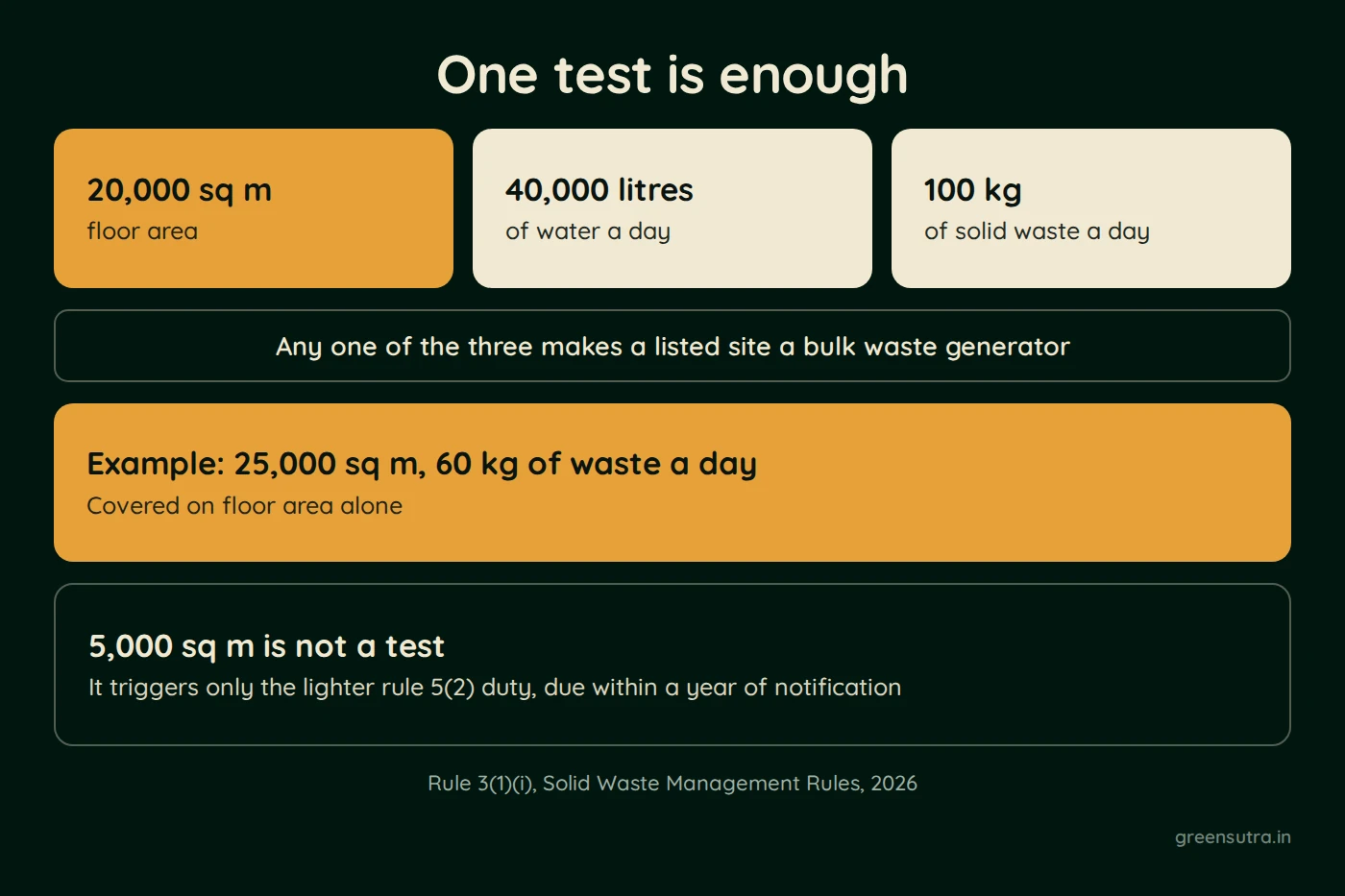
A building with 20,000 sq m or more of floor area is a bulk waste generator under India’s Solid Waste Management Rules, 2026. That holds even if it makes less than 100 kg of waste a day. Rule 3(1)(i) needs only one of three tests to be met, provided the site is one of the kinds the rule lists.
The three tests
Rule 3(1)(i) covers listed entities that satisfy “at least one” of three criteria. The CPCB portal at swm.cpcb.gov.in lists the same three figures when a site registers.
| Test | Threshold | Usual evidence |
|---|---|---|
| Floor area | 20,000 sq m or more | Building records |
| Water | 40,000 litres a day | Water bills or meter readings |
| Solid waste | 100 kg a day | A few weeks of weighed waste |
The site must also fall in one of the three groups the rule names. Institutional users include government offices, public sector undertakings, private companies and schools. Commercial users include transport hubs, industrial units, malls, hotels, hospitals, wholesale markets and venues. The third group is residential societies.
Example: an office complex
Example. A private company’s office complex has 25,000 sq m of floor area, uses 20,000 litres of water a day and generates 60 kg of waste a day. It fails the water and waste tests but passes on floor area, so it is a bulk waste generator. Its duties are the same as for any other:
- register with the local body on the CPCB portal;
- segregate wet, dry, sanitary and special care waste;
- process wet waste on site or, as an existing site that cannot, get an exemption and buy certificates for it;
- buy EBWGR certificates for the other three streams;
- file an annual return by 30 June.
As an institutional user below 500 kg a day, it pays a one-time fee of ₹1,500 under CPCB’s fee guidelines of September 2026, and ₹375 with each annual return.
What 5,000 sq m means
Some city and district pages still give 5,000 sq m as the line. That figure is a carry-over from the 2016 rules. In the 2026 rules it triggers a lighter duty under rule 5(2). Gated communities and institutions over 5,000 sq m must arrange segregation with the local body within a year of the rules’ notification, that is by late January 2027. They must also process wet waste on site as far as possible. Crossing 5,000 sq m alone does not make a site a bulk waste generator.
Sources: Solid Waste Management Rules, 2026, S.O. 388(E), CPCB guidelines for portal fees, September 2026, CPCB centralised portal
The full set of duties and dates is in Bulk Waste Generators in 2026. GreenSutra’s waste management service starts with a site walk-through and a few months of weighed waste records.