

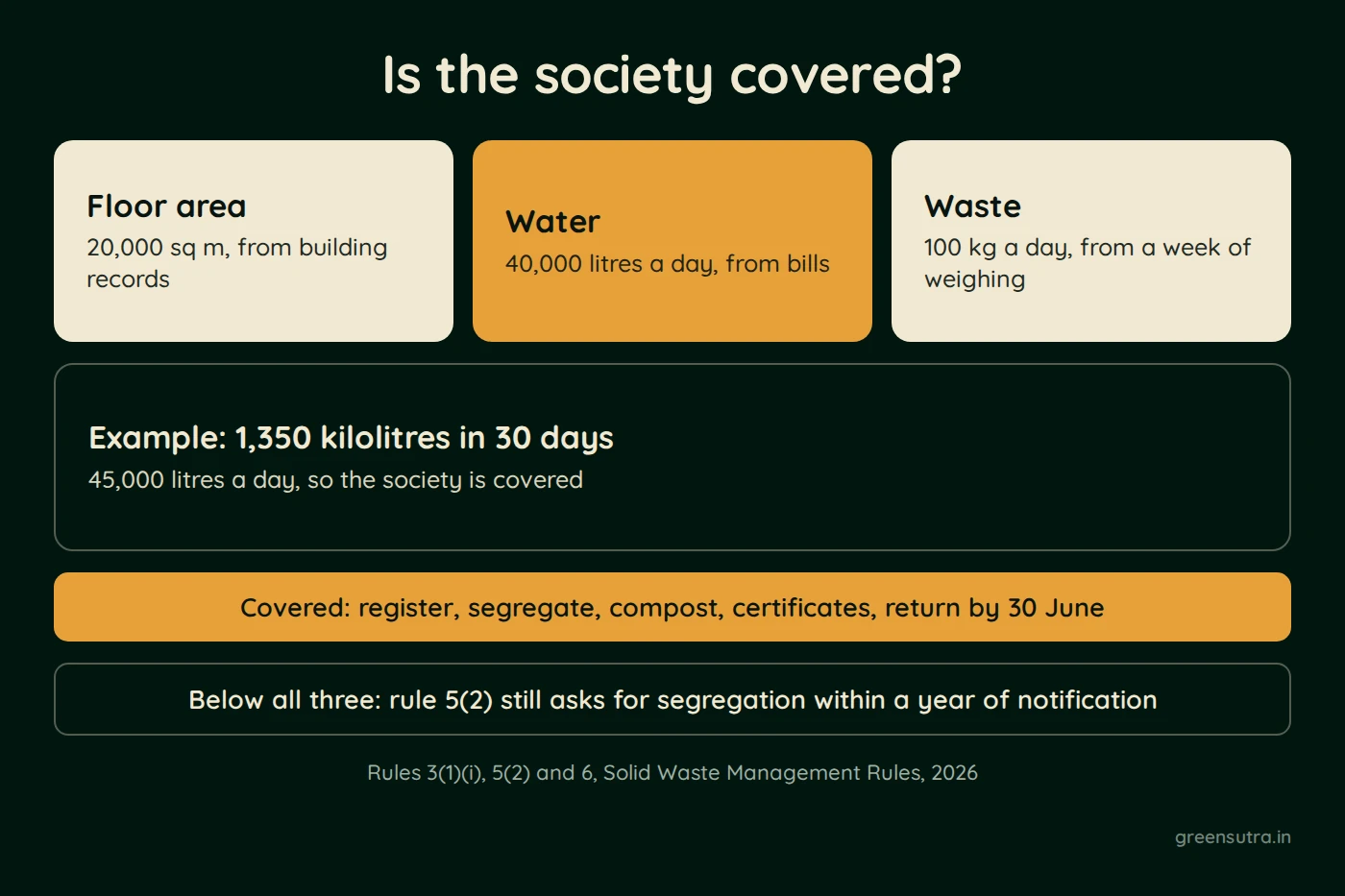
A housing society is a bulk waste generator under the Solid Waste Management Rules, 2026 once it crosses any one of three tests. The tests are 20,000 sq m of floor area, 40,000 litres of water a day and 100 kg of solid waste a day. Societies register on the CPCB portal under “Residential”, sub-category “Residential Societies / RWA”.
Checking the three tests
A society settles the tests from its own records rather than estimates.
- Floor area: from the society’s building records. The rule does not say how the floor area of several towers is counted.
- Water: monthly bills or meter readings, divided by the days in the month.
- Waste: a week or more of weighing every stream before handover.
Example. A society’s water bill shows 1,350 kilolitres for a 30-day month. That is 45,000 litres a day, above the 40,000 litre test, so the society is covered even if its waste stays under 100 kg a day.
What a society must do
| Duty | What it means for a society |
|---|---|
| Register | On swm.cpcb.gov.in with its local body; one-time fee of ₹1,000 below 500 kg a day, then ₹250 with each return |
| Segregate | Four streams at source: wet, dry, sanitary and special care waste |
| Wet waste | Compost or biomethanate on site; an existing society that cannot applies to the local body for an exemption |
| Certificates | EBWGR certificates for dry, sanitary and special care waste, and for wet waste too under an exemption |
| Annual return | On the portal by 30 June each year |
As of 11 October 2026 no local body had notified a certificate cost, so certificates could not yet be bought. A society can register, compost and keep weighed records in the meantime.
State urban and rural development departments must provide incentives, such as tax benefits, to residential societies and other bulk waste generators that treat wet waste on their own premises.
Below the line
A society under all three tests falls outside the definition, but rule 5(2) still reaches every resident welfare association, whatever its size, and gated communities over 5,000 sq m. Within a year of the rules’ notification, that is by late January 2027, they must arrange segregation with the local body. They must also process wet waste on site as far as possible.
A society that ignores the rules faces the same enforcement as any other bulk waste generator, including a possible water or electricity cut under Supreme Court orders.
Sources: Solid Waste Management Rules, 2026, S.O. 388(E), CPCB guidelines for portal fees, September 2026, CPCB centralised portal
Registration, certificates and the dates ahead are covered in Bulk Waste Generators in 2026. GreenSutra’s waste management service handles portal registration and the annual return for societies, with the society’s own staff running segregation.