


A bulk waste generator needs one EBWGR certificate for every kilogram of its calculated solid waste that it does not process itself. Under rules 6(e) and 6(f) of the Solid Waste Management Rules, 2026, that always covers dry, sanitary and special care waste. It covers wet waste too when the site holds an exemption from on-site processing.
The formula
Rule 10(3) fixes the unit. Certificates in kilograms equal the quantity of solid waste the local body collected and sent to registered processors or recyclers, so one certificate is 1 kg. Under rule 10(6), a certificate generated in one year counts toward obligations for three years.
The obligation is not simply what the site weighs. Rule 6(e) says it is estimated from norms CPCB issues with the Ministry of Housing and Urban Affairs and the Department of Drinking Water and Sanitation. Each year the urban local body audits what different types of bulk waste generator actually produce, and reports the figures against the norms to the State Pollution Control Board.
Example: a college campus at 220 kg a day
Example. These are invented figures, and they assume the CPCB norm, once issued, matches the campus’s own weights.
| Stream | Per day | Per year |
|---|---|---|
| Wet | 130 kg | 47,450 kg |
| Dry | 70 kg | 25,550 kg |
| Sanitary | 12 kg | 4,380 kg |
| Special care | 8 kg | 2,920 kg |
| Total | 220 kg | 80,300 kg |
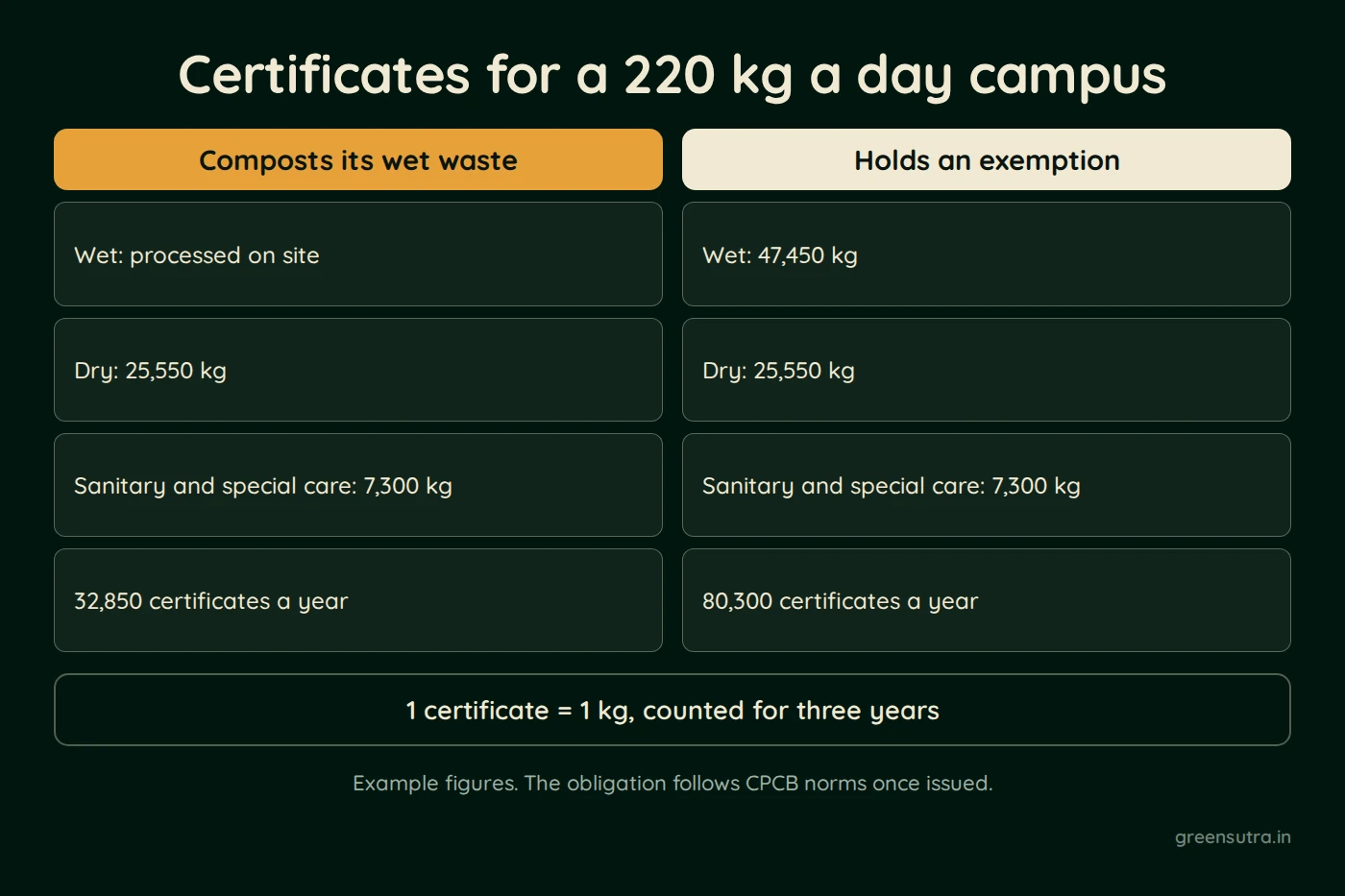
If the campus composts all its wet waste, it needs 32,850 certificates a year for the other three streams. With an exemption instead, it needs 80,300. The bill is the number of certificates times the cost per kg its local body notifies.
New and existing sites
Rule 6(d) treats the two differently. A new bulk waste generator must build processing for all its wet and garden waste. An existing one that cannot may apply to its local body for an exemption, and then buys certificates for its wet waste as well. The rules do not define “new” or “existing”.
Where things stand
As of 11 October 2026, CPCB had not issued the norms or the cost guidelines. No local body had notified a price, and the portal had no certificate module. Until certificates exist, a site can keep daily weights and handover receipts for every stream. Those records can support the annual return once CPCB publishes its format.
Sources: Solid Waste Management Rules, 2026, S.O. 388(E), CPCB centralised portal
How certificates differ from producer EPR is set out in How is EBWGR different from EPR for producers?, and the wider picture in Bulk Waste Generators in 2026. GreenSutra’s waste management service works out the certificate quantity from a site’s own records.