


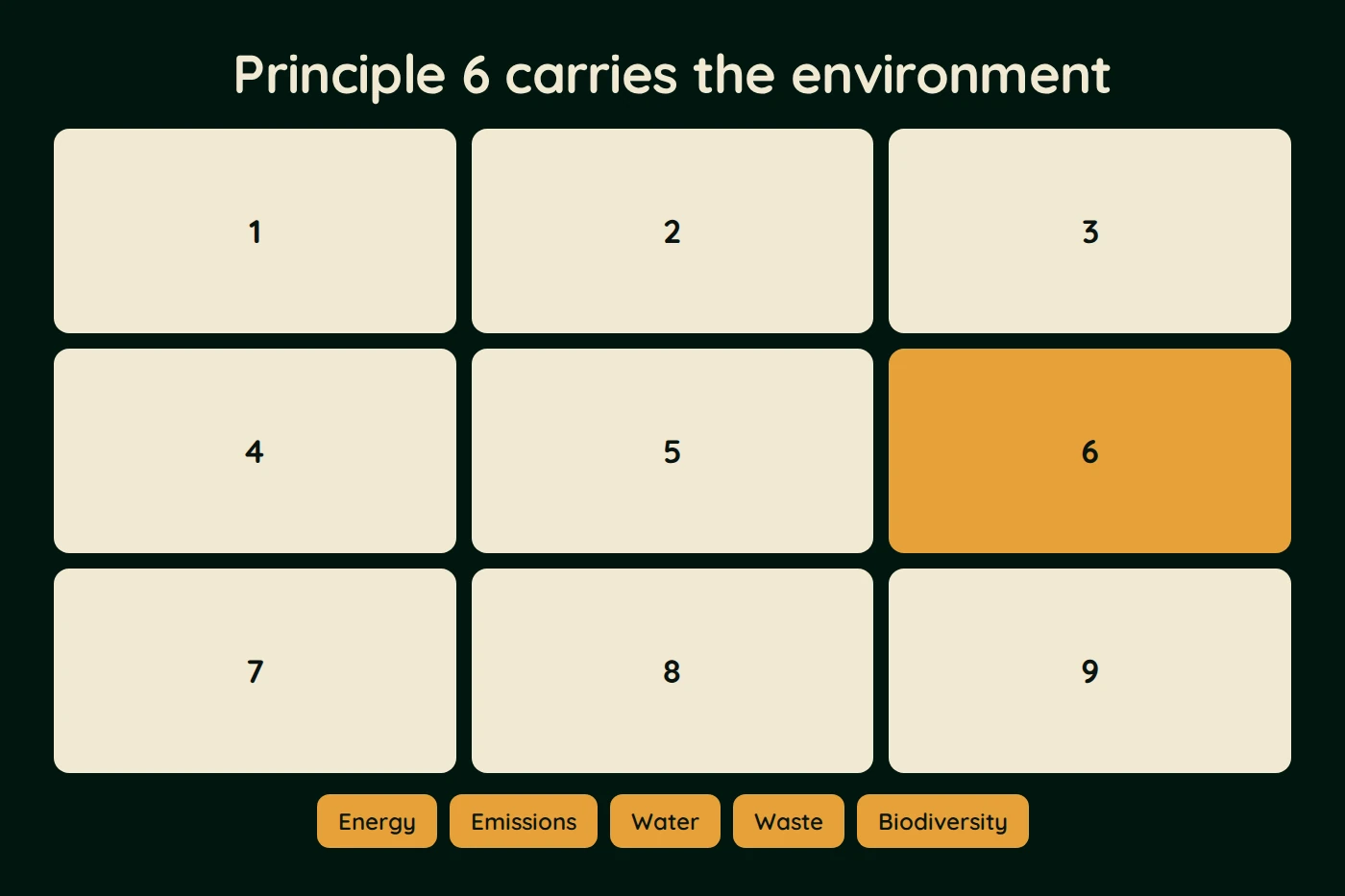
Principle 6 of the National Guidelines on Responsible Business Conduct covers the environment. It states that businesses should respect and make efforts to protect and restore the environment, and it is where energy, emissions, water, waste and biodiversity data sit in Section C of the BRSR.
Section C of the Business Responsibility and Sustainability Report is organised by principle rather than by ESG pillar, so environmental data is not found in a section labelled environmental. It is found under Principle 6.
What Principle 6 requires
The principle states that businesses should respect and make efforts to protect and restore the environment. In the BRSR this translates into the essential and leadership indicators covering energy consumption, greenhouse gas emissions, water withdrawal, consumption and discharge, waste generation and recovery, and biodiversity.
| Indicator | What a company reports |
|---|---|
| Essential 1 | Energy consumption and energy intensity |
| Essential 2 | Sites named as designated consumers under the PAT scheme, and whether targets were met |
| Essential 3 | Water withdrawal, consumption and intensity |
| Essential 4 | Water discharged, by destination and level of treatment |
| Essential 5 | Zero liquid discharge |
| Essential 6 | Air emissions other than greenhouse gases |
| Essential 7 | Scope 1 and Scope 2 greenhouse gas emissions and intensity |
| Essential 8 | Projects to reduce greenhouse gas emissions |
| Essential 9 | Waste generated, recovered and disposed |
| Essential 10 | Waste management practices, and the strategy on hazardous and toxic chemicals |
| Essential 11 | Operations in or around ecologically sensitive areas |
| Essential 12 | Environmental impact assessments of projects |
| Essential 13 | Compliance with India's environmental laws |
| Leadership 1 | Water withdrawal, consumption and discharge in areas of water stress |
| Leadership 2 | Scope 3 emissions and intensity |
| Leadership 3 | Impact on biodiversity in ecologically sensitive areas |
| Leadership 4 | Initiatives to improve resource efficiency or cut emissions, effluent and waste |
| Leadership 5 | Business continuity and disaster management plan |
| Leadership 6 | Adverse environmental impact from the value chain |
| Leadership 7 | Share of value chain partners assessed for environmental impacts |
| Leadership 8 | Green credits generated or procured |
Why Principle 6 dominates assurance
Principle 6 is the environmental heart of Section C, and most of the assurable BRSR Core environmental indicators cross-reference back to Principle 6 essential indicators. Specifically, the greenhouse gas footprint, water footprint, energy footprint and circularity attributes of BRSR Core all trace to Principle 6.
Where the other Core attributes sit
The remaining BRSR Core attributes reach into other principles:
| Core attribute | Principle |
|---|---|
| Employee wellbeing and safety | Principle 3 |
| Gender diversity in business | Principle 5 |
| Inclusive development | Principle 8 |
| Fairness with customers and suppliers | Principles 9 and 1 |
| Open-ness of business | Principle 1 |
The practical consequence
An entity preparing for assessment or assurance concentrates first on Principle 6 essential indicators, because that is where the largest share of assurable data sits and where measurement, boundary and metering issues usually surface.
Sources: Ministry of Corporate Affairs, NGRBC, 15 March 2019
The BRSR guide maps every Core attribute to its principle. BRSR reporting services covers Principle 6 data systems and assurance readiness.
Related questions