

Under the PPWR, Regulation (EU) 2025/40, the manufacturer answers for the packaging and the producer answers for its waste. The manufacturer, one per packaging EU-wide, ensures conformity and draws up the EU declaration of conformity. The producer registers, reports and pays EPR fees in each Member State where the packaging is first made available. One business can be both.
What does each role answer for?
The Commission’s guidance says they “are defined under the PPWR for different purposes”.
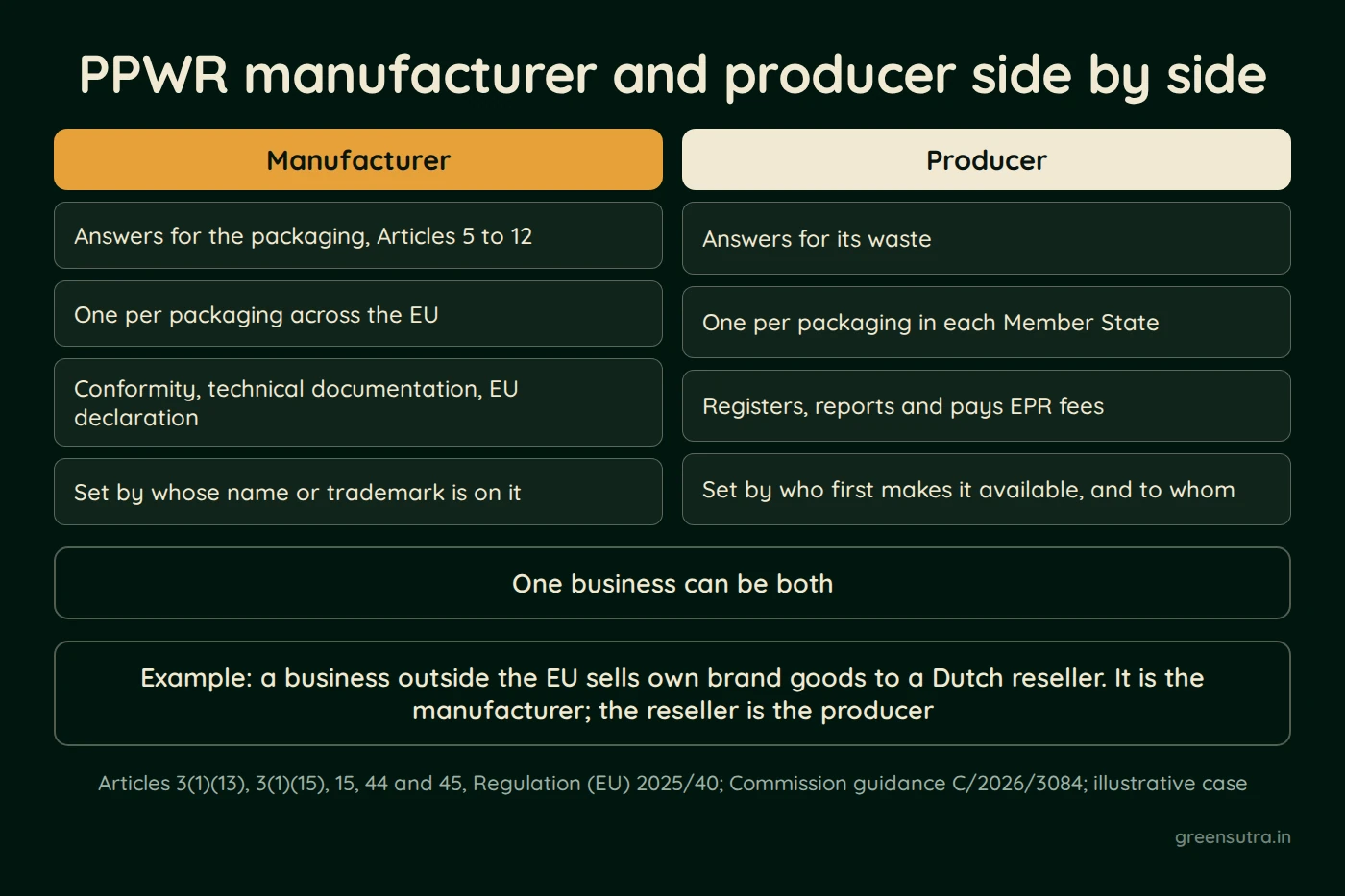
| Manufacturer, Article 3(1)(13) | Producer, Article 3(1)(15) | |
|---|---|---|
| Answers for | Sustainability and labelling requirements, Articles 5 to 12 | Financing waste management where the packaging becomes waste |
| How many | One per packaging EU-wide, says the Commission’s guidance | One per packaging in each Member State |
| Main duties | Article 15: conformity assessment, technical documentation, EU declaration of conformity | Article 44: registration before first making packaging available, yearly reports; Article 45(1): EPR fees |
| Decided by | Whose name or trademark is on it, with a micro-enterprise exception | Who first makes it available in a Member State, and to whom |
Who is the manufacturer?
The business that has packaging or a packaged product designed or made under its own name or trademark, even if another trademark is visible. The guidance says this is “not necessarily” whoever physically makes it; for sales packaging it is normally the filler, often the brand owner. For unbranded packaging, the test is who orders it and sets the design. Under Article 21, an importer or distributor that sells under its own brand becomes the manufacturer, unless it is a micro-enterprise with a supplier in the EU.
Who is the producer?
Any manufacturer, importer or distributor, “irrespective of the selling technique used”, that meets one of five points in Article 3(1)(15):
- Points (a) and (b): established in a Member State, it first makes packaging or packaged products available “from within the territory of that Member State and on that same territory”.
- Points (c) and (d): established “in a Member State or in a third country”, it first makes them available in another Member State “directly to end users”.
- Point (e): established in a Member State, it “unpacks packaged products without being an end user”, unless someone else is the producer.
Which role applies? Four illustrative cases
| Case | Manufacturer | Producer |
|---|---|---|
| A German brand owner sells its branded jars to German retailers | The brand owner | The brand owner |
| A business outside the EU sells own-brand goods to a Dutch reseller | The business outside the EU | The Dutch reseller |
| The same business sells directly to Dutch consumers | The business outside the EU | The business outside the EU, in the Netherlands |
| A Polish retailer sells own-brand goods packed by a supplier outside the EU | The Polish retailer | The Polish retailer, if it first sells them in Poland |
The private-label case, routes for sellers outside the EU and sales to EU businesses that use the goods are answered separately. The packaging supplier is a third role. A manufacturer can delegate tasks, not responsibility.
Sources: Regulation (EU) 2025/40 (PPWR), Commission guidance, C/2026/3084
GreenSutra’s PPWR consulting starts by mapping each product and buyer to a role per country. The EU PPWR guide sets out each role’s duties.