

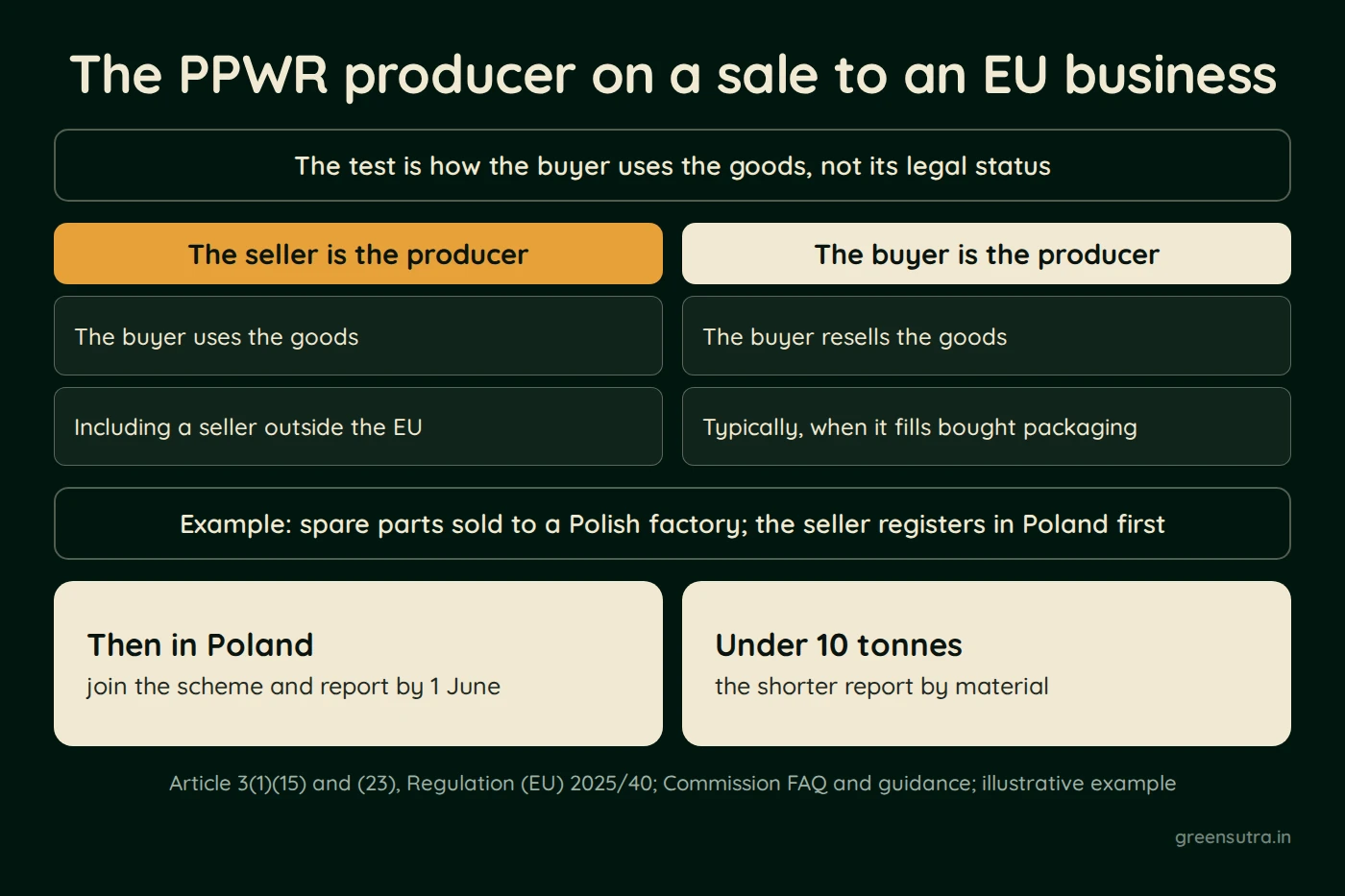
A seller that ships packaged goods directly to an EU business that uses them is the PPWR producer in that business’s Member State, even from outside the EU. Under Article 3(1)(23) of Regulation (EU) 2025/40, the business is a professional end user. If it resells the goods, or fills the packaging with its own products, the buyer is the producer.
When is an EU business an end user?
When it uses the product and does not make it further available “in the form supplied to it”. Article 3(1)(23) covers professional end users acting “in the course of its industrial or professional activities”. The Commission’s FAQ says “The determining factor is therefore not the legal status of the recipient, but how the product is used.”
The FAQ expects the seller to judge this from the packaging and its sales channels.
Who is the producer for each kind of B2B buyer?
| EU business buyer | PPWR producer in the buyer’s Member State | Basis |
|---|---|---|
| Uses the goods in its operations or production | The seller, from another Member State or outside the EU | Article 3(1)(15)(c) and (d) |
| Resells the goods | The buyer | Recital 122 |
| Fills bought empty packaging with its own products | Typically the buyer | Commission FAQ |
| Logistics company that unpacks or repacks | Never an end user; producer of the transport packaging if it repacks | Commission guidance |
For transport packaging, the Commission’s guidance says the manufacturer sending it to another Member State is the producer only if the recipient is the end user of the packaged product. Otherwise the recipient is. No official text addresses a delivery that is partly used and partly resold.
Example: spare parts for a Polish factory (illustrative)
1. A manufacturer outside the EU sells boxed spare parts directly to a Polish factory that fits them into its own machines. The factory is a professional end user. 2. The manufacturer is therefore the producer in Poland for the boxes, wrap and pallets that arrive with the parts. 3. Before the first delivery, it registers in Poland under Article 44(2) and (4), which until the harmonised register exists means Poland’s national rules. It also checks whether Poland requires producers outside the EU to appoint an EPR authorised representative, an option Article 45(3) gives Member States. 4. It joins or pays into the Polish scheme and reports the packaging weight under Polish rules, by 1 June each year once the harmonised register applies. Under 10 tonnes in Poland, the shorter report by material applies. 5. If the same parts go to a Polish distributor that resells them, the distributor is the producer and steps 2 to 4 are its duties.
Does the manufacturer role change?
No. An own-brand seller stays the manufacturer, with the Article 15 conformity duties. The manufacturer and producer comparison sets the roles side by side. Delivery terms such as DDP are a separate question from this end-user test. The marketplace and fulfilment checks in Article 45(4) and (7) cover offers to consumers only, not these sales.
Sources: Regulation (EU) 2025/40 (PPWR), Commission guidance document, C/2026/3084, PPWR FAQ, 2nd edition
GreenSutra’s PPWR consulting starts by sorting the buyer list into users and resellers. The EU PPWR guide covers registration.