


EN 15804:2012+A2:2019 has been the mandatory basis for every new construction-product EPD since October 2022.
An Environmental Product Declaration (EPD) is a standardised document that reports the life-cycle environmental performance of a product. It is an environmental statement under ISO 14025, built on a life cycle assessment (LCA) of the product and independently verified before publication.
An EPD is not a marketing claim and not a single carbon number. It reports multiple environmental impact categories against pre-set rules for that product category, so that one product can be compared with another on a like-for-like basis. This primer explains what an EPD is, the rules that make it comparable, and how one is prepared, verified, and published.
What an Environmental Product Declaration is
An Environmental Product Declaration (EPD) is an environmental statement under ISO 14025: a standardised, independently verified document that reports how a product performs across its life cycle against a pre-set set of Product Category Rules (PCRs).
Three features define it:
- Built on an LCA. Every EPD sits on top of a life cycle assessment (LCA) of the product, modelled to ISO 14040 and ISO 14044.
- Multi-category, not carbon-only. An EPD reports global warming, acidification, eutrophication, ozone depletion, resource use, and more. A single climate figure is only one line inside it.
- Independently verified. An EPD is checked by an independent competent third party before a programme operator publishes it. The document reports results; it does not set targets and does not pass or fail a product.
ISO 14025 governs how EPD programmes operate. It defines the process for declaring results, not a threshold a product must clear.
Product Category Rules: why EPDs are comparable
A Product Category Rule (PCR) defines how every product in a given category is assessed, so that two EPDs in that category can be read side by side. A PCR fixes:
- the functional unit (the basis of measurement, such as one square metre of flooring);
- the system boundary (which life-cycle stages are counted);
- which impact categories to include; and
- the reporting format.
Without a common PCR, two declarations for similar products could measure different things and could not be compared. An EPD must therefore be prepared against the PCR for its product category. Where no PCR yet exists, one is developed through the programme operator before the EPD can be published.
How an EPD is made: prepare, verify, publish
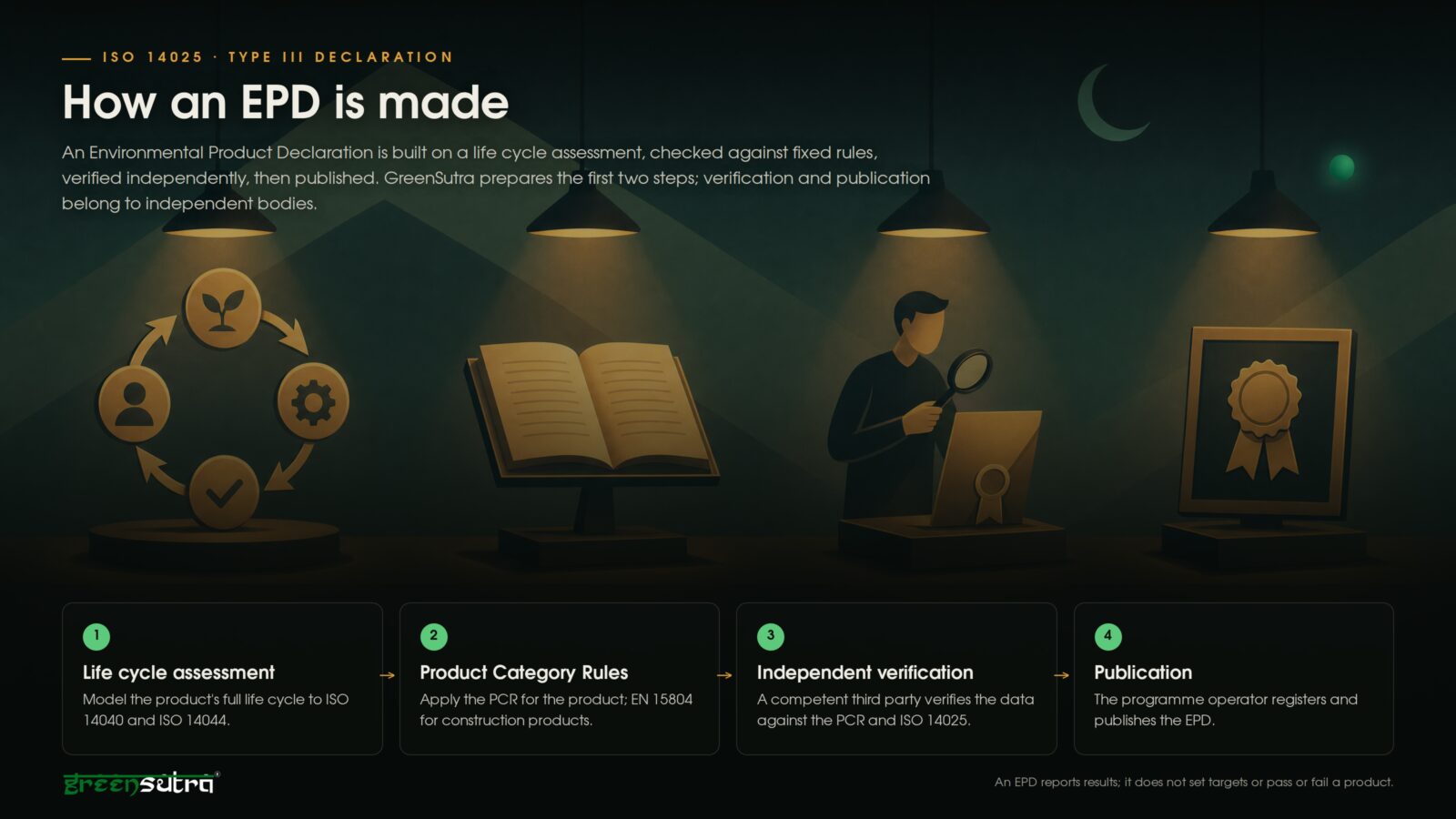
An EPD moves through a fixed workflow. Preparation, verification, and publication are handled by different parties, and that separation is what gives the final document its credibility.
| Step | What happens | Who does it |
|---|---|---|
| 1. Model the life cycle | Build the LCA to ISO 14040 and ISO 14044 on primary and background data | GreenSutra (preparation) |
| 2. Select the PCR and programme | Choose the applicable PCR and a recognised programme operator | GreenSutra (preparation) |
| 3. Compile the EPD | Assemble the declaration in the programme’s format from the LCA results | GreenSutra (preparation) |
| 4. Verify | Independent third-party verification of the LCA and EPD against the PCR and ISO 14025 | Independent competent third party |
| 5. Register and publish | Registration and publication, with a fixed validity period commonly up to five years, after which the EPD is renewed | Programme operator |
GreenSutra performs steps 1 to 3, the preparation of the LCA and EPD data. Step 4 is carried out by an independent competent third party. Step 5 is carried out by the programme operator. This division matters: the party that prepares the evidence is not the party that verifies it or publishes it.
EN 15804 and the A to D module structure
For construction products, the core PCR is EN 15804:2012+A2:2019. The +A2 amendment was approved in July 2019 and has been the mandatory basis for all new construction-product EPDs since October 2022.
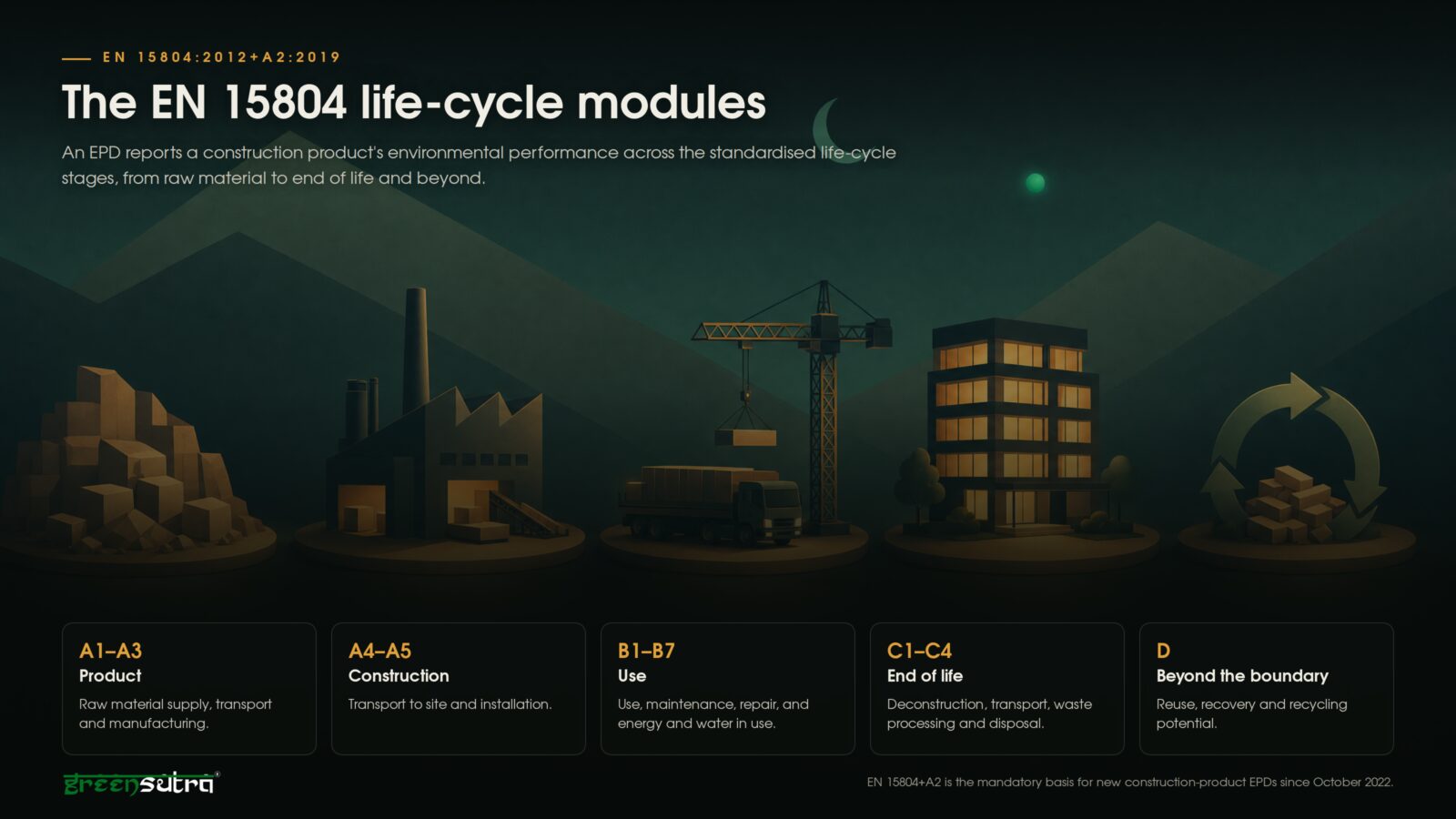
EN 15804 organises results into life-cycle modules, grouped by stage:
| Modules | Stage | What it covers |
|---|---|---|
| A1 to A3 | Product stage | Raw materials, transport, manufacturing |
| A4 to A5 | Construction stage | Transport to site and installation |
| B1 to B7 | Use stage | Use, maintenance, repair, replacement, operational energy and water |
| C1 to C4 | End-of-life stage | Deconstruction, transport, waste processing, disposal |
| Module D | Beyond the system boundary | Benefits and loads from reuse, recovery, and recycling potential |
The module structure lets a reader see exactly which parts of the life cycle a declaration covers, from raw material extraction (A1) through to recycling potential (module D).
Why exporters need an EPD
Manufacturers exporting construction products, and increasingly other goods, are asked for a verified EPD as common evidence of environmental performance. This holds for buyers and specifiers in the European Union and for buyers in Singapore, the United Arab Emirates, and Saudi Arabia. An EPD prepared to ISO 14025 and EN 15804 travels across these markets, and it is used in green procurement and building-rating systems.
The European Union is tightening this requirement. The revised Construction Products Regulation (EU) 2024/3110 (CPR) entered into force on 7 January 2025, and its environmental requirements, including the declaration of a construction product’s environmental performance, apply from 8 January 2026, with the calculation method based on EN 15804. The practical effect is that EU buyers increasingly require an EN 15804 EPD as the accepted proof of a product’s declared environmental performance. The detailed regulatory timeline is covered separately; the point for an exporter is that a verified EPD is becoming the standard entry ticket. The life cycle assessment behind that EPD is the work that has to be in place first.

EPD, LCA, and PCF in one line
An EPD is one output of a modelled life cycle: the full LCA (ISO 14040 and ISO 14044) is the multi-category study behind it, and a product carbon footprint (PCF) (ISO 14067:2018) is the single climate indicator that sits inside that LCA. For the full comparison of the three, see the LCA guide.
Frequently asked questions
What is an EPD?
An Environmental Product Declaration (EPD) is an environmental statement under ISO 14025. It is a standardised, independently verified document that reports the life-cycle environmental performance of a product against a pre-set Product Category Rule, and it is built on a life cycle assessment (LCA) of the product.
Is an EPD only about carbon?
No. An EPD is multi-category. It reports global warming, acidification, eutrophication, ozone depletion, resource use, and more. A single carbon figure, the product carbon footprint, is only one indicator inside the wider LCA that an EPD is built on.
What is a Product Category Rule?
A Product Category Rule (PCR) defines how every product in a category is assessed, so that EPDs in that category are comparable. It fixes the functional unit, the system boundary, the impact categories to include, and the reporting format. Where no PCR exists, one is developed through the programme operator before an EPD can be published.
Who verifies an EPD?
An independent competent third party verifies the LCA and the EPD against the PCR and ISO 14025, and the programme operator then registers and publishes it. GreenSutra prepares the LCA and EPD data; it does not verify or publish the declaration.
Does an exporter to the EU need an EPD?
EU buyers and specifiers increasingly require an EN 15804 EPD as the accepted proof of a construction product’s declared environmental performance. Under the revised Construction Products Regulation (EU) 2024/3110, which entered into force on 7 January 2025, environmental requirements apply from 8 January 2026, with the calculation method based on EN 15804.
