


A Carbon Border Adjustment Mechanism (CBAM) declarant using verified actual emissions can claim fewer certificates for a carbon price effectively paid in any third country, under Article 9. A tax, levy, fee or allowances all count, net of rebates such as free allowances. With default values, only Commission default carbon prices can be used, and none exists before 2027.
What counts as a carbon price?
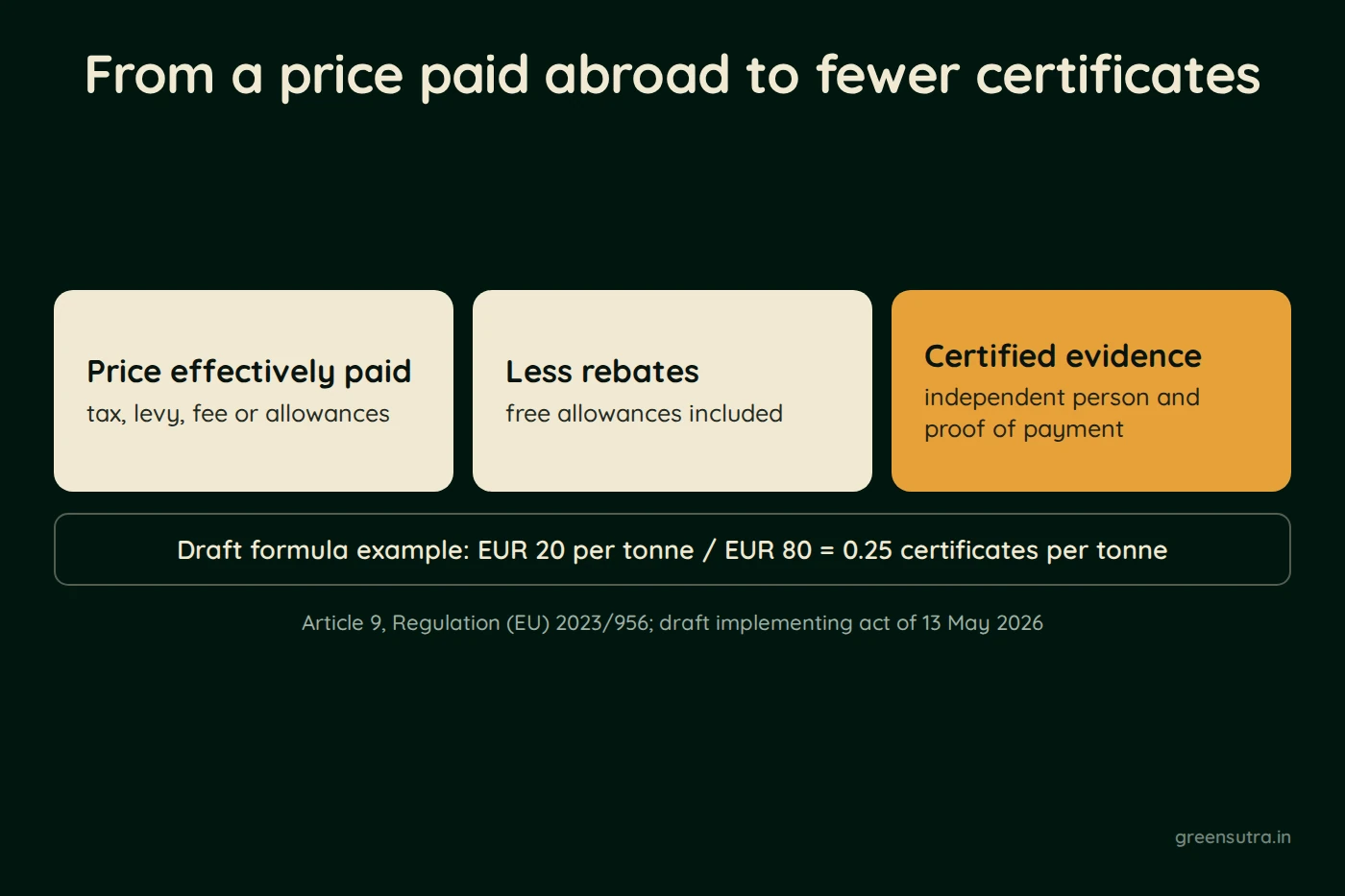
A carbon price, as Article 3(29) defines it, is money paid in a third country under a carbon emissions reduction scheme, calculated on the gases the measure covers. The claim is allowed only where the price was “effectively paid”, after any rebate or other compensation that would lower it, under Article 9(1).
| Paid or received abroad | Effect on the CBAM deduction |
|---|---|
| Tax, levy or fee | Counts |
| Emission allowances under a greenhouse gas trading system | Counts |
| Rebates, free allowances or other compensation | Subtracted; the Commission’s Q&A of 15 October 2026 names free allowances |
| A price paid outside the country of origin | Counts since Regulation (EU) 2025/2083 |
| Paris Agreement Article 6 credits | Draft act only: capped at 10% of the emissions reported under the foreign scheme |
A scheme that hands out most allowances free therefore leaves less to deduct.
What evidence does the declarant need?
The declarant keeps documentation that the price was effectively paid, evidence of any rebate with references to the country’s law, and proof of payment, as Article 9(2) requires. A person independent of both the declarant and the third country’s authorities certifies the information. Records stay available until the end of the fourth year after the declaration was due, and Article 9 sets no separate step in which the EU recognises the foreign scheme.
What if the declarant uses default values?
With default emission values, a deduction is possible only through yearly default carbon prices, which the Commission may publish from 2027 under Article 9(4). None exist yet. The implementing act that turns a price into certificates appeared as a draft on 13 May 2026. It was not in the Official Journal by 15 October 2026.
How many certificates can a deduction save?
Example, with illustrative inputs and the draft’s formula: an installation’s verified emissions are 2.0 t CO2e per tonne of product. It paid a net EUR 10 per tonne of CO2e, so EUR 20 per tonne of product. Divided by an assumed yearly reference CBAM price of EUR 80, that is 0.25 certificates per tonne, or 250 fewer certificates for 1,000 t.
The draft would also require the certifier to hold accreditation for carbon price certification and to meet EN ISO/IEC 17029. Like the cap on Paris Agreement Article 6 credits, that rule is not law yet.
The UK runs its own relief, covered in the UK overseas carbon price answer. The deduction works only with actual emissions or a published default carbon price, so the hydrogen example, which uses default values, carries none.
Sources: Regulation (EU) 2023/956, consolidated, Regulation (EU) 2025/2083, CBAM Questions and Answers, 15 October 2026, Draft implementing regulation on carbon price paid
GreenSutra’s CBAM solutions gather the operator’s payment records and rebate details into one file for the independent person to certify. The bill before any deduction comes from the CBAM cost calculator.