

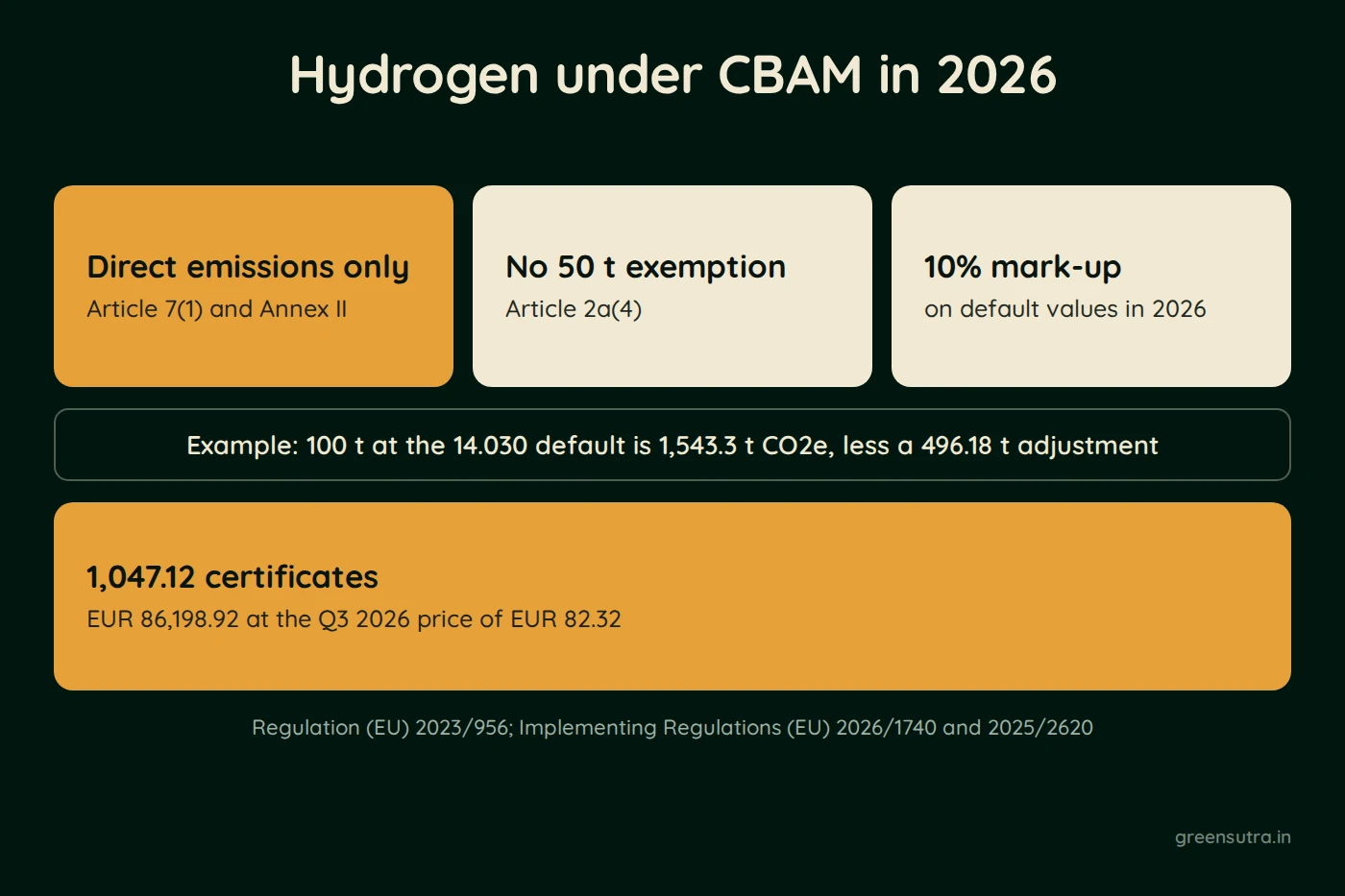
Hydrogen under Combined Nomenclature (CN) code 2804 10 00 is a Carbon Border Adjustment Mechanism (CBAM) good priced on its direct emissions only. The 50-tonne exemption never applies, so every import needs an authorised CBAM declarant. Without verified installation data, the importer uses the country default value, 10.820 t CO2e per tonne for most listed countries, plus a 10% mark-up in 2026.
What CBAM counts for hydrogen
Hydrogen counts direct emissions only, like iron and steel, aluminium and electricity, under Article 7(1) and Annex II of Regulation (EU) 2023/956. It also sits outside the 50-tonne de minimis under Article 2a(4), as electricity does, so an authorised declarant is needed from the first kilogram. Article 2(3a) excludes hydrogen originating on the continental shelf or in the exclusive economic zone of a Member State or a point 1 Annex III country.
What default value applies to hydrogen in 2026?
Implementing Regulation (EU) 2025/2621, as corrected by 2026/1740, sets the hydrogen defaults. The mark-up is 10% in 2026, 20% in 2027 and 30% from 2028.
| Origin | Default, t CO2e per tonne | With the 2026 mark-up |
|---|---|---|
| Most listed countries, including Türkiye, the UAE, the UK, Egypt, Canada and Brazil | 10.820 | 11.902 |
| Kuwait, Saudi Arabia | 13.450 | 14.795 |
| India, Japan, the Republic of Korea, Singapore and six others | 14.030 | 15.433 |
| South Africa | 25.940 | 28.534 |
| China, United States | 26.640 | 29.304 |
| Countries with no listed value | 17.740 | 19.514 |
How many certificates do 100 tonnes of hydrogen need?
Example: take 100 t of hydrogen from a country with the 14.030 default, imported in the third quarter of 2026. Embedded emissions are 100 x 14.030 x 1.10 = 1,543.3 t CO2e. The free allocation adjustment uses the CBAM benchmark of 5.089 in Implementing Regulation (EU) 2025/2620. With the 2026 CBAM factor of 97.5% and a correction factor of 100%, it is 100 x 5.089 x 0.975 = 496.18 t, rounded. That leaves 1,047.12 certificates, or EUR 86,198.92 at the Q3 2026 price of EUR 82.32.
Is green hydrogen exempt from CBAM?
No. Implementing Regulation (EU) 2025/2547 sets monitoring rules for steam reforming, partial oxidation and steam cracking. The Commission’s hydrogen guidance of 14 August 2026 says water electrolysis has “minimal” direct emissions, and the electricity it uses is not counted for CBAM.
A low figure needs actual emissions verified by an accredited verifier. Where verified direct emissions fall below the 2026 adjustment of about 4.962 t per tonne, the result is negative and is set to zero.
The 5.089 benchmark applies to 2026 imports. The EU Emissions Trading System (EU ETS) benchmark for hydrogen for 2026 to 2030 is 7.98 allowances per tonne. A revised CBAM benchmark based on it is planned for 2027 imports but not yet adopted.
Sources: Regulation (EU) 2023/956, consolidated, Implementing Regulation (EU) 2025/2621, Implementing Regulation (EU) 2026/1740, Implementing Regulation (EU) 2025/2620, Guidance No. 5b, hydrogen
For a specific plant, the CBAM hydrogen page and the cost calculator apply these figures. In GreenSutra’s CBAM consulting, the producer’s monitoring data is prepared for an accredited verifier, who checks it separately.