


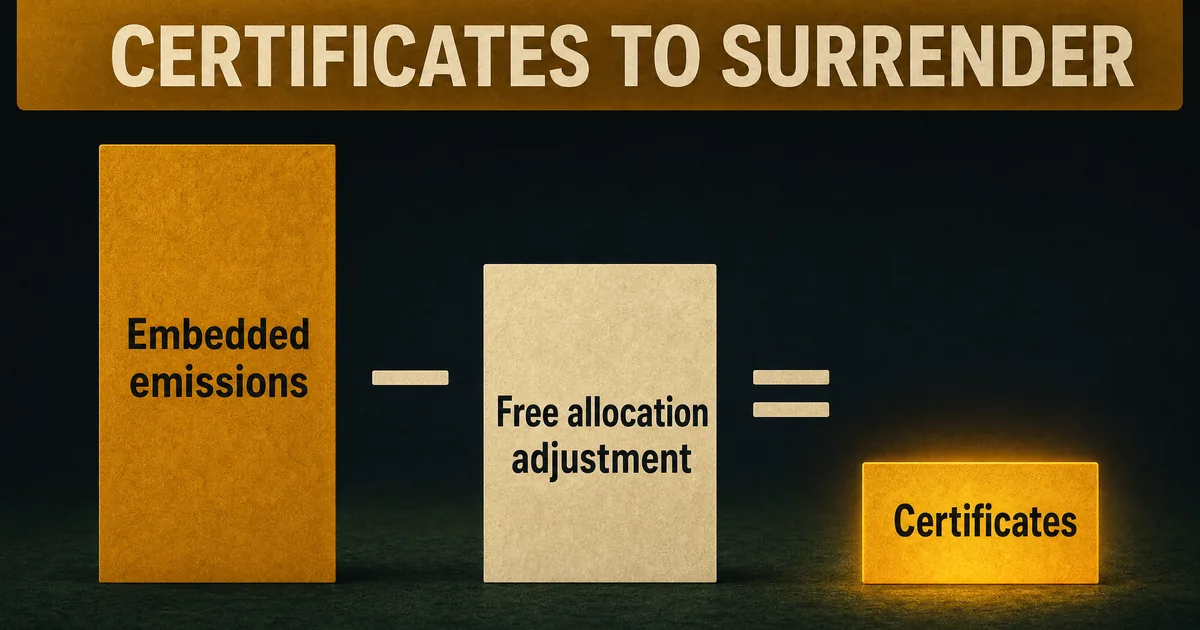
Certificates to surrender equal verified embedded emissions minus the free allocation adjustment, and one certificate covers one tonne of CO2e. The 2026 adjustment leaves about 2.5 per cent of the gross obligation payable. Purchases open 1 February 2027; the first annual declaration falls due 30 September 2027.
The number of CBAM certificates needed for a reporting year equals the verified embedded emissions of the imported goods minus the free allocation adjustment, and each certificate covers one tonne of CO2e. Commission Implementing Regulation (EU) 2025/2620, adopted 16 December 2025 and applicable from 1 January 2026, sets the methodology for that adjustment under Article 31 of Regulation (EU) 2023/956.
How the adjustment is calculated
The Annex of Regulation 2025/2620 gives the core formula: FAAg = SEFAg,y x Mg. The free allocation adjustment for a good equals its specific embedded free allocation for the year, expressed in tonnes of CO2e per tonne of good, multiplied by the total mass of that good imported during the reporting year. The declarant includes the adjustment in the annual CBAM declaration, where it reduces the certificates to be surrendered. Because EU producers retain 97.5 per cent of their EU ETS free allocation in 2026, CBAM-covered imports effectively face about 2.5 per cent of their gross certificate obligation that year. The share is not permanent; it ramps up as free allocation is withdrawn.
| Year | Payable share of embedded emissions |
|---|---|
| 2026 | 2.5 per cent |
| 2027 | 5 per cent |
| 2028 | 10 per cent |
| 2029 | 22.5 per cent |
| 2030 | 48.5 per cent |
| 2031 | 61 per cent |
| 2032 | 73.5 per cent |
| 2033 | 86 per cent |
| 2034 | 100 per cent |
Buying, holding, declaring
Certificate purchases open on 1 February 2027. Certificates carry no fixed price: the 2026 price is the quarterly average of EU ETS auction clearing prices, published at EUR 75.36 for Q1 2026 (7 April 2026) and EUR 75.28 for Q2 2026 (6 July 2026), moving to weekly averages from 2027. At the end of each quarter the declarant must hold certificates covering at least 50 per cent of the cumulative embedded emissions accumulated since the start of the year, so purchasing runs ahead of the annual settlement. The first annual CBAM declaration falls due on 30 September 2027.
Cost planning starts from the same flow: expected import mass, the payable share for the year, and the running certificate price. The CBAM cost calculator turns those inputs into a budget figure across scenarios. GreenSutra’s consultants prepare the embedded-emissions calculation and the certificate cost plan behind that number; CBAM advisory covers declarant registration through to surrender.
Sources: Regulation (EU) 2023/956 · Implementing Regulation (EU) 2025/2620 · European Commission CBAM