


CBAM sets imported-electricity emissions from the exporting country’s grid CO2 emission factor, a five-year average published per country in Implementing Regulation (EU) 2025/2621, Annex III. Actual generation emissions apply only where a power purchase agreement and the installation meet all the criteria in Article 7(3) and Annex IV, point 5 of Regulation (EU) 2023/956.
Under CBAM, imported electricity is not measured at a single installation the way steel or cement can be. The default embedded-emission value is the exporting country’s grid CO2 emission factor, a five-year average based on best available data and published for each country in Implementing Regulation (EU) 2025/2621, Annex III. The value that governs a consignment is the one listed for its country of origin in Annex III. For a country not listed, the EU figure of 0.612 tCO2eq per MWh applies unless a lower factor is shown on reliable data. Electricity carries no de-minimis threshold, so no flow is exempt on volume grounds. Electricity originating in Iceland, Liechtenstein, Norway or Switzerland is outside CBAM.
Default versus verified actual
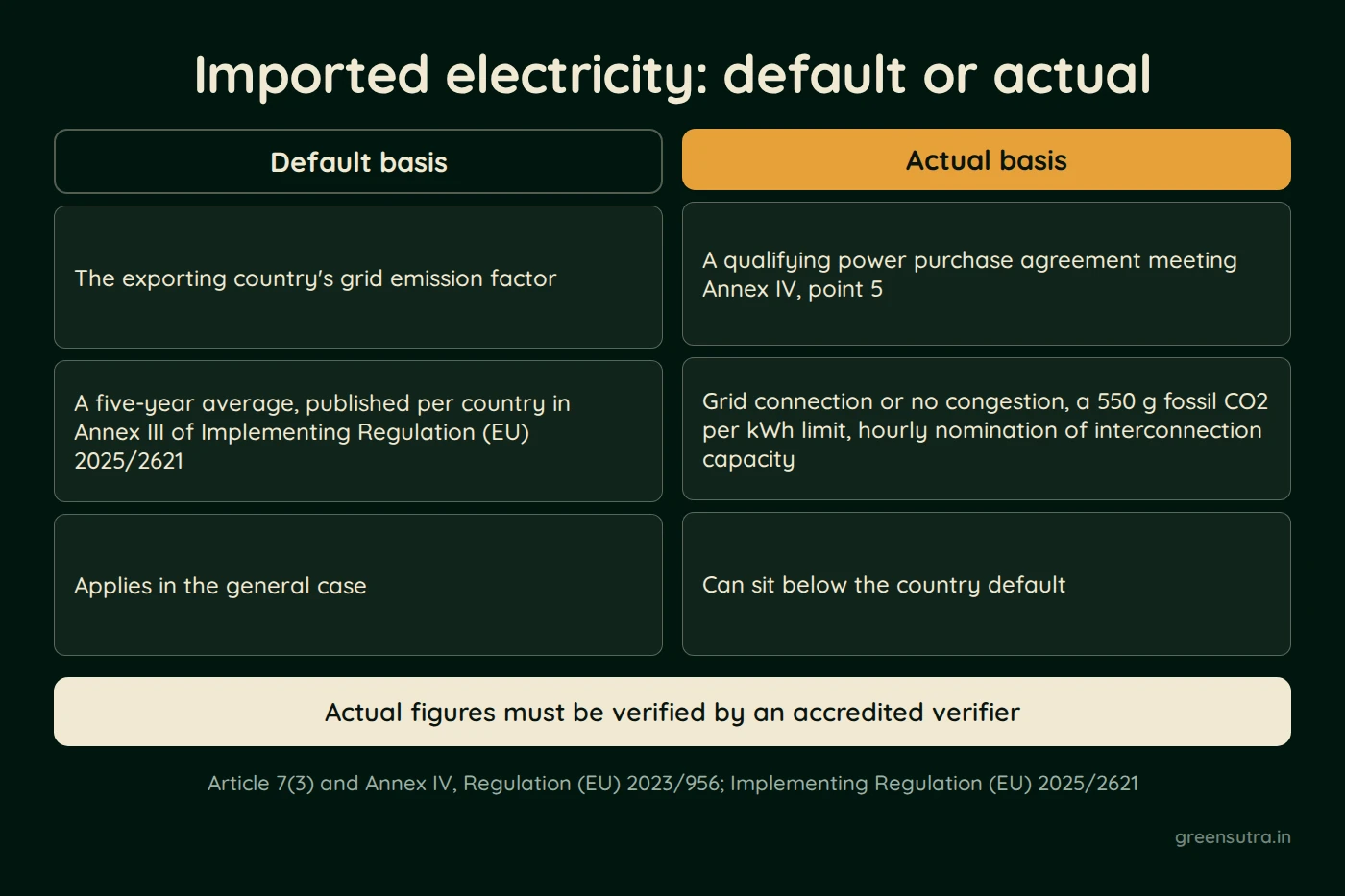
| Basis | When it applies | Effect |
|---|---|---|
| Grid emission factor default | The general case | Country-of-origin grid factor, published per country |
| Actual generation emissions | Qualifying power purchase agreement | Can sit below the country default |
When actual emissions can be used
Actual generation data may replace the default, but only under narrow conditions:
- A power purchase agreement between the declarant and a third-country producer must meet Annex IV, point 5. That means grid connection or no congestion, a 550 g fossil CO2 per kWh limit, and hourly nomination of interconnection capacity.
- Generation that meets the 550 g limit is then declared at its actual emissions, which can be below the country default.
- The data must be verified by a verifier accredited under Commission Delegated Regulation (EU) 2025/2551, an independent step separate from any advisory work.
Electricity traders may expect a plant-level figure, but the country grid factor governs unless a qualifying power purchase agreement is in place. CBAM compliance support covers preparing for declarant status, embedded-emissions calculation and certificate-cost planning for electricity flows.
The CBAM cost calculator converts an emission factor into an estimated charge by volume and import year.
Sources: Regulation (EU) 2023/956 · Implementing Regulation (EU) 2025/2621 · Commission Delegated Regulation (EU) 2025/2551