


Article 2(7) of Regulation (EU) 2023/956 exempts electricity from a coupled third-country market only after the Commission assesses the conditions and lists the country in Annex III, point 2. The relief is conditional, resting on anti-circumvention safeguards and a decarbonisation commitment from the exporting country, not on physical grid connection alone.
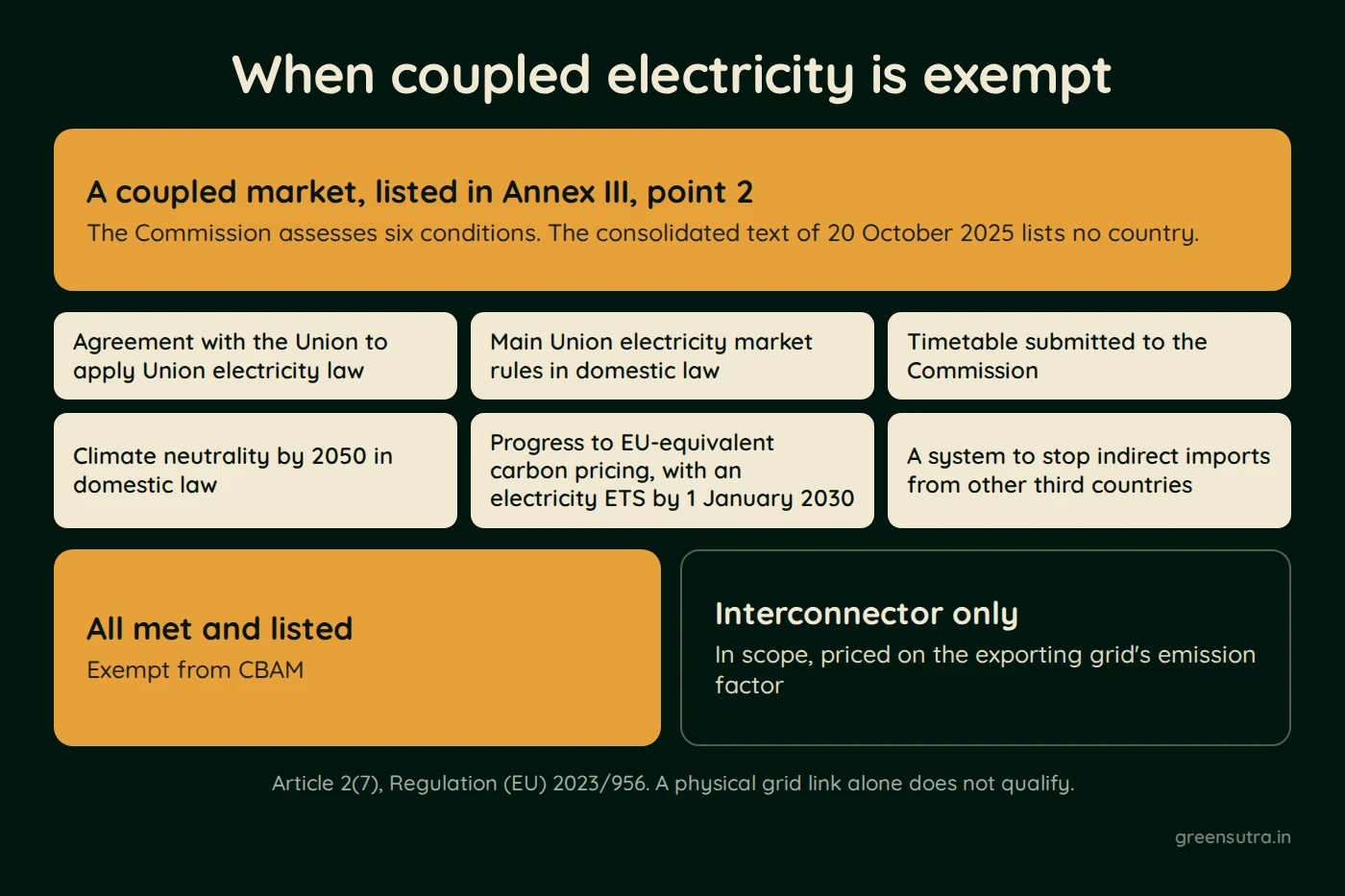
Imported electricity can be exempt from CBAM under Article 2(7) of Regulation (EU) 2023/956 when the exporting country’s electricity market is integrated with the EU’s through market coupling and the Commission has listed the country in Annex III, point 2. The consolidated text of 20 October 2025 lists none. The exemption is conditional. It rests on anti-circumvention safeguards and a firm decarbonisation commitment from the exporting country, not on a physical grid link. Where those conditions are absent, imported electricity is treated like any other covered flow and priced on the exporting grid’s emission factor.
Coupling, not connection
Being wired to the EU is not the same as being part of its market. That distinction sets the exemption apart from the rest of the CBAM regime, where most goods have few routes to relief, such as a carbon price paid abroad, an origin exempted in Annex III or the 50 tonne threshold. Market coupling is the starting point. The exemption exists because CBAM has no technical solution for coupled flows, and it depends on EU-equivalent carbon pricing. A market that merely exports power across an interconnector does not qualify.
What the exemption tests
Article 2(7) applies to a coupled market as a whole, not to a single generator or a single supply contract within it. It also requires that no technical solution exists for applying CBAM to those flows. The country must meet six conditions, and the Commission assesses them:
- Agreement: the country has an agreement with the Union to apply Union electricity law.
- Domestic law: it implements the main Union electricity market rules, including market coupling.
- Roadmap: it has submitted a timetable to the Commission for the climate steps below.
- Climate neutrality: it has committed to climate neutrality by 2050 in domestic law.
- Carbon pricing: it shows progress towards EU-equivalent carbon pricing, with an electricity emissions trading system at an equivalent price finalised by 1 January 2030.
- Indirect imports: it has a system to stop indirect imports from other third countries.
Connected exporters sometimes read an interconnector as automatic relief, when the article layers market-integration and policy tests on top. The CBAM advisory covers preparing for declarant status, embedded-emissions calculation and certificate obligations, and a CBAM guide sets out the qualifying criteria in more detail.
Sources: Regulation (EU) 2023/956 · Implementing Regulation (EU) 2025/2621 · European Commission CBAM