

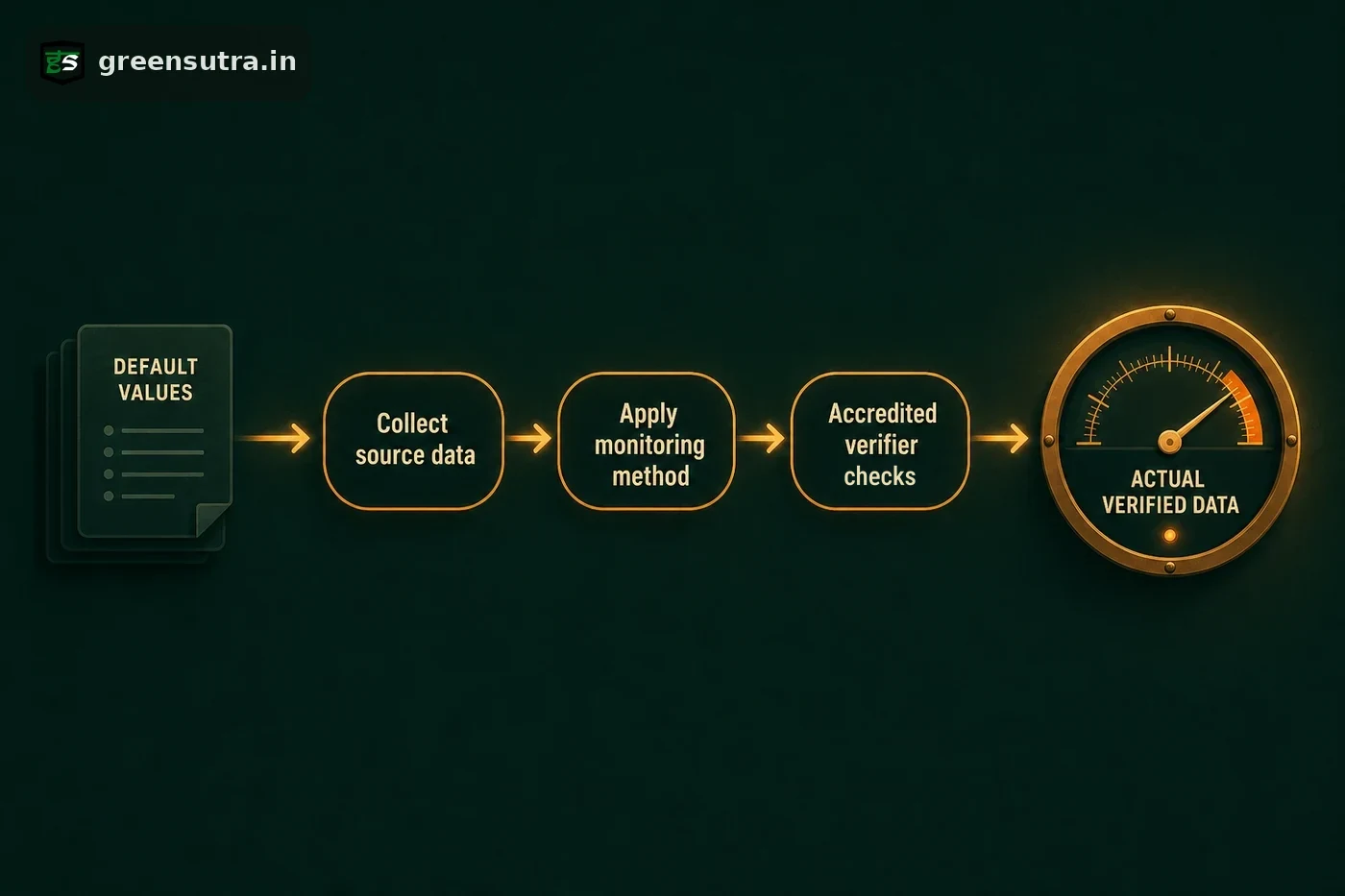
CBAM actual emissions data replaces conservative default values in three steps. The exporting installation collects source-level data, applies a calculation-based or measurement-based monitoring method, and has the figures verified by an accredited verifier before the importer declares them.
Why default values cost more than actual data
The CBAM definitive regime, live since 1 January 2026, is built on specific actual embedded emissions from the producing installation. Where actual data is not supplied, country-of-origin default values from Implementing Regulation (EU) 2025/2621 apply, carrying an escalating mark-up of 10 per cent in 2026, 20 per cent in 2027 and 30 per cent from 2028, with a flat 1 per cent for fertilisers. Because those defaults are deliberately conservative, verified actual data usually lowers the declared figure and the certificate obligation. GreenSutra’s CBAM advisory team calculates embedded emissions and prepares the declaration on this basis.
Three steps to actual emissions data
Switching means the exporting installation supplies monitored, source-level emissions and activity data to the importer, and the figures follow a recognised monitoring methodology set in the operational rules. Article 8(1) of Regulation (EU) 2023/956 requires those figures to be verified by an accredited verifier before the importer declares them. Verifier registration for the definitive regime opened on 1 September 2026, so installations can now engage a verifier for their 2026 emissions. The move from default values to actual data follows the steps summarised below.
| Step | What happens | Basis |
|---|---|---|
| Supplier data collection | Exporting installation records source-level fuel, process and electricity data | Annex IV, Regulation (EU) 2023/956 |
| Monitoring methodology | Calculation-based approach (including mass-balance) or measurement-based approach (continuous emission monitoring) | Implementing Regulation (EU) 2025/2547 |
| Third-party verification | Declared actual emissions verified by a verifier accredited to ISO 14065 and ISO/IEC 17029 | Delegated Regulation (EU) 2025/2551 |
Default values since 1 January 2026
Article 7(2) of Regulation (EU) 2023/956 lets the importer elect default values instead of actual data. Defaults need no verification, but their mark-up rises each year, which makes verified actual data progressively cheaper.
- The transitional rules ended on 31 December 2025. They allowed default values only until 31 July 2024, then capped estimates at 20 per cent of a complex good’s embedded emissions.
- A complex good can combine actual emissions for the installation’s own processes with default values for one or more precursors, under Article 15 of Implementing Regulation (EU) 2025/2547.
- The installation keeps the records behind the calculation for at least six years after the reporting period, under Implementing Regulation (EU) 2025/2547.
Across GreenSutra’s CBAM work, exporters frequently find their installation already logs much of the source-level data an actual calculation needs, though rarely in the structure a verifier expects. A short CBAM discovery call maps the gap between existing meters and figures that will pass accredited verification.
Sources: Regulation (EU) 2023/956 · Implementing Regulation (EU) 2025/2621 · European Commission CBAM