


A CBAM verifier is a legal person accredited by a national accreditation body under Commission Delegated Regulation (EU) 2025/2551, which sets the conditions for accreditation. Only national accreditation bodies located in an EU country, or in an EEA country once the CBAM Regulation is incorporated into the EEA Agreement, may grant it. Accredited verifiers are registered in the CBAM registry.
Verification of declared embedded emissions is a regulated activity, and the credential behind it is specific. Checking the credential means confirming the accreditation with the accreditation body or the Commission list, not accepting a general claim of competence.
The instruments behind CBAM accreditation
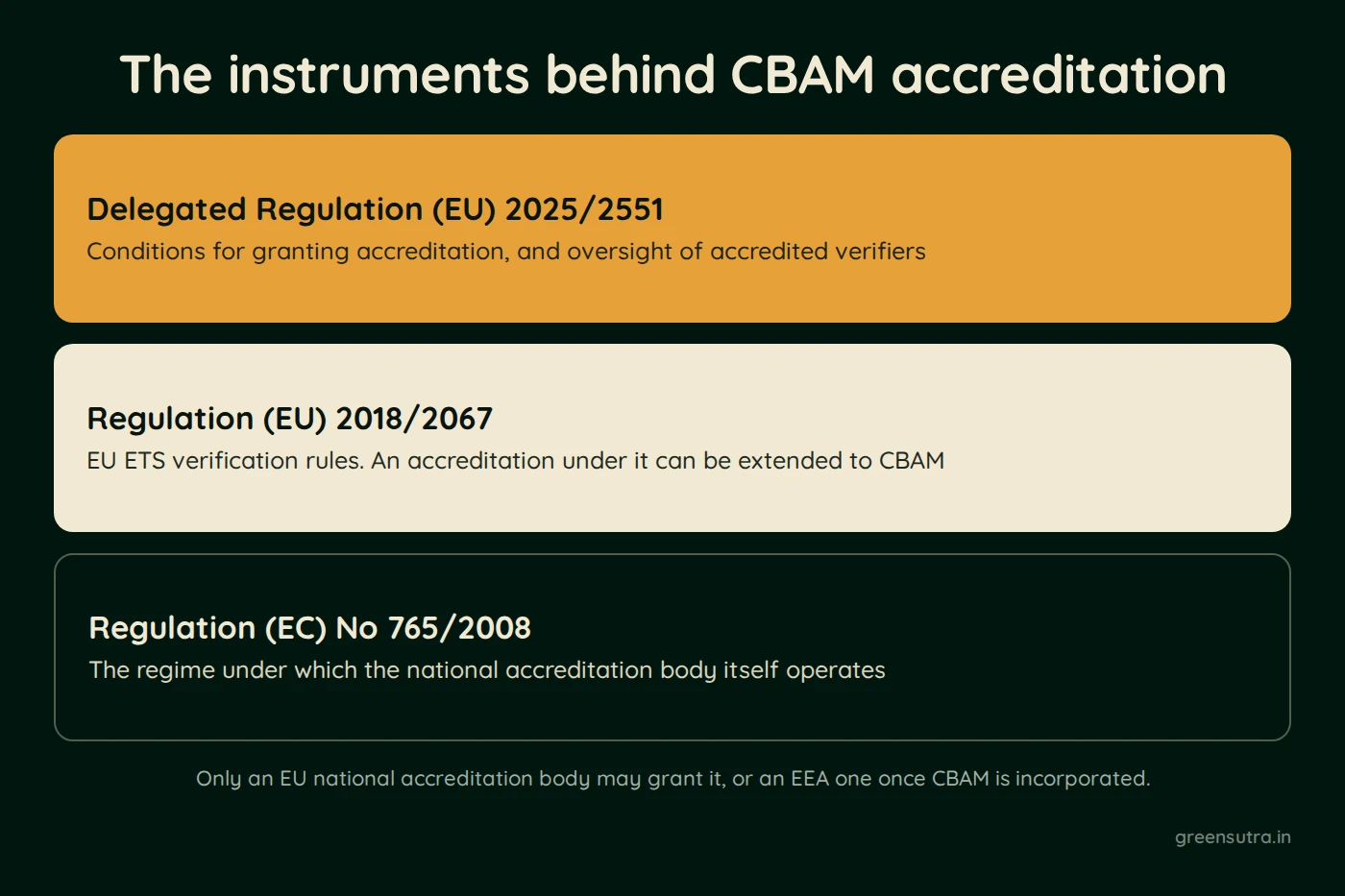
| Instrument | What it governs |
|---|---|
| Commission Delegated Regulation (EU) 2025/2551 | Conditions for granting accreditation, oversight of accredited verifiers, withdrawal, mutual recognition and peer evaluation of accreditation bodies |
| Regulation (EU) 2018/2067 | EU ETS verification rules. An accreditation under it can be extended to CBAM activity groups, and Article 18(2) of Regulation (EU) 2023/956 takes it into account |
| Regulation (EC) No 765/2008 | The regime under which the national accreditation body itself operates |
Regulation (EU) 2018/2067 is not the basis of CBAM accreditation. Under Article 4 of Delegated Regulation (EU) 2025/2551 it only lets an accredited body apply to extend its scope.
The territorial rule that decides most questions
Only national accreditation bodies located in an EU country, or in an EEA country once the CBAM Regulation is incorporated into the EEA Agreement, are competent to grant accreditation for CBAM. An accreditation body established outside that territory cannot grant CBAM accreditation, whatever its standing under other schemes. That single rule settles most questions about whether a given credential counts. Only the accreditation must come from an EU national accreditation body, and a verification body based outside the Union can hold it and verify there.
What an applicant has to demonstrate
A legal person seeking accreditation must show competence, independence and impartiality under Delegated Regulation (EU) 2025/2551, adopted under Article 18 of Regulation (EU) 2023/956. Independence and impartiality are accreditation criteria rather than optional attributes.
How to check a specific verifier
After accreditation, the verifier requests registration in the CBAM registry within two months, under Article 10a of Regulation (EU) 2023/956. The request goes to the competent authority of the Member State where the accreditation body is established. The accreditation body passes on the details and any updates under Article 18 of Delegated Regulation (EU) 2025/2551. The registry is not open to the public, so the public checks are the accreditation body’s website and the Commission’s published list of accredited verifiers. Verifiers can request registration only from 1 September 2026.
Sources: Commission Delegated Regulation (EU) 2025/2551, European Commission, CBAM verification, Regulation (EU) 2023/956
Preparing an installation so that verification proceeds without findings is separate work from the verification itself. CBAM solutions covers embedded emissions calculation and evidence assembly, and the CBAM guide sets out where verification falls in the annual declaration cycle.