

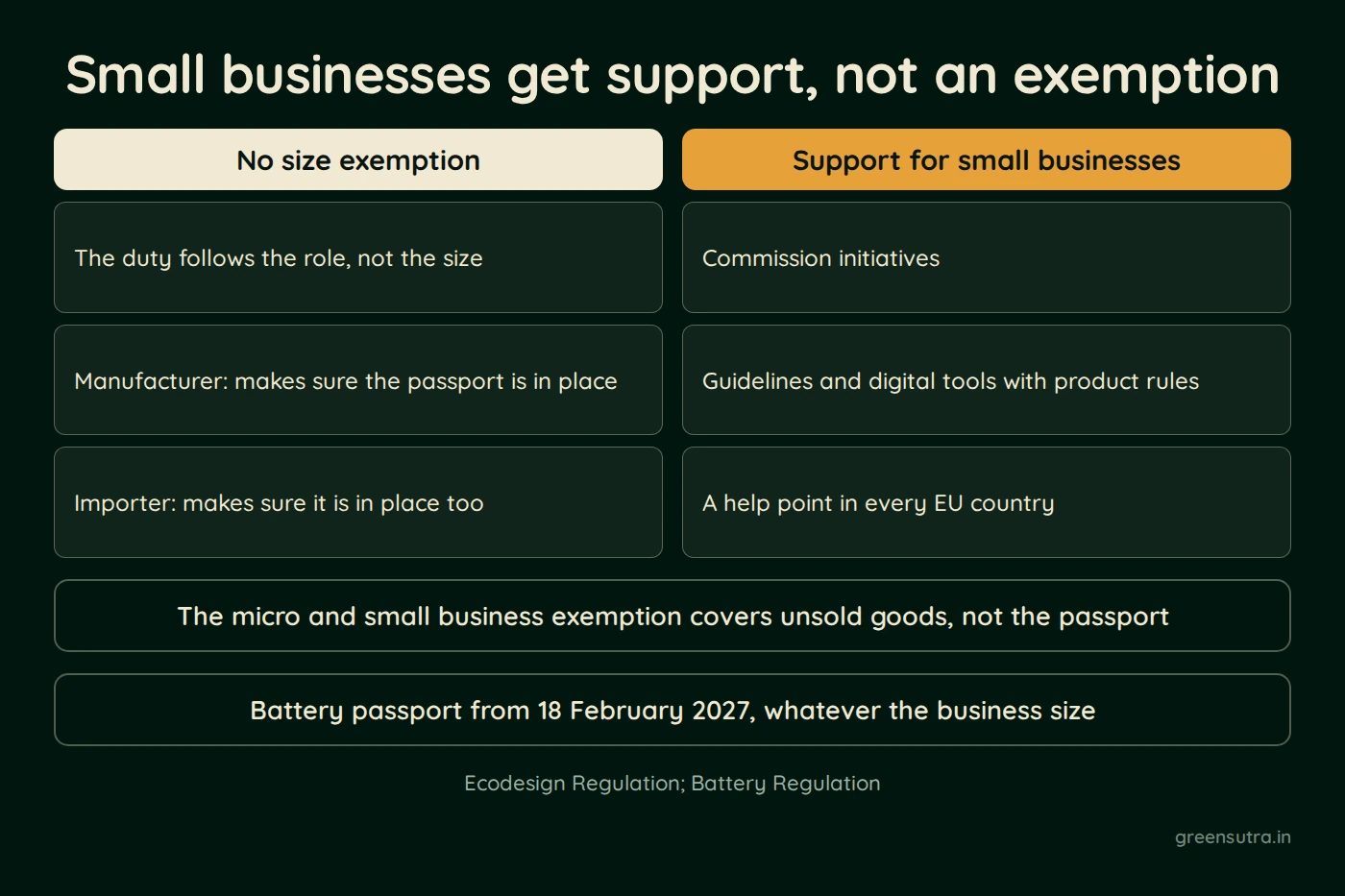
No. None of the EU laws that bring in a Digital Product Passport (DPP) exempts a business for being small. A workshop of five people and a multinational carry the same duty once their product needs a passport. What small and medium-sized businesses get instead is help.
Why is there talk of an SME exemption?
Because the Ecodesign Regulation does have one, just not for passports. Micro and small businesses are exempt from its ban on destroying unsold clothing and footwear, and from reporting what unsold stock they throw away. Medium-sized businesses come under both from 19 July 2030. The passport rules contain no such clause.
What help is on offer?
- Commission initiatives to help small businesses build sustainability into their supply chains.
- Digital tools and guidelines published alongside each product group’s rules, where appropriate. None exist yet.
- A help point in every EU country that explains the rules. Countries may add funding, training and technical support.
For toys, the Commission must publish passport guidelines for small businesses by 1 August 2029.
Could future rules go easier on small firms?
Partly. Each product group’s rules must give enough time to comply and avoid a disproportionate burden on small businesses. A rule could, for example, leave out products made in very small numbers. But that would be a test of the product, not of the company’s size.
Does the battery passport have a size test?
No. The battery passport applies from 18 February 2027 whatever the size of the business. A turnover threshold in the Battery Regulation applies only to its supply chain due diligence rules.
Where this comes from: Ecodesign Regulation (EU) 2024/1781, Articles 4(4), 5(11), 22, 24, 25, 27 and 29, and recital 13; Commission Recommendation 2003/361/EC; Battery Regulation (EU) 2023/1542, Article 77; Toy Safety Regulation (EU) 2025/2509.