


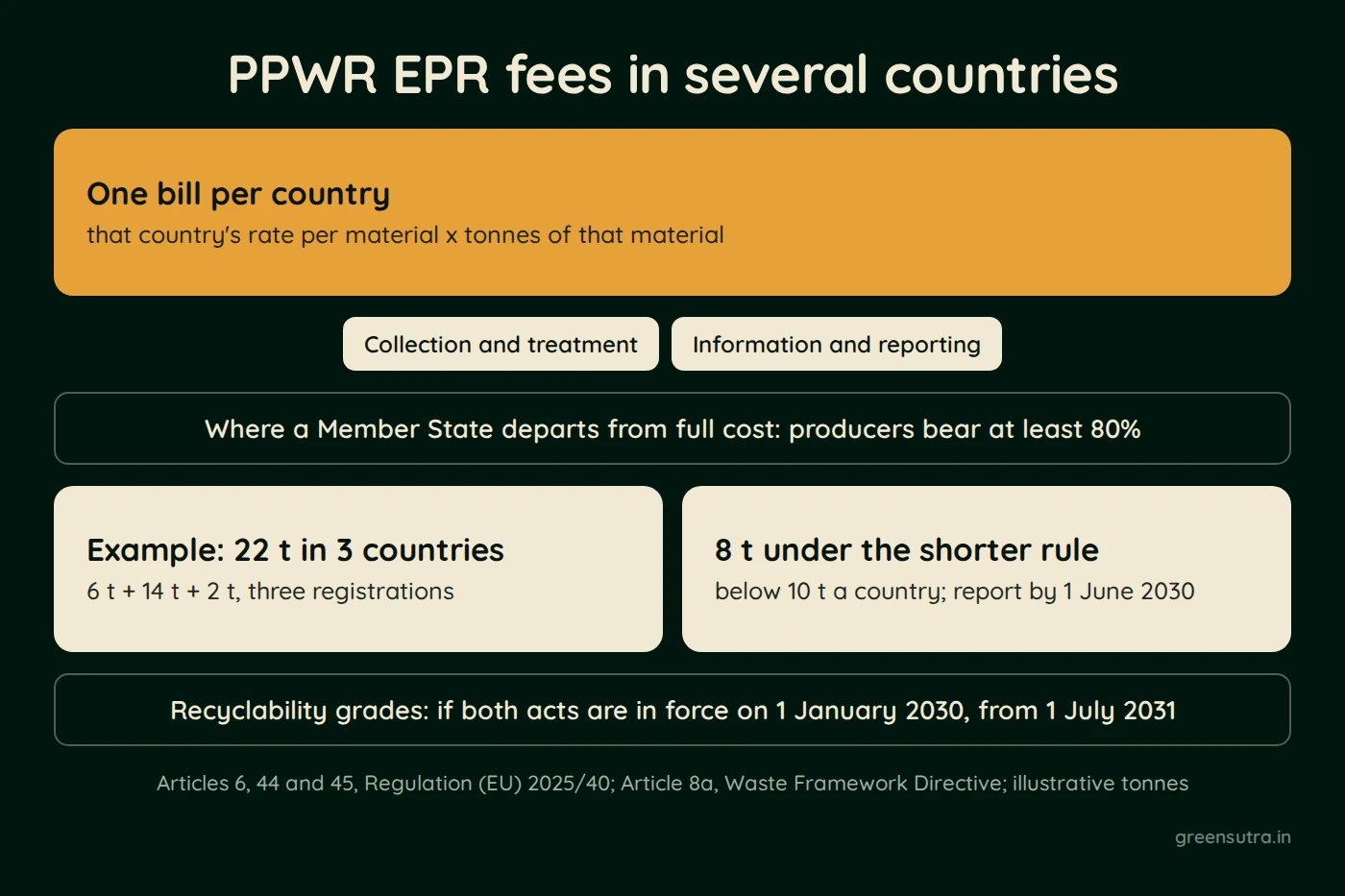
Extended producer responsibility (EPR) costs under the PPWR, Regulation (EU) 2025/40, are set country by country, so a seller pays fees in every Member State where it is the producer. Each national fee depends on the quantity of each packaging material placed on that market and the scheme’s rates. The fees must cover collection, transport, treatment, public information and reporting.
Where does a seller pay EPR fees?
In each Member State where it is the producer. Article 45(1) ties EPR to packaging first made available on a Member State’s territory, and the Commission’s guidance says fees are paid where the packaging is expected to become waste.
What costs must EPR fees cover?
Under Article 8a(4)(a) of the Waste Framework Directive, fees cover:
- separate collection, transport and treatment, net of revenue from re-use, secondary raw materials and unclaimed deposits;
- information to waste holders;
- data gathering and reporting.
Article 45(2) of the PPWR adds the cost of labelling collection bins and of surveying mixed municipal waste. Fees may not exceed the cost of a cost-efficient service. Where a Member State departs from full cost, producers still bear at least 80% of the necessary costs.
Can a seller estimate its EPR fees in advance?
Partly: it can know where it pays, what the fees cover and the current rates. Collective schemes must publish producer contributions “per unit sold or per tonne”, under Article 8a(3) of the directive. Future rates cannot be known, and recital 35 says the harmonised criteria do not set fee amounts. The Commission’s FAQ says there is no general exemption for a sector. Its small business page says Member States can waive administrative costs and set proportionate flat fees for producers under 10 tonnes.
When will recyclability grades change fees?
Only after Commission acts that do not exist yet. Today, collective schemes modulate fees “where possible” by criteria such as recyclability. EU-wide modulation by recyclability grade starts 18 months after two sets of Commission acts enter into force, under Article 6(8). The delegated acts are due by 1 January 2028 and the implementing acts by 1 January 2030. Neither had been adopted by 18 October 2026. If both were in force on 1 January 2030, modulation would start on 1 July 2031. Modulation by recycled content stays optional under Article 7(7).
Example: one seller, three countries
Quantities are illustrative; no prices are used. An online seller outside the EU sells directly to consumers in three Member States in 2029:
| Country | Tonnes placed | Annual report, Article 44(7) or (8) |
|---|---|---|
| A | 6 | Shorter, under 10 tonnes |
| B | 14 | Full |
| C | 2 | Shorter, under 10 tonnes |
The seller appoints an authorised representative in each of the three countries under Article 45(3), registers in all three before its first sale and files three reports, due by 1 June 2030 unless a country asks for quarterly data. The year assumes the harmonised registers are running; before that, national rules and dates apply. Of its 22 tonnes in total, 8 fall under the shorter rule. Each bill is that country’s rate per material times the tonnes of that material.
Sources: Regulation (EU) 2025/40 (PPWR), Directive 2008/98/EC, consolidated, Commission guidance document, C/2026/3084, PPWR Frequently Asked Questions, 2nd edition, Commission, EPR for packaging for small businesses
GreenSutra’s PPWR consulting starts with a tonnage split by country and material. The EU PPWR guide covers reporting.