


Non-compliant packaging is not banned on sight. Under Article 62 of Regulation (EU) 2025/40, the Member State must first order the economic operator to end the non-compliance. Prohibition, recall or withdrawal follows only where an administrative defect persists, and substantive breaches attract penalties under Article 68.
Article 62 is headed Formal non-compliance. Paragraph 1 lists fourteen circumstances, such as a declaration of conformity that has not been drawn up or unmet recycled-content requirements. Where a Member State becomes aware of one, it “shall require the relevant economic operator to put an end to the non-compliance concerned”. The first step is an order to fix the problem, not a penalty.
What follows depends on which track the defect sits in
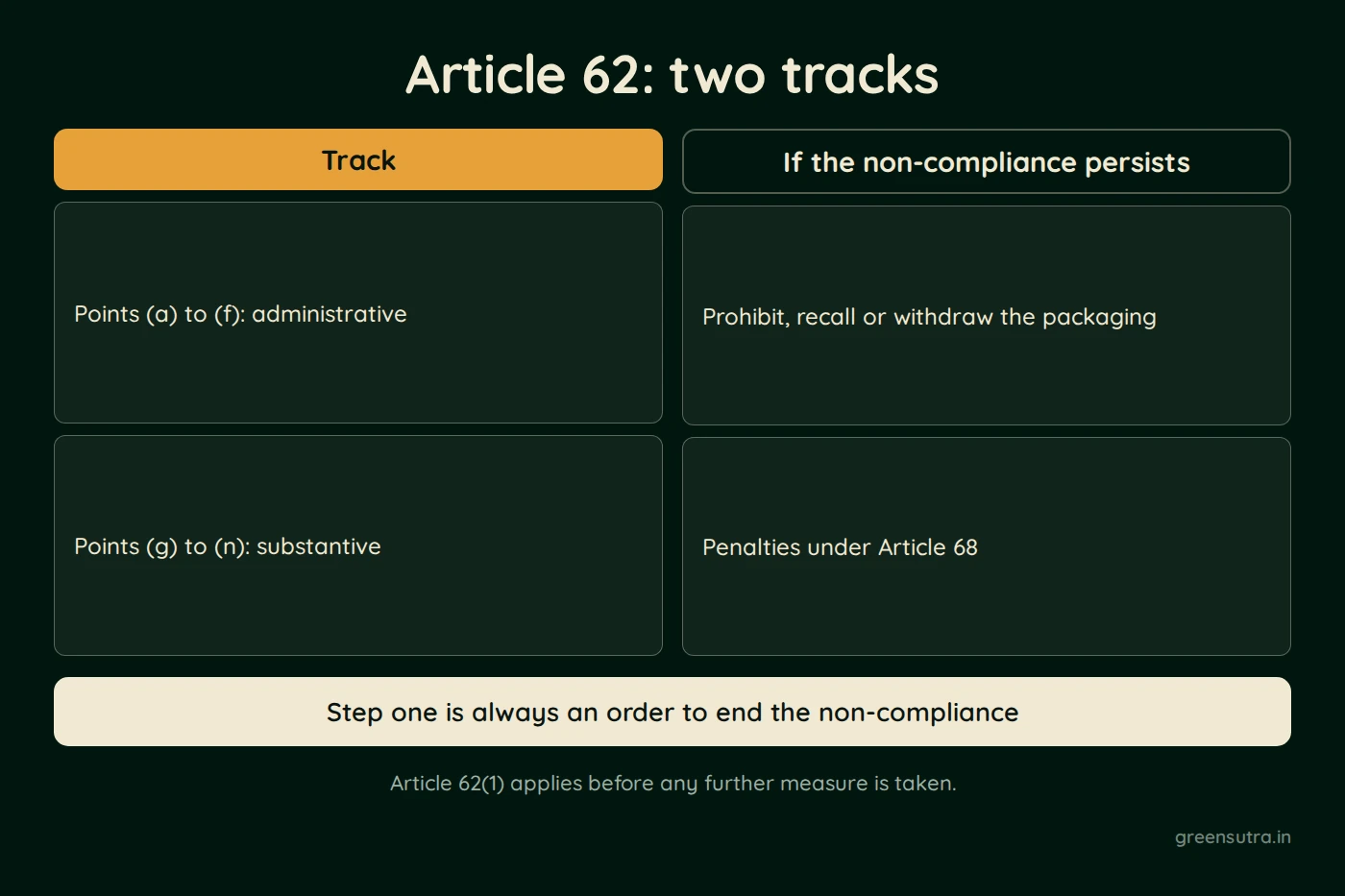
| Track | Examples | Consequence if the non-compliance persists |
|---|---|---|
| Article 62(1), points (a) to (f): administrative | Declaration of conformity missing or drawn up incorrectly; Annex VII technical documentation unavailable, incomplete or containing errors; Article 15(6) or Article 18(3) information absent, false or incomplete | Member State takes all appropriate measures to prohibit the packaging from being made available, or to ensure it is recalled or withdrawn |
| Article 62(1), points (g) to (n): substantive | Articles 24 and 25 on excessive packaging and banned formats; Article 29 reuse targets; Article 6 recyclability; Article 7 recycled content | Member States apply the rules on penalties laid down under Article 68 |
The two tracks end differently. A missing document can end in loss of market access, while a missed reuse target is penalised in money without the goods being removed. One breach sits outside Article 62 altogether. Since 12 August 2026, Article 44(4) of the PPWR bars a producer from selling packaging in a Member State where it is not registered. Registration and other EPR breaches are not on the Article 62 list, so they fall under the national penalty rules each Member State must set by 12 February 2027.
How the Commission describes the first months
The August 2026 edition of the Commission FAQ says three things about enforcing the duties that apply from 12 August 2026. It should not disrupt trade flows, supply chains or consumer access to goods. An operator should first get a warning and a chance to correct the problem. Market surveillance authorities should support responsible operators instead of starting with sanctions.
This describes how authorities are expected to act. It is not a grace period written into the Regulation, and the obligations applied in full on 12 August 2026.
Sources: Regulation (EU) 2025/40, PPWR Frequently Asked Questions, second edition
The track a defect falls into decides how quickly it has to be closed, so GreenSutra’s EU PPWR solutions work sorts defects by track first. The PPWR compliance guide sets out the dates behind each track.