


The PPWR has applied since 12 August 2026 under Article 71. The duties that bind companies now include the substance limits, the conformity documentation and producer registration before the first sale in each Member State. Labelling follows from 12 August 2028 at the earliest, deposit return systems from 2029, and recyclability, recycled content, empty space and reuse from 2030. Several of those dates move later with Commission acts still to be adopted.
Article 71 provides that the Regulation applies from 12 August 2026, with Article 67(5) applying from 12 February 2029. Everything else sits on the phased schedule below.
What binds when
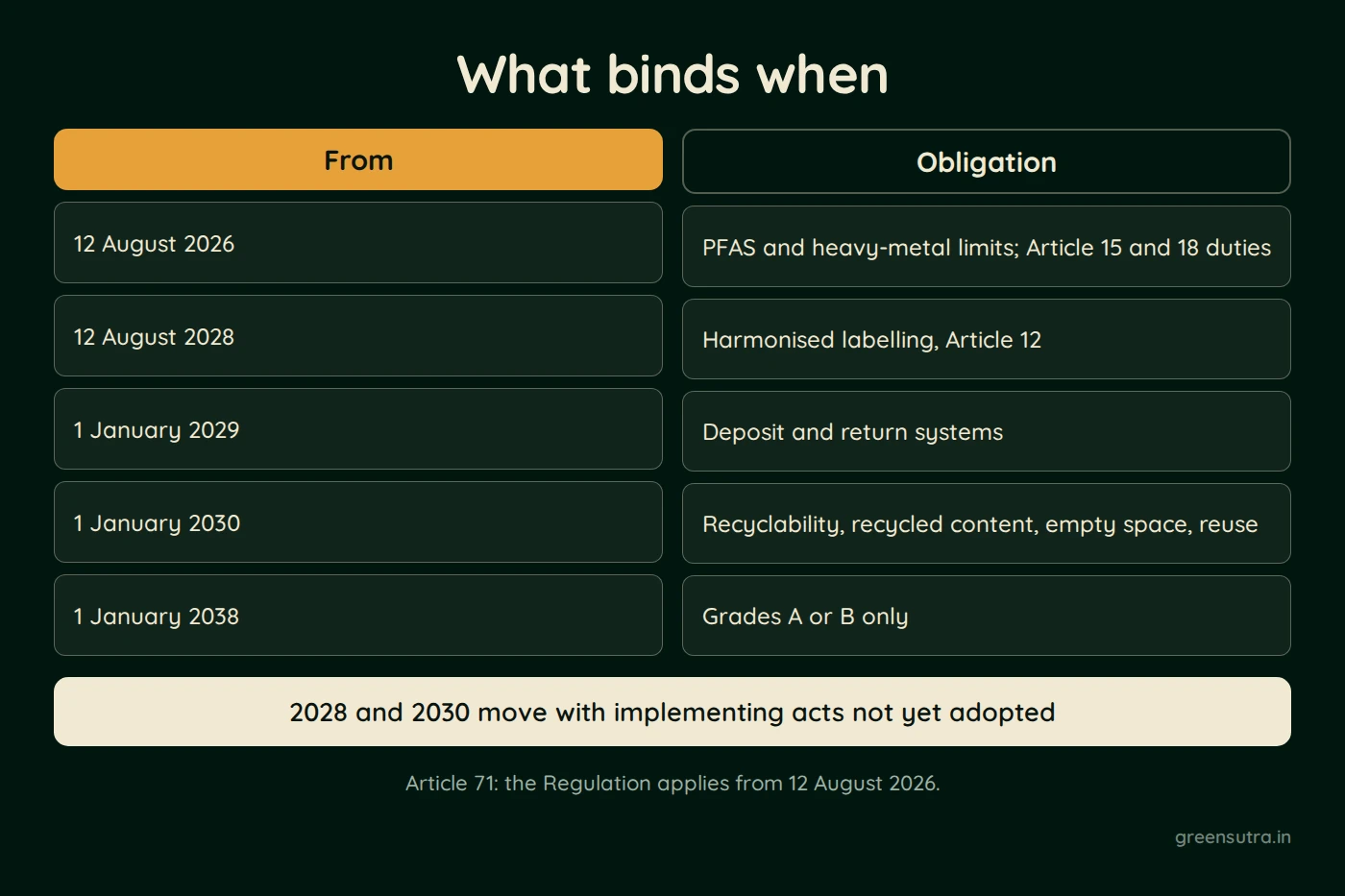
| From | Obligation | Fixed or conditional |
|---|---|---|
| 12 August 2026 | Article 5(5) PFAS limits in food-contact packaging; Article 5(4) heavy-metal cap of 100 mg/kg; Article 15 and Article 18 documentation, identification and importer duties; Article 44 producer registration in each Member State before the first sale there | Fixed |
| 12 February 2027 | Article 12(9) EPR symbol on packaging only in digital form, such as a QR code; Article 32 bring-your-own-container option in HORECA take-away | Fixed |
| 12 February 2028 | Article 24(4) sales packaging empty space minimised; Article 9(1) compostable tea bags, pods and fruit stickers; Article 33 reusable take-away option | Fixed |
| 12 August 2028 | Article 12 harmonised material-composition labelling | Or 24 months from the paragraph 6 or 7 implementing acts, whichever is latest |
| 1 January 2029 | Deposit and return systems with 90 percent separate collection of single-use plastic beverage bottles and metal beverage containers | Fixed |
| 1 January 2030 | Article 6 grades A, B or C; Article 7 recycled content; Article 10 minimisation, false bottoms banned; Article 24 empty space; Article 25 format bans; Article 29 reuse targets | Articles 6, 7 and 24 can move later: Article 6 to 24 months after its delegated acts, Articles 7 and 24 to three years after their implementing acts. Articles 10, 25 and 29 are fixed. |
| 1 January 2035 | Recycled-at-scale assessment added to recyclability | Or five years from the relevant implementing acts |
| 1 January 2038 | Only grades A or B may be placed on the market | Fixed |
Why the conditional dates matter commercially
Article 7(1) starts with a condition: “By 1 January 2030 or 3 years from the date of entry into force of the implementing act referred to in paragraph 8 of this Article, whichever is the latest”. Articles 6 and 12 tie their dates to their own acts in the same way. On 26 September 2026 the Commission was still preparing these acts. The labelling acts were due on 12 August 2026, so the label date will fall after 12 August 2028. A plan that treats 2030 as a hard deadline may be counting from a date that has not started running.
Not every fixed date is in the past. The 2030 format bans, the 2030 reuse targets and the 2038 end of grade C are fixed but still to come. Directive 94/62/EC was repealed from 12 August 2026 by Article 70, with four provisions continuing on their own timetables.
Sources: Regulation (EU) 2025/40, PPWR Frequently Asked Questions, second edition
GreenSutra’s EU PPWR solutions work plans the fixed dates first and the conditional ones after. The PPWR compliance guide sets out the full schedule.