

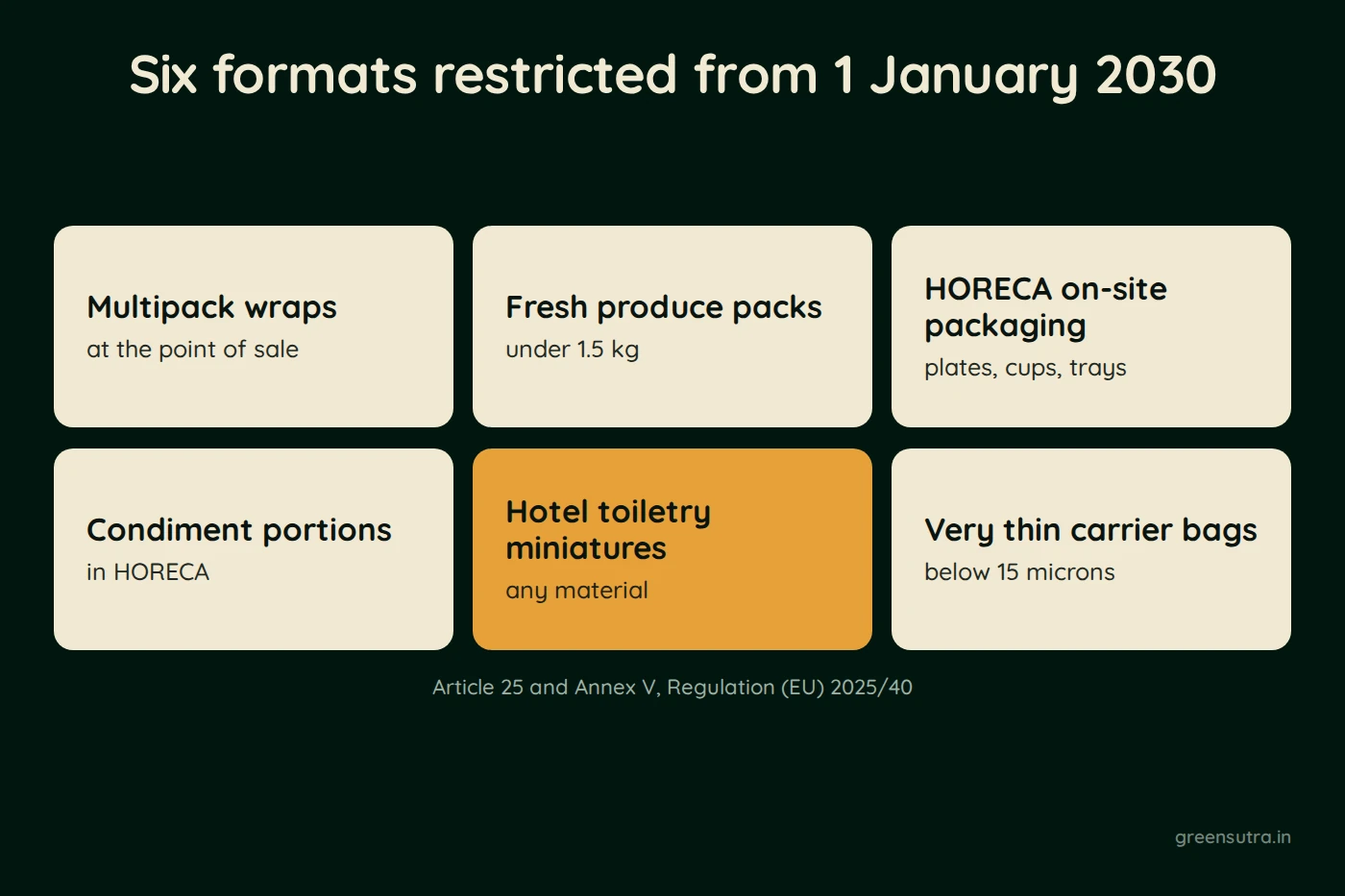
From 1 January 2030, Annex V of the Packaging and Packaging Waste Regulation (PPWR) bans six single-use packaging formats. Five are plastic, among them multipack wraps, fresh-produce packs under 1.5 kg, condiment portions and very thin carrier bags. The sixth, hotel toiletry miniatures, covers any material.
Which packaging formats are banned from 2030?
| Annex V point | Format | Exceptions |
|---|---|---|
| 1 | Single-use plastic convenience packaging that groups bottles, cans, tins, pots, tubs or packets at the point of sale to encourage buying more than one, such as shrink wrap | Grouped packaging needed to facilitate handling |
| 2 | Single-use plastic packaging for less than 1.5 kg of pre-packed fresh fruit and vegetables, such as nets, bags and trays | Member States may exempt produce with a demonstrated need to avoid water or turgidity loss, microbiological hazards, physical shocks or oxidation, or to keep organic produce apart |
| 3 | Single-use plastic packaging for food and drink filled and consumed on hotel, restaurant and café (HORECA) premises, such as disposable plates, cups and trays | Premises without drinking water; under Article 25(4), Member States may also allow micro-enterprises that show it is not technically feasible to do without such packaging or to reach re-use infrastructure |
| 4 | Single-use plastic portion packs for condiments, preserves, sauces, coffee creamer, sugar and seasoning in HORECA | Packs given with take-away ready-prepared food, or needed for safety and hygiene where there is a medical requirement for individualised care, as in hospitals |
| 5 | Single-use packaging for cosmetics and toiletries meant for one booking in the accommodation sector | None listed |
| 6 | Very lightweight plastic carrier bags, below 15 microns | Bags required for hygiene, or sold as packaging for loose food to prevent food waste |
The Commission must publish guidelines with examples by 12 February 2027, under Article 25(6).
How much plastic counts?
The Regulation does not define “single-use plastic packaging”. The Commission’s guidance treats composite packaging, including paper-based packaging, with 5% or more plastic as covered by points 1 to 4.
Example, applying that guidance to illustrative weights: a 20 g paperboard tray, 1.5 g of which is a plastic coating, is 7.5% plastic. Used for food eaten on the premises, it falls within point 3. The same tray with 0.8 g of plastic is 4% plastic and falls outside point 3, though national measures under Directive (EU) 2019/904 can still apply to it.
Related bans from 2029 and 2030
From 12 February 2029, Article 67(5) adds multipack plastic rings, airport and station luggage shrink wrap and plastic loose-fill transport chips to the single-use plastics directive’s ban list. It also extends the polystyrene ban to extruded polystyrene food containers, beverage containers and cups. Under the Commission’s guidance, Article 10(2) bars packaging designed only to look bigger, such as false bottoms, from 1 January 2030.
The transport packaging answer and the minimisation answer cover the rules for shipping materials and design.
Sources: Regulation (EU) 2025/40 (PPWR), Commission guidance document, C/2026/3084, PPWR Frequently Asked Questions, 2nd edition, Directive (EU) 2019/904 on single-use plastics
A packaging inventory under GreenSutra’s EU PPWR solutions marks each format the bans will catch, and the EU PPWR guide places Annex V among the other 2030 duties.