

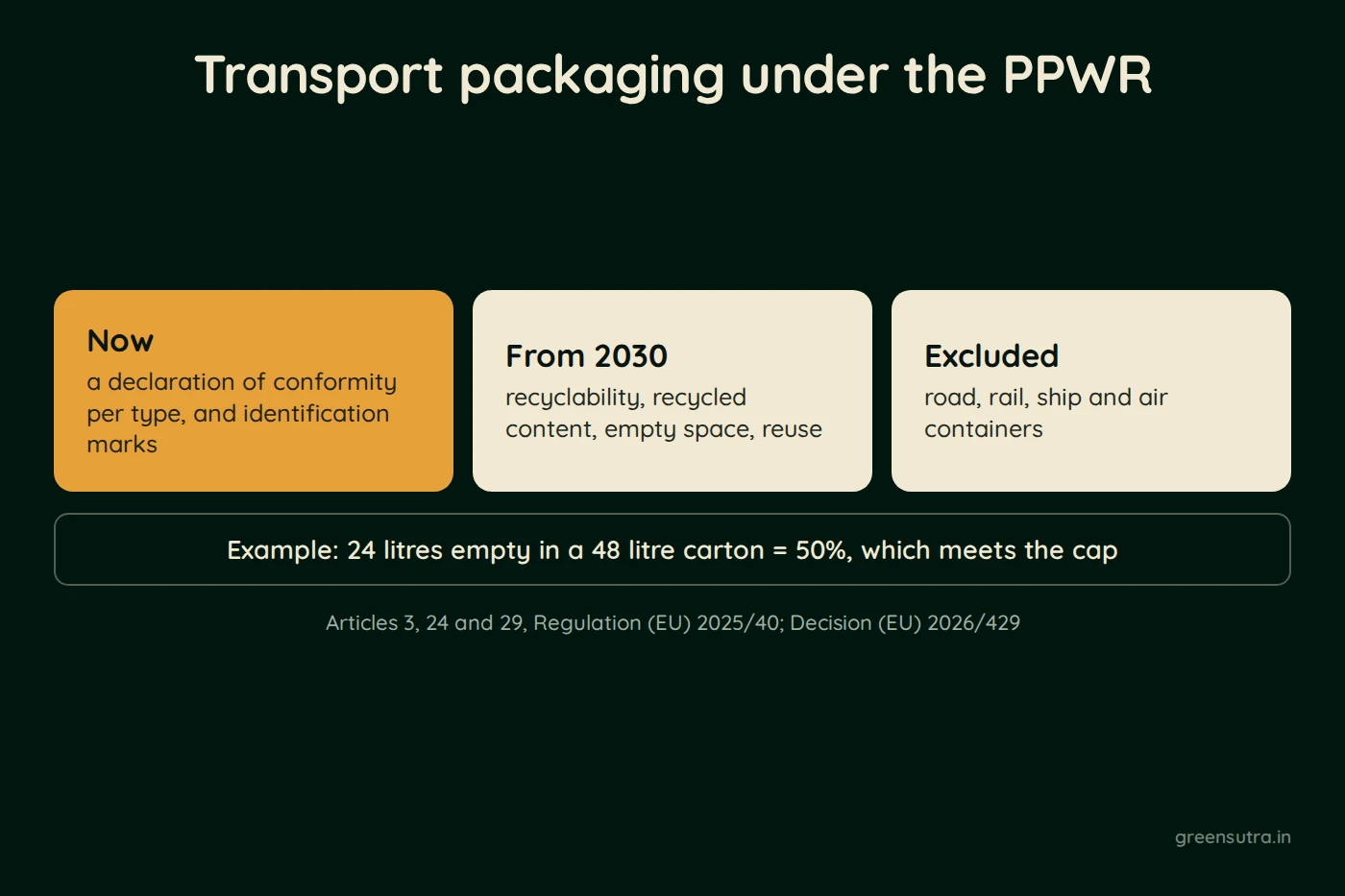
Yes: pallets, pallet wrap, straps and cartons that protect goods in transit are transport packaging under the Packaging and Packaging Waste Regulation (PPWR). Each packaging type needs its own conformity assessment and declaration of conformity before the goods are placed on the EU market. Road, rail, ship and air containers are excluded, and the 2030 reuse targets apply only inside the EU.
What counts as transport packaging
Transport packaging is packaging that eases handling and transport and prevents damage, under Article 3(1)(7). All packaging is in scope under Article 2, industrial and commercial included. The Commission’s FAQ says imported goods are generally placed on the market when declared for release for free circulation, while goods only in transit are not.
Which duties reach pallets, wrap and boxes
| Duty | For transport packaging | From |
|---|---|---|
| Conformity assessment and declaration of conformity | Pallets, collars, wrap and straps each need their own | 12 August 2026 |
| Identification marks, Articles 15(5), 15(6) and 18(3) | Apply in full | 12 August 2026 |
| Recyclability grades | Apply | 1 January 2030 or 24 months after the delegated acts, whichever is later |
| Recycled content in plastic parts | Apply; the FAQ’s pallet-wrap example needs 35% | 1 January 2030 or 3 years after the implementing act, whichever is later |
| Empty space ratio of 50% at most | Apply to whoever fills the packaging | 1 January 2030 or 3 years after the method act, whichever is later |
| Sorting label | Not required, except for e-commerce packaging | Later than 12 August 2028 |
What are the reuse targets for pallets and wrap?
From 1 January 2030, Article 29(1) requires operators using pallets, boxes, crates, drums, wrap and straps within the EU to make at least 40% of them, in total, reusable. Use between an operator’s own sites, or within one Member State, must be fully reusable. Cardboard boxes are exempt. Delegated Decision (EU) 2026/429 lifts only those full-reuse rules for pallet wrap and straps, which stay in the 40% pool. The Commission’s guidance says the targets start at the first EU warehouse, so the inbound leg from outside the EU is not caught.
Who is the producer under extended producer responsibility?
The producer is normally the EU business that first makes the transport packaging available in its Member State, or unpacks the goods without being an end user, under Article 3(1)(15). The guidance counts logistics firms that repack imported goods as producers. An exporter that sells straight to an EU end user, such as a factory using the goods, normally becomes the producer there under point (c).
What is the empty space ratio?
Example: a 40 x 30 x 40 cm carton holds 48 litres. Packed with twelve 2-litre sales boxes, it has 24 litres of empty space, a ratio of 50%, which meets the cap. With ten boxes and air cushions it has 28 litres of empty space, a ratio of 58.3% and over the cap, because Article 24(3) counts air cushions as empty space.
Sources: Regulation (EU) 2025/40 (PPWR), Commission Delegated Decision (EU) 2026/429, Commission guidance document, C/2026/3084, PPWR Frequently Asked Questions, 2nd edition
For exporters, GreenSutra’s EU PPWR solutions list shipping materials and EU customers, then set out which duties fall on each side. Producer rules are covered in the EU PPWR guide.