


UK CBAM covers goods in five sectors from 1 January 2027: aluminium, cement, fertilisers, hydrogen, and iron and steel. The mechanism also reaches downstream producers using those goods in their supply chains. Electricity is not covered. Reliefs apply to UK-origin goods, to returned goods, and to equivalent reliefs on re-importation.
Scope under UK CBAM is defined by the goods rather than by the importer, so the first question for any importer is whether a commodity code falls inside one of the five sectors.
The five covered sectors
1. Aluminium 2. Cement 3. Fertilisers 4. Hydrogen 5. Iron and steel
The mechanism extends beyond primary imports to downstream producers that use these goods in their supply chains, so a manufacturer importing components rather than raw material is not automatically outside scope.
What is relieved or outside scope
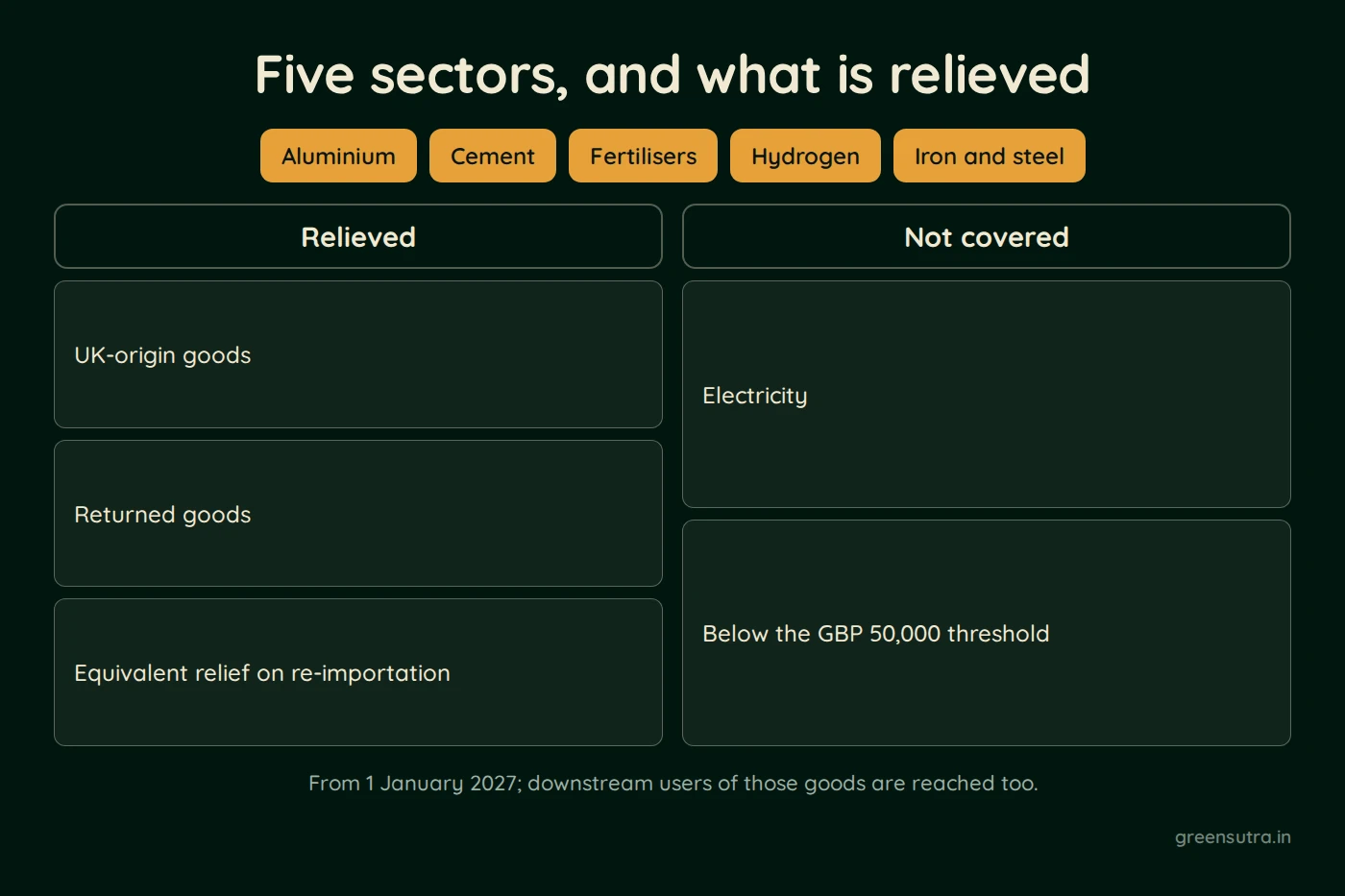
| Category | Treatment |
|---|---|
| Electricity | Not a covered sector under UK CBAM |
| UK-origin goods | Relieved |
| Returned goods | Returned goods relief applies |
| Re-imported goods | Equivalent reliefs on re-importation apply |
| Goods below the threshold | Registration is only triggered at £50,000, tested forward over 30 days and backward over 12 months |
Records must be kept for six years from 1 January 2027, and the record-keeping duty extends to goods that are exempt, not only to goods that carry a charge. An importer relying on a relief still has to be able to evidence it.
The electricity divergence
Electricity is the clearest structural difference from EU CBAM, whose Annex I covers six sectors including electricity. An importer of electricity into the EU is inside CBAM at any volume, since electricity and hydrogen are excluded from the EU mass-based de minimis. The same importer bringing electricity into the UK is outside UK CBAM entirely. Anyone mapping exposure across both markets has to treat the sector lists as two separate lists rather than one.
Weight is measured in kilograms and excludes packaging, which matters where a commodity is shipped in heavy containment.
Sources: GOV.UK CBAM guidance collection, Finance Act 2026, Part 5
Mapping commodity codes against two different sector lists is where most exposure assessments start. CBAM solutions covers scope determination for exporters and importers, and the CBAM guide sets out the EU covered-goods position that runs alongside.