


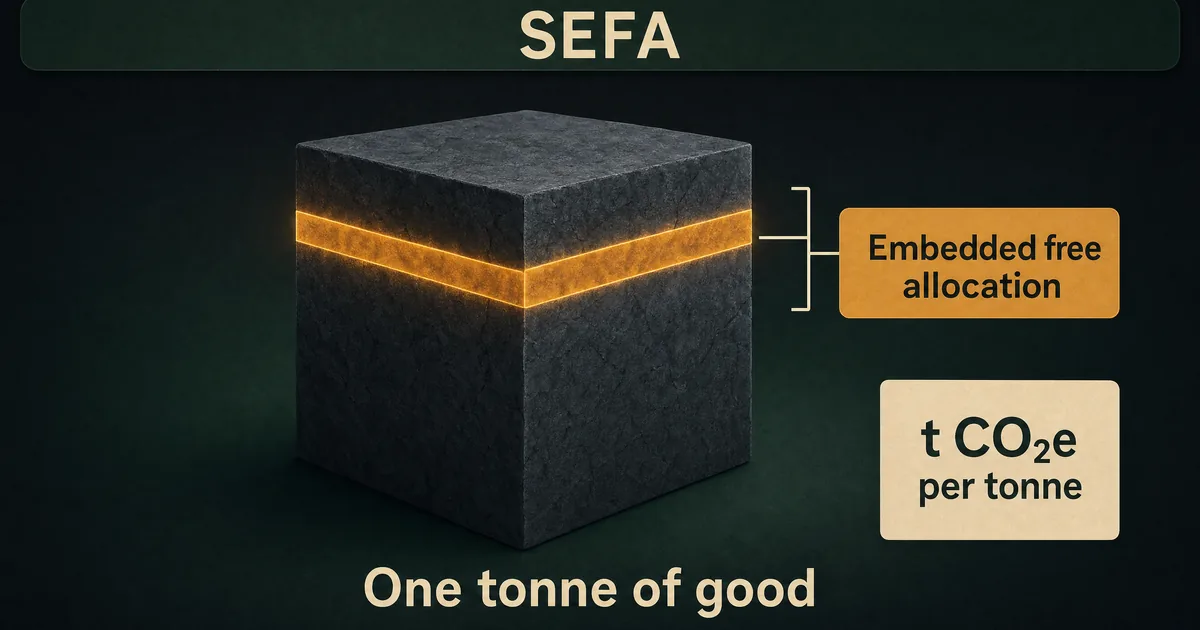
SEFA, the specific embedded free allocation, is the free allocation embedded in one tonne of a CBAM good, expressed in t CO2e per tonne. Implementing Regulation (EU) 2025/2620 defines it and uses it in the free allocation adjustment, which reduces the CBAM certificates a declarant must surrender.
SEFA stands for specific embedded free allocation. It is the free allocation embedded in one tonne of a good, expressed in tonnes of CO2e per tonne, and it is defined by Commission Implementing Regulation (EU) 2025/2620. That regulation was adopted on 16 December 2025 and applies from 1 January 2026. It sets the methodology for the free allocation adjustment referred to in Article 31 of Regulation (EU) 2023/956.
How SEFA feeds the free allocation adjustment
The free allocation adjustment, or FAA, is the adjustment to the number of CBAM certificates to be surrendered. The Annex to Regulation 2025/2620 sets the core formula in Equation 1: the FAA for a good equals its SEFA for the year multiplied by the total mass of that good imported during the year the declaration covers. The declarant includes the FAA in the annual CBAM declaration, and it reduces the certificates to be surrendered.
The logic follows the EU ETS. The FAA mirrors the free allocation EU producers of the same good still receive. With default values, SEFA is the good’s CBAM benchmark, times the CBAM factor for the year, times the cross-sectoral correction factor, which is 100 per cent for 2026 to 2030. The declarant surrenders certificates for the embedded emissions minus the FAA, and minus any carbon price deduction, never below zero.
The deduction shrinks each year. The CBAM factor is 97.5 per cent in 2026, 95 per cent in 2027, 90 per cent in 2028 and 77.5 per cent in 2029. It falls to 51.5 per cent in 2030, 39 per cent in 2031, 26.5 per cent in 2032 and 14 per cent in 2033. From 2034 nothing is deducted for free allocation. In 2026, 2.5 per cent of the benchmark is no longer deducted. That figure is not 2.5 per cent of the embedded emissions.
Example: one tonne of Indian hot-rolled flat steel (CN 7208) imported in the third quarter of 2026 on default values. The default value of 4.280 tonnes of CO2e, with the 10 per cent mark-up, gives 4.708. Its SEFA is 0.975 x 1.00 x 1.370, or 1.336, so the free allocation adjustment for that tonne is 1.336. The declarant surrenders 4.708 minus 1.336, or 3.372 certificates, about EUR 278 at the third-quarter 2026 price of EUR 82.32.
Two routes to a SEFA value
| Route | Basis |
|---|---|
| Actual data (Annex point 3) | CBAM benchmarks derived from EU ETS free-allocation benchmarks, scaled by the CBAM factor (Art. 10a(1a), Directive 2003/87/EC) and the cross-sectoral correction factor |
| Default values (Annex point 4) | Predefined default CBAM benchmarks matched to the same production routes and precursor assumptions as the emission defaults |
Regulation 2025/2620 should not be confused with Regulation 2025/2621. The former sets allocation defaults, and its FAA reduces the certificates due; the latter sets emission default values, whose markups increase the base.
GreenSutra’s consultants model SEFA and the FAA when planning certificate budgets ahead of certificate purchase opening on 1 February 2027 and the first surrender, due by 30 September 2027. CBAM advisory covers embedded-emissions calculation, declaration preparation and certificate cost planning. The CBAM cost calculator gives a first estimate of the certificate cost a product line carries.
Sources: Implementing Regulation (EU) 2025/2620 · Regulation (EU) 2023/956 · European Commission CBAM