


An authorised CBAM declarant is a person the competent authority of an EU country has authorised to import CBAM goods. It is either an importer established in the EU or an indirect customs representative acting for an importer. Where the importer is not established in the EU, the representative must hold the status. Importers whose CBAM goods stay at or below 50 tonnes net mass in a calendar year are exempt, except for electricity and hydrogen. The status is granted by an authorisation decision, which the competent authority records in the CBAM registry.
The importer or its indirect customs representative
Article 4 of Regulation (EU) 2023/956 reserves the import of CBAM goods to authorised declarants from 2026. Article 2a exempts importers whose CBAM goods stay at or below 50 tonnes net mass in a calendar year. The status belongs to an importer established in the EU or to an indirect customs representative acting for it, never to the overseas producer. Where the importer is not established in the EU, the representative must hold the status. The definitive regime, live since 1 January 2026, converts transitional quarterly reporting into a financial obligation. Unless the importer is exempt under that threshold, covered goods can be released for free circulation only through an authorised declarant. GreenSutra supports this transition as a consultant through its CBAM advisory services. It calculates embedded emissions and prepares the declaration, and any actual emissions data in it is verified by an accredited verifier.
How authorisation and the registry work
Applications run through the Authorisation Management Module of the CBAM registry and go to the competent authority of the Member State of establishment, independently of where goods physically enter. Under Article 17, that authority may consult relevant competent authorities or the Commission before granting status, for at most 15 calendar days. For the definitive period the Commission operates a central CBAM registry, through which authorised declarants file the single annual declaration and surrender certificates. Certificates are bought on the common central platform from 1 February 2027 and held in the declarant’s registry account until they are surrendered by 30 September each year.
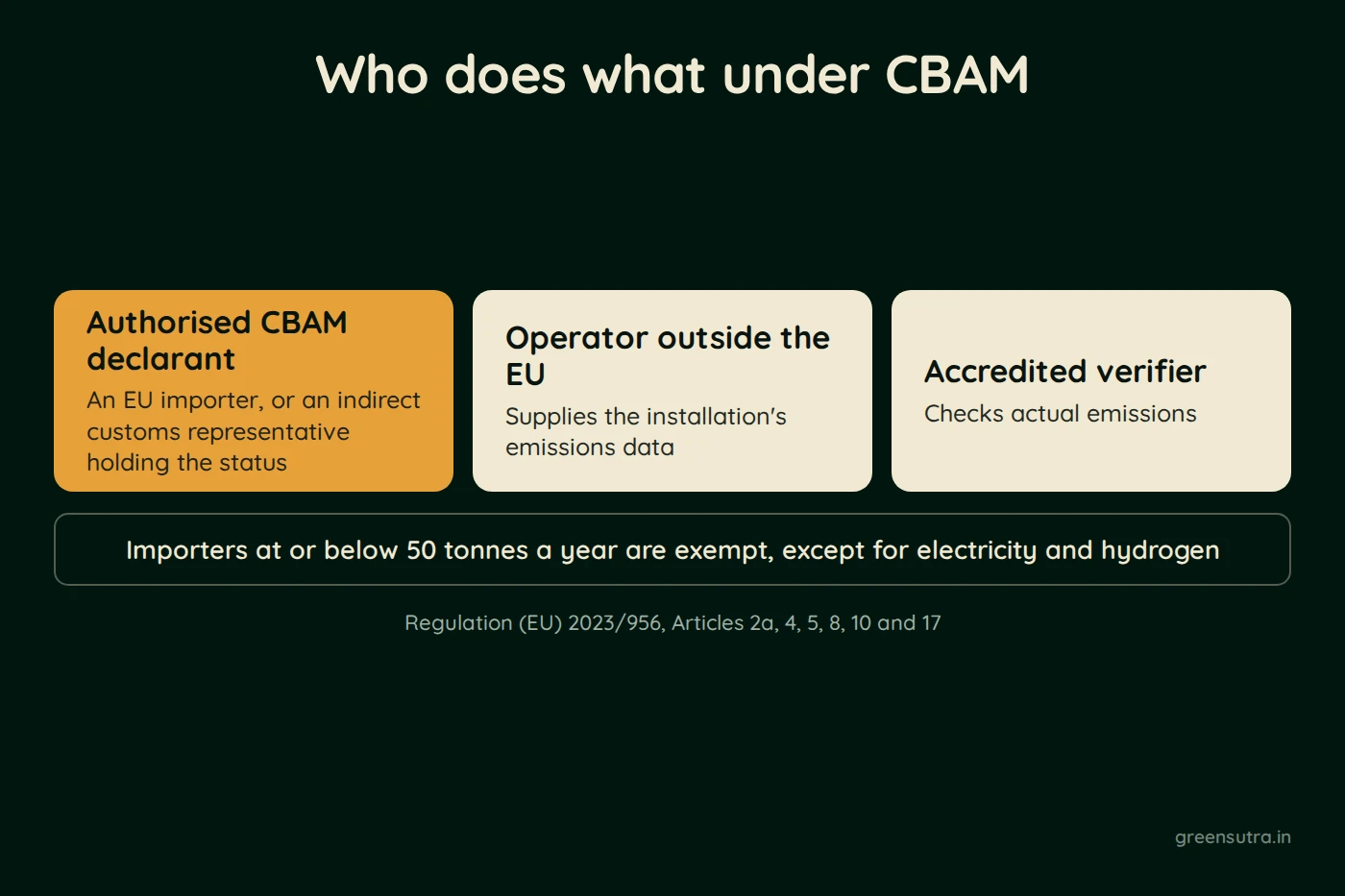
| Party | Role | Registry action |
|---|---|---|
| Authorised CBAM declarant (importer established in the EU, or its indirect customs representative) | Imports covered goods, files declaration | Applies via Authorisation Management Module, files annual declaration in the CBAM registry |
| Non-EU operator (producer) | Runs the installation, monitors emissions | Supplies monitored emissions data to the declarant |
| Accredited verifier | Independent third party | Verifies declared actual emissions |
Timing and shared emissions data
Applications for the status can be made at any time. 31 March 2026 was the cut-off for the rule that let an applicant keep importing while its application was pending. Once authorised, the declarant depends on the exporting installation to supply monitored, source level emissions and activity data. Where the declarant uses those actual figures, they must first be verified by an independent accredited verifier. Goods brought in by a person that is not an authorised declarant attract a penalty of three to five times the excess emissions penalty for each certificate not surrendered. Readiness to import rests on a reliable data chain from the overseas producer. Authorisation readiness also depends on securing dependable emissions data from overseas suppliers. Further practical detail sits in the CBAM compliance guide.
Sources: Regulation (EU) 2023/956 · Regulation (EU) 2025/2083 (Omnibus I) · European Commission CBAM