


The share of CBAM emissions that needs certificates in 2026 depends on the good. The declarant surrenders certificates for the embedded emissions minus the free allocation adjustment, and minus any carbon price deduction, never below zero. In 2026, 2.5 per cent of the benchmark is no longer deducted. That figure is not 2.5 per cent of the embedded emissions. In the steel example below, certificates cover 3.372 of 4.708 tonnes of CO2e, about 72 per cent.
The free allocation adjustment mirrors the EU Emissions Trading System. It deducts the free allocation EU producers of the same good still receive. EU producers in CBAM sectors retain 97.5 per cent of their EU ETS free allocation in 2026 under the CBAM factor in Article 10a(1a) of Directive 2003/87/EC. Article 31 of Regulation (EU) 2023/956 requires an equivalent adjustment for imports. In 2026 imports therefore get a deduction of 97.5 per cent of the good’s benchmark, not 97.5 per cent of its emissions.
Commission Implementing Regulation (EU) 2025/2620, adopted 16 December 2025 and applying from 1 January 2026, sets the methodology. It defines the specific embedded free allocation, SEFA: the free allocation embedded in one tonne of a good, expressed in tonnes of CO2e per tonne. The free allocation adjustment for a good equals its SEFA for the year times the total mass of that good imported during the reporting year. The declarant includes this adjustment in the annual CBAM declaration, and it reduces the certificates to be surrendered. With default values, SEFA is the good’s CBAM benchmark, times the CBAM factor for the year, times the cross-sectoral correction factor, which is 100 per cent for 2026 to 2030.
Example: one tonne of Indian hot-rolled flat steel (CN 7208) imported in the third quarter of 2026 on default values. The default value of 4.280 tonnes of CO2e, with the 10 per cent mark-up, gives 4.708. The free allocation adjustment is 0.975 x 1.00 x 1.370, or 1.336. The declarant surrenders 4.708 minus 1.336, or 3.372 certificates, about EUR 278 at the third-quarter 2026 price of EUR 82.32.
The deduction, year by year
The deduction shrinks each year as EU free allocation is withdrawn. The CBAM factor sets how much of the benchmark is still deducted:
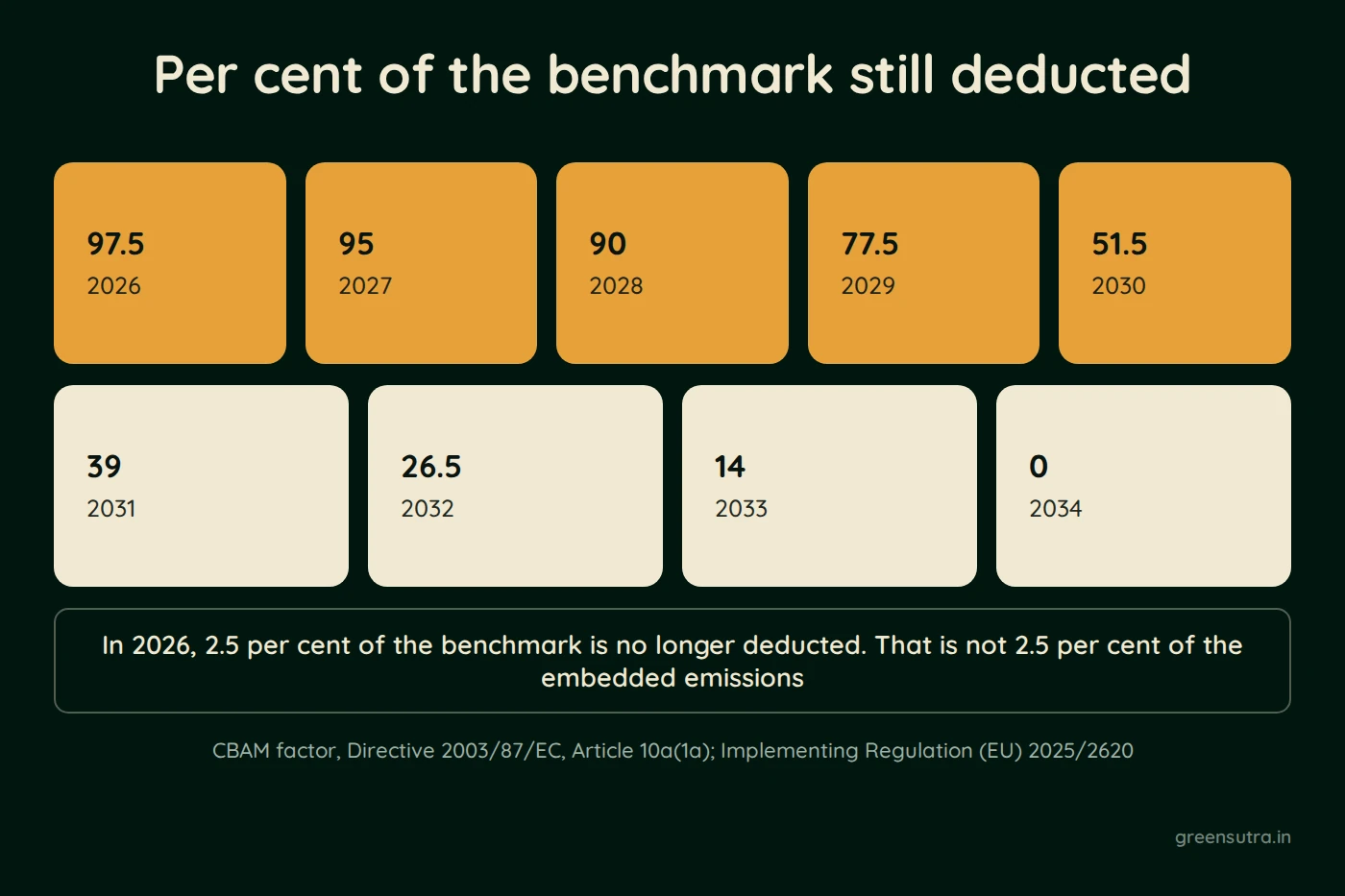
| Year | 2026 | 2027 | 2028 | 2029 | 2030 | 2031 | 2032 | 2033 | 2034 |
|---|---|---|---|---|---|---|---|---|---|
| Share of the benchmark still deducted (CBAM factor) | 97.5 per cent | 95 per cent | 90 per cent | 77.5 per cent | 51.5 per cent | 39 per cent | 26.5 per cent | 14 per cent | 0 per cent |
Planning beyond 2026
How fast the bill grows depends on how far a good’s emissions sit above its benchmark. On default values, Indian hot-rolled flat steel (CN 7208) needs 3.372 certificates a tonne in 2026 and about 4.86 in 2030, if the benchmark stays at its 2026 value. That is about 1.4 times, before any change in price. A plant whose emissions equal the benchmark starts far lower and rises much faster. The certificate price is never fixed: in 2026 it is the quarterly average of EU ETS auction clearing prices. The Commission published EUR 75.36 for Q1, EUR 75.28 for Q2 and EUR 82.32 for Q3. From 2027 it becomes a weekly average. Certificate purchase begins on 1 February 2027, and the first annual declaration and surrender are due by 30 September 2027. Budgeting on the 2026 figure alone therefore understates the exposure a supply contract carries into the 2030s.
GreenSutra’s consultants model certificate exposure across the full ramp as part of CBAM advisory. The work includes exposure assessment, embedded-emissions calculation and certificate cost planning. The CBAM cost calculator gives a first estimate of how the same import volume prices year by year.
Sources: Regulation (EU) 2023/956 · Implementing Regulation (EU) 2025/2620 · European Commission CBAM