

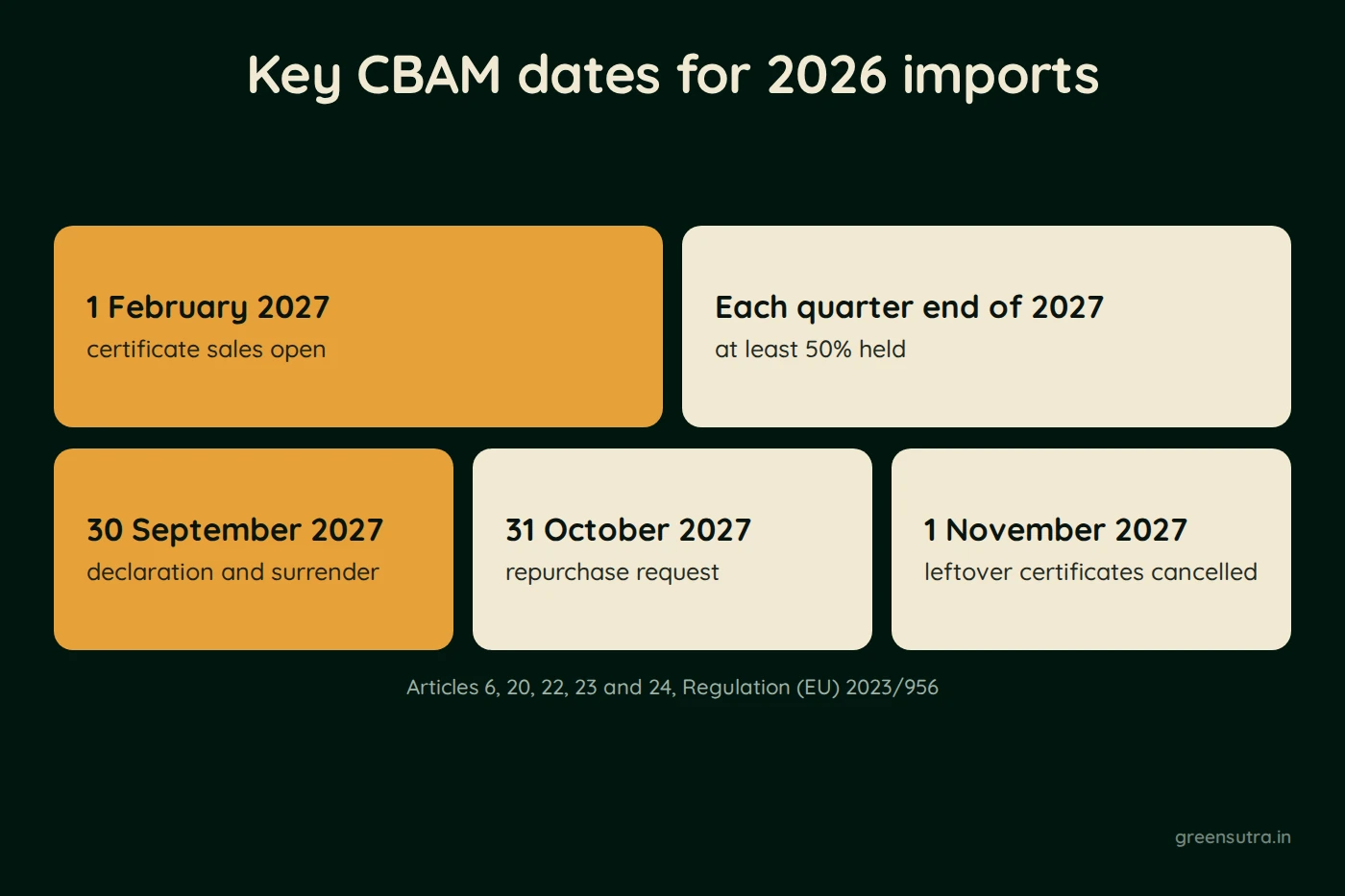
For goods imported in 2026, the main Carbon Border Adjustment Mechanism (CBAM) deadlines fall in 2027. Certificates go on sale on 1 February 2027, and the declaration and surrender are due by 30 September 2027. From 2027, declarants must also hold certificates for at least 50% of year-to-date emissions, after the free allocation adjustment, at each quarter end.
CBAM dates for importers, 2026 and 2027
| Date | What happens | Article |
|---|---|---|
| 31 March 2026, passed | Importers that applied for authorised declarant status by this date may keep importing provisionally until the decision | 17(7a) |
| 7 April, 6 July and 5 October 2026 | 2026 prices for Q1, Q2 and Q3 published: EUR 75.36, EUR 75.28 and EUR 82.32 | 21(1a); Implementing Regulation 2025/2548 |
| 1 January 2027 | Quarterly holding applies, and certificate prices become weekly | 22(2), 21(1) |
| 4 January 2027 | Q4 2026 price due | Commission price page |
| 1 February 2027 | Certificate sales open on the common central platform | 20(1) |
| 31 March, 30 June, 30 September and 31 December 2027 | Certificates on the account must cover at least 50% of the emissions in goods imported since 1 January | 22(2) |
| 30 September 2027 | Declaration for 2026 imports, with verification reports for actual data, and surrender of certificates | 6(1), 22(1) |
| 31 October 2027 | Last day to request repurchase of excess certificates | 23(1) |
| 1 November 2027 | Certificates bought for 2026 and still held are cancelled without compensation | 24(2) |
| 30 September 2028 | Declaration and surrender for 2027 imports | 6(1), 22(1) |
The Commission’s Q&A of 15 October 2026 lists 31 October among the quarter ends; under Article 22(2) the third quarter ends on 30 September.
What will certificates for 2026 imports cost?
A certificate for 2026 emissions costs the quarterly average EU Emissions Trading System (ETS) auction price of the quarter in which the goods were imported, under Implementing Regulation (EU) 2025/2548. From 2027 the price is a weekly average, published on the first working day of the following week.
The number of certificates is the embedded emissions minus the free allocation adjustment and any carbon price deduction, never below zero. The adjustment shrinks each year: the share of the benchmark still deducted, the CBAM factor, is 97.5% in 2026 and 95% in 2027. On default values, one tonne of Indian hot-rolled flat steel (CN 7208) imported in 2026 needs 3.372 certificates, as the cost answer for steel exporters works out.
Example, with illustrative quantities: a declarant needs 400 certificates for goods imported in Q1 2026 and 600 for goods imported in Q3 2026. At EUR 75.36 and EUR 82.32 they cost EUR 30,144 and EUR 49,392, so EUR 79,536 in total, bought between 1 February and 30 September 2027.
How do quarterly holding and repurchase work?
The 50% quarterly holding is measured on default values without the mark-up, or on the previous year’s surrender for the same CN codes and origins, after the free allocation adjustment. A shortfall gets one month to correct. Repurchase is generally capped at the number the declarant was obliged to buy under the quarterly rule that year, at the purchase price. Certificates bought in 2027 for 2026 emissions can be repurchased only in 2027.
Missing the surrender date carries the Article 26 penalties, and importers whose CBAM goods stay at or below 50 tonnes net mass in a calendar year are exempt, except for electricity and hydrogen (CBAM exemptions). The authorised declarant answer covers registration.
Sources: Regulation (EU) 2023/956, consolidated, Implementing Regulation (EU) 2025/2548, European Commission, price of CBAM certificates, CBAM Questions and Answers, 15 October 2026
GreenSutra’s CBAM service runs on the calendar year, with a quarterly check against the 50% rule and the declaration readied for 30 September. These prices become a budget in the CBAM cost calculator.