


A non-EU installation does not have to register in the CBAM Registry. Article 10 of Regulation (EU) 2023/956 makes registration something the operator requests, and the Commission’s Guidance No. 2 of 14 August 2026 calls it “recommended, but currently voluntary”. Verification is still required wherever the installation’s actual emissions are used in a CBAM declaration.
Registered or not
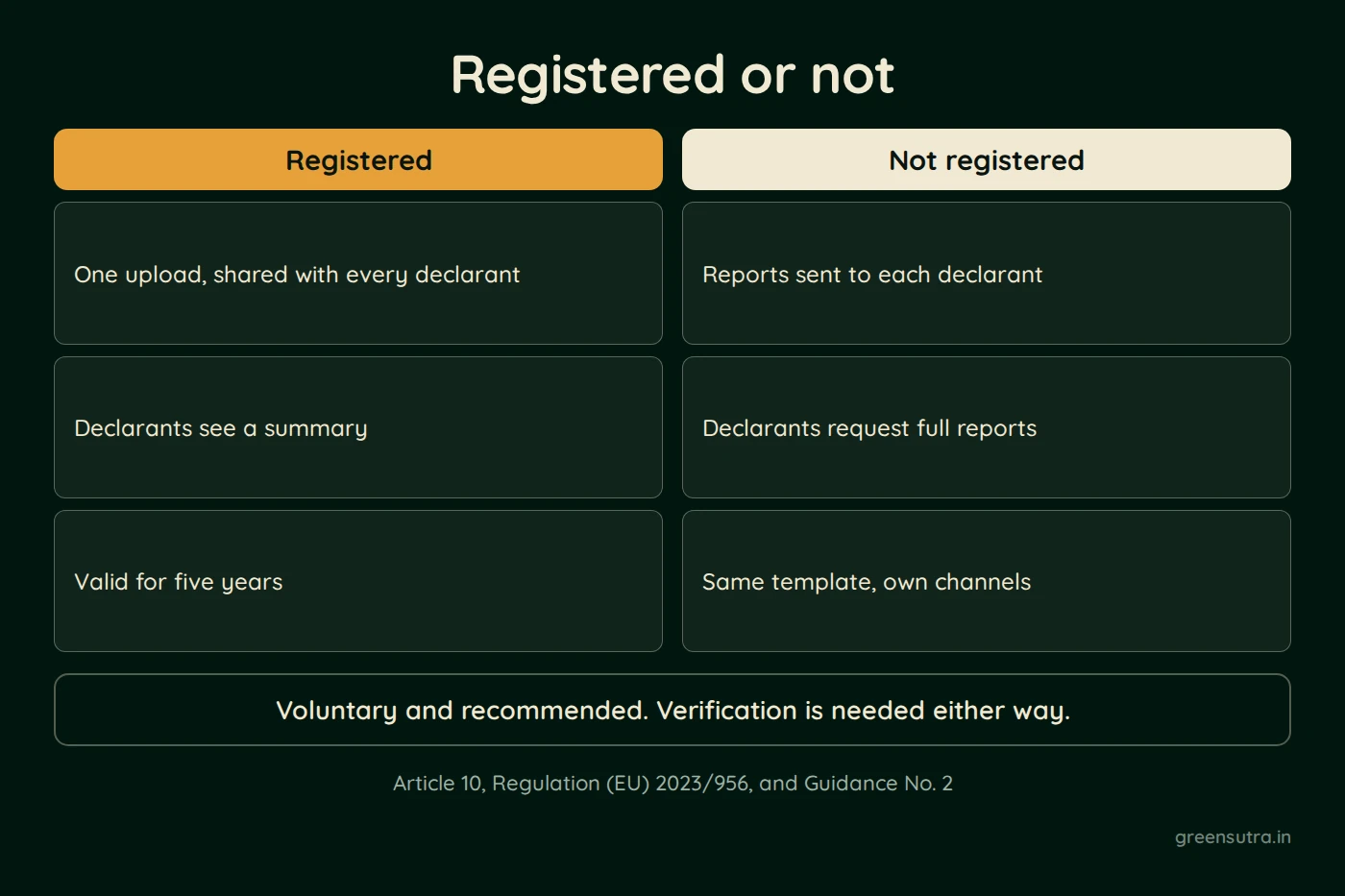
| Point | Registered operator | Unregistered operator |
|---|---|---|
| How data reaches declarants | Uploaded once, verified, then disclosed to each declarant in the Registry | Sent to each declarant separately, using the same report template |
| What declarants see | A summary of the emissions report | The full emissions and verification reports, which declarants must request and keep |
| Confidentiality | Limited to the summary | Guidance No. 2 advises email only for non-confidential data unless it is encrypted |
Registration happens in the Registry’s portal for operators of third-country installations, known as O3CI. Guidance No. 1 notes that the verification process is documented in the Registry in either case.
What registration asks for
Under Article 10(2) the request gives the operator’s name, address, registration number and contacts, and its controlling entities. It also gives each installation’s address with coordinates to six decimals, and its main economic activity. Registration lasts five years from notification. Changes are reported without delay, and the operator may ask to be deregistered at any time.
A registered operator determines its embedded emissions, has them verified by an accredited verifier and keeps the verification report and records for four years after verification, under Article 10(5). From 2027, Guidance No. 2 says the Registry will also let operators share data with other operators that use their goods as precursors.
Example: six EU customers
Example. An aluminium extruder outside the EU sells to six EU importers. Registered, it uploads one verified 2026 report and discloses the summary to all six in the Registry. Unregistered, it sends six sets of full reports through its own channels, and each importer keeps copies in case the authorities review its declaration.
Sources: Regulation (EU) 2023/956, consolidated text, Guidance No. 1, Introduction to CBAM concepts, Guidance No. 2, Quick guide for non-EU operators
How the Registry fits with the monitoring plan and verification is covered in CBAM Monitoring Plan in 2026 and the CBAM compliance guide. GreenSutra’s CBAM solutions cover registry onboarding with the emissions report.