


EU customs will check a Digital Product Passport by matching its registration identifier and commodity code against the EU registry before releasing goods for free circulation. The check confirms that a registered passport exists, not that the product complies. It runs automatically once the registry connects to the EU customs single window, which the law requires by 6 August 2030.
What the declarant provides
The mechanism is in Article 15 of the Ecodesign for Sustainable Products Regulation (ESPR). Whoever declares a covered product for release for free circulation must give customs its unique registration identifier, the number the EU registry returns when a passport is registered. Customs may release the goods only after checking that this identifier and the commodity code match the data in the registry.
The match is electronic and automatic, through a link between the registry and the EU Customs Single Window Certificates Exchange System (EU CSW-CERTEX). The Commission has four years to set it up, counted from the entry into force of Implementing Regulation (EU) 2026/1778 on 6 August 2026, under Article 15(3). The legal deadline is therefore 6 August 2030, although the Commission’s FAQ expects the link “around 2029”.
When the check starts for each product
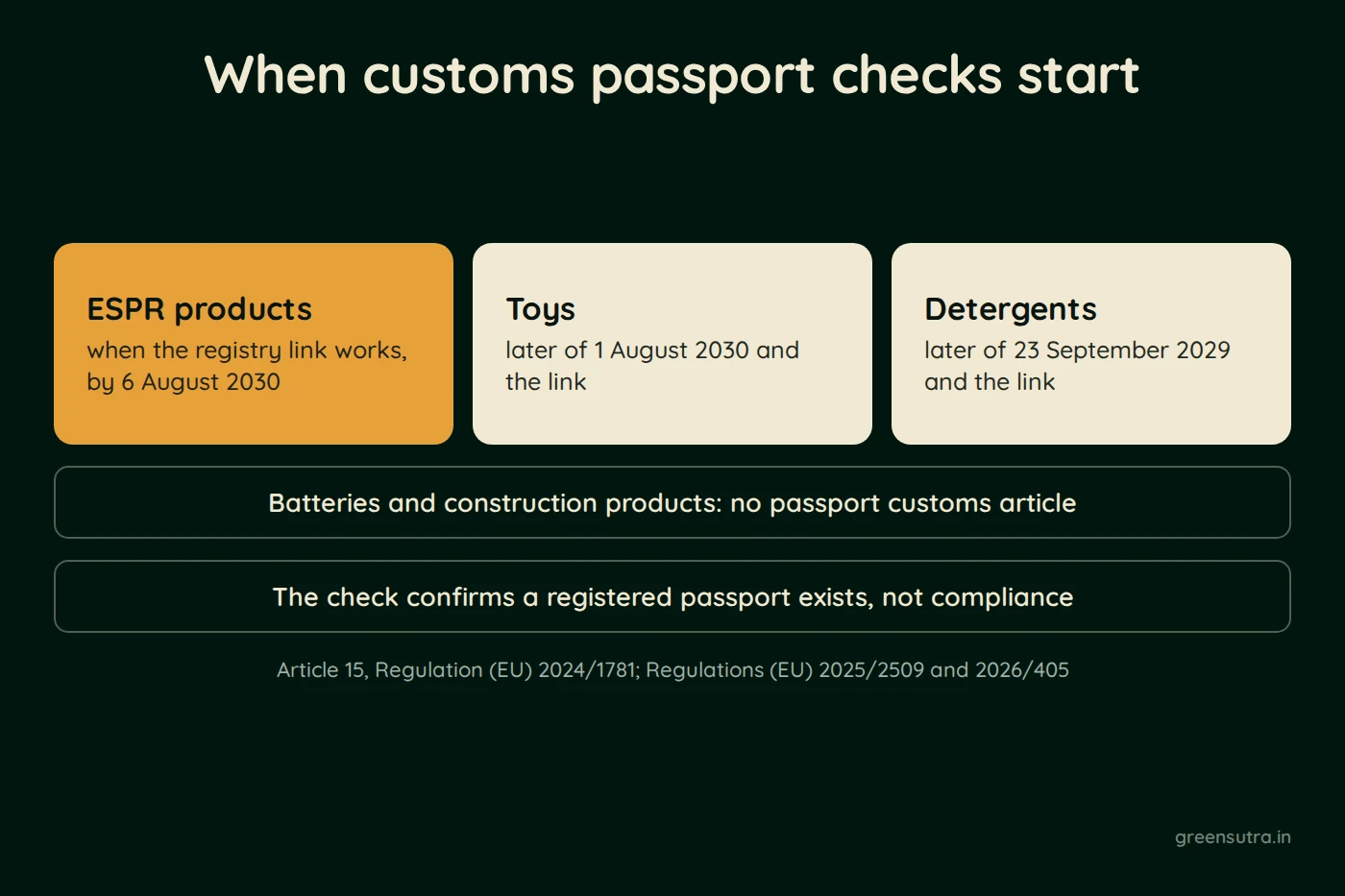
| Product | Legal basis | Customs check |
|---|---|---|
| ESPR product groups | ESPR Article 15 | When the link works; no group is covered yet |
| Toys | Regulation (EU) 2025/2509, Article 23 | The later of 1 August 2030 and the link date |
| Detergents and end-user surfactants | Regulation (EU) 2026/405, Article 25 | The later of 23 September 2029 and the link date |
| Batteries | Regulation (EU) 2023/1542 | No passport customs article |
| Construction products | Regulation (EU) 2024/3110 | No passport customs article |
What if the link opens on its deadline?
Example: suppose the registry link starts on 6 August 2030, its last legal date. The customs match for detergents would then begin on 6 August 2030 rather than 23 September 2029. For toys it would begin on 6 August 2030 rather than 1 August 2030. If the link works before a law’s own start date, that start date governs.
What customs do not check
Release for free circulation “shall not be deemed to be proof of compliance”, in the words of ESPR Article 15(2). Judging compliance stays mainly with market surveillance authorities. Customs may still use passport and registry data for risk management and customs controls under Article 15(4), and the border controls of Regulation (EU) 2019/1020 still apply. The new Union Customs Code, Regulation (EU) 2026/2108, names the passport only in a recital.
For goods made outside the EU, the passport and its registration in the EU registry have to exist before the goods are declared for release. The detergent passport answer covers one product law in detail.
Sources: Regulation (EU) 2024/1781 (ESPR), Regulation (EU) 2025/2509 on the safety of toys, Regulation (EU) 2026/405 on detergents, Regulation (EU) 2026/2108, Union Customs Code, European Commission, DPP FAQ
GreenSutra’s DPP consulting covers the data a passport and its registration need, while customs clearance stays with the importer and its customs representative. Each passport law’s dates are listed in the DPP guide.