


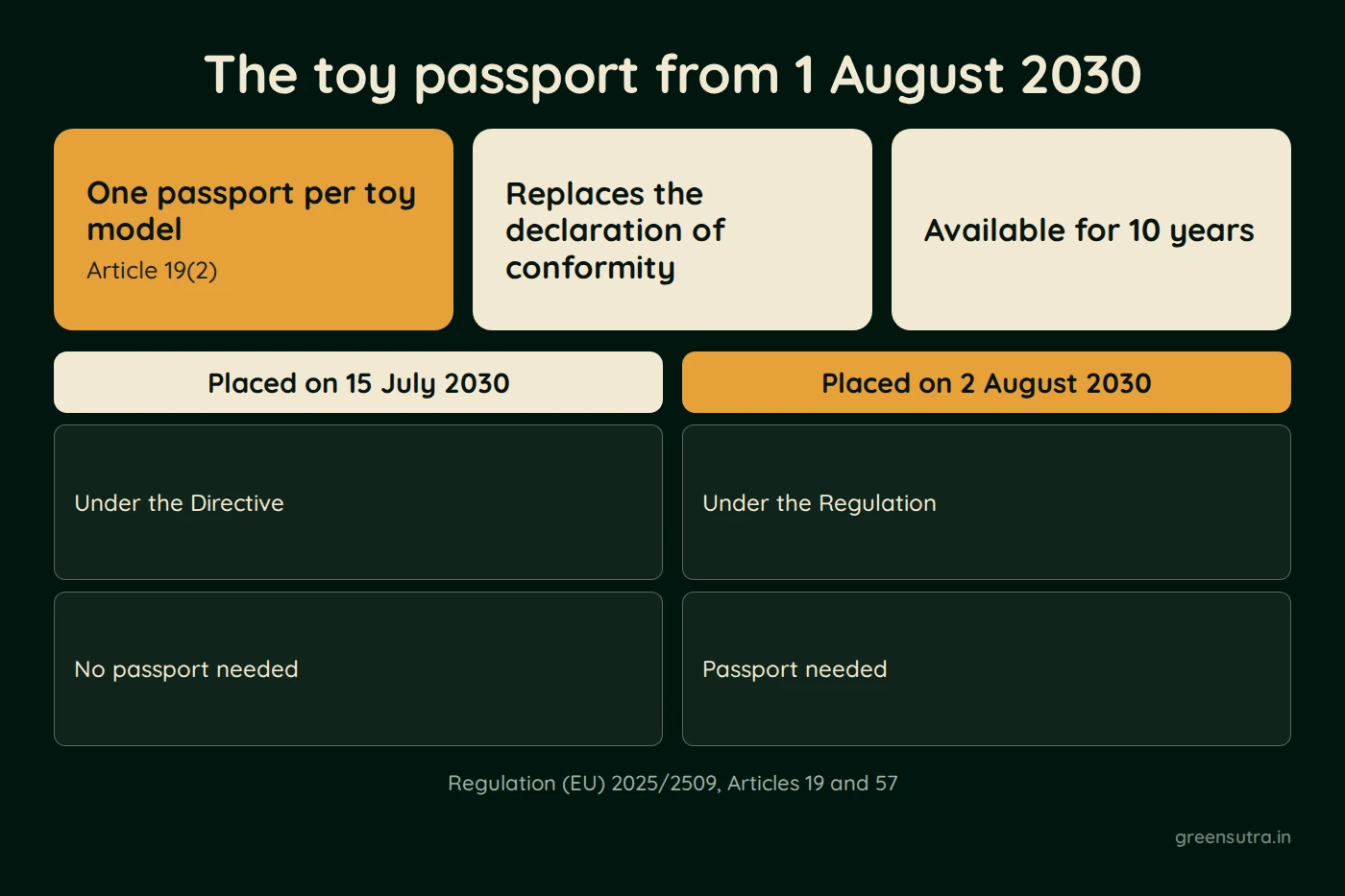
Yes, toys will need a Digital Product Passport from 1 August 2030. The Toy Safety Regulation (EU) 2025/2509 requires the manufacturer to create one for each toy model before placing it on the EU market. The passport replaces the EU declaration of conformity. Toys placed on the market under the old Toy Safety Directive before that date may still be sold.
What the toy DPP must contain
Minimum data under Article 19 and Part I of Annex VI:
- the unique product identifier and, where applicable, the commodity code
- names and addresses of the manufacturer, any authorised representative and the operator responsible under Regulation (EU) 2019/1020, with unique operator identifiers
- a statement that the passport is issued under the manufacturer’s sole responsibility
- identification of the toy, including a colour image
- references to all Union law the toy complies with, and the harmonised standards or common specifications used
- the notified body’s name, number and certificate reference, where one was involved
- the CE marking and the allergenic fragrances that must be labelled
- where the passport replaces a declaration of conformity under another law, a statement saying so
- the communication channel required by Article 7(12) and the service provider holding the back-up copy
Safety warnings and instructions for use are optional passport content under Part II, though they must still accompany the toy.
How the passport works
One passport covers each toy model, or each batch where another law requires it, under Article 19(2). It stays available for 10 years after the toy is placed on the market, even after insolvency. A data carrier links it to a persistent unique product identifier. The carrier sits on the toy or an affixed label, otherwise on the packaging or accompanying documents, and must be visible before purchase, online included. It also links to the Safety Gate portal for reporting dangerous toys.
The operator placing the toy on the market first uploads its product and operator identifiers to the EU registry, under Article 22. Importers check that the passport exists, the carrier is affixed and the upload is done. Customs checks begin on the later of 1 August 2030 and the date the registry links to the customs single window.
What about toys already on the market?
Example: a unit placed on the market under the Directive on 15 July 2030 can stay on sale after 1 August 2030 without a passport, because Article 57(1) protects it. Another unit of the same model placed on the market on 2 August 2030 needs one.
What is still missing?
The Commission may adopt a delegated act on carriers, layout, standards and access rights under Article 49. Its rules cannot apply earlier than 18 months after it enters into force, except in duly justified cases. An act in force after 1 February 2029 could therefore not normally apply by 1 August 2030, and no draft existed on 15 October 2026.
Sources: Regulation (EU) 2025/2509 on the safety of toys, Commission Implementing Regulation (EU) 2026/1778, European Commission, Stronger toy safety rules enter into force
GreenSutra’s DPP consulting maps a toy’s declaration and test file to the Annex VI fields. The DPP guide and the answer on which products need a passport first compare toys with the other passport laws.