


Mainly what is in the product. From 23 September 2029, detergents placed on the EU market need a Digital Product Passport (DPP) under the new Detergents Regulation. Products that meet only the old rules get a one-year transition. It names the product, says who made it, and lists every substance and micro-organism added on purpose. The manufacturer creates the passport before the product goes on sale.
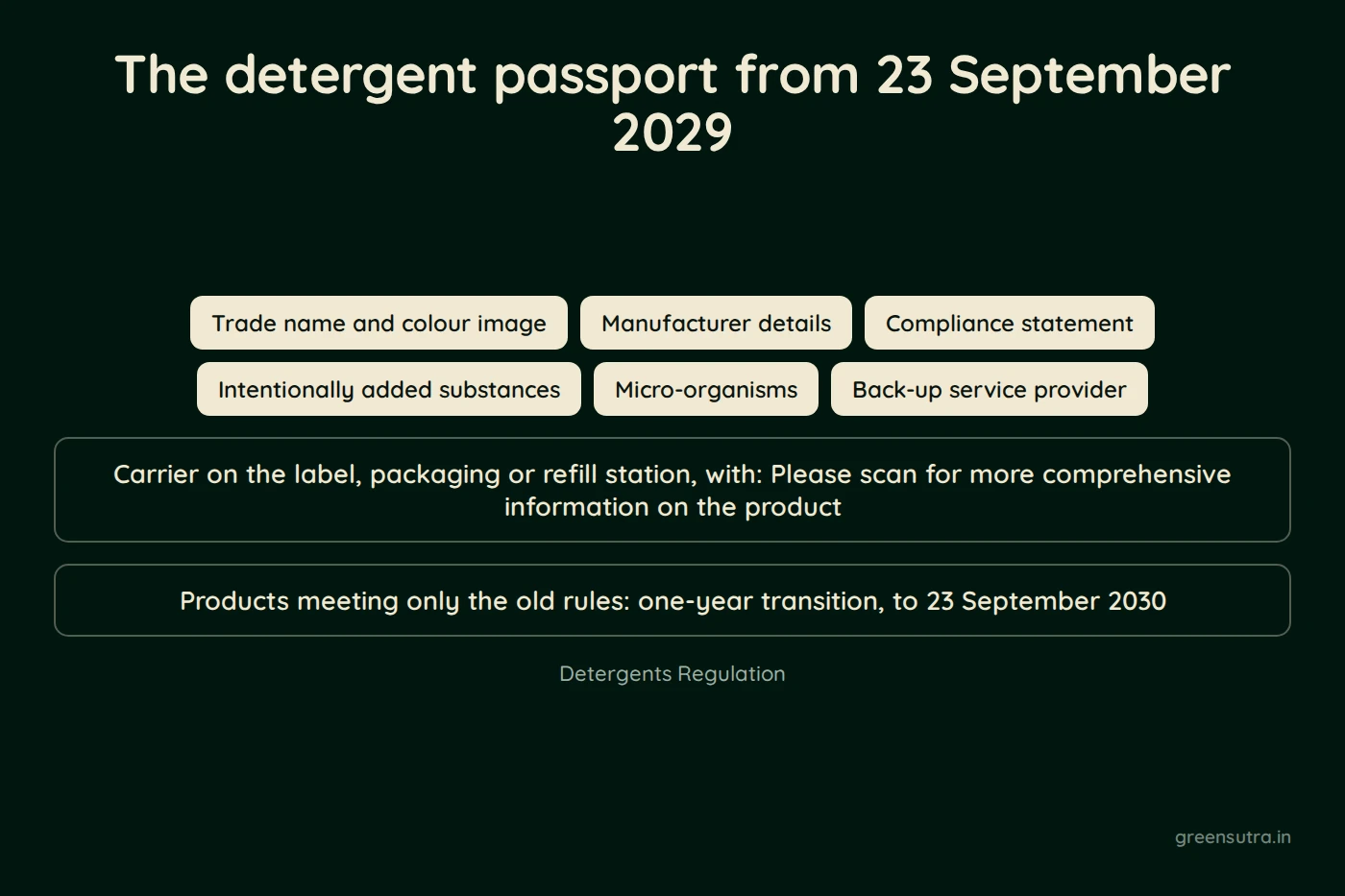
What exactly goes in?
At a minimum:
- the trade name, a unique product identifier and a colour image of the pack or label
- contact details for the manufacturer, and for the importer or authorised representative if there is one
- a statement that the manufacturer takes sole responsibility and that the product complies
- the full list of intentionally added substances, using their official chemical names, plus any preservatives carried over that must be labelled
- every intentionally added micro-organism, down to its strain
- the commodity code where it applies, and the service provider keeping the back-up copy
Detergents for industrial and institutional use can skip the substance list when the safety data sheet already gives it.
Where will buyers find it?
Through a QR code or similar carrier on the label or pack. For refills it sits on the refill station, and for bulk deliveries on the papers that come with them. It must be readable before purchase, online too. The Commission still has to settle the carrier type and access rights, and as of mid-October 2026 it had not done so.
What about products already on shelves?
A detergent placed on the market under the old rules before 23 September 2029 can stay on sale. For example, a bottle placed on 1 September 2029 needs no passport. One placed on 1 October 2029 that meets only the old rules can be sold until 23 September 2030.
What if the manufacturer is outside the EU?
It must appoint an authorised representative in the EU, who checks the passport exists and is registered. The EU importer must also make sure the passport has been created, the carrier is in place and the passport is in the EU registry. Customs checks start on 23 September 2029, or later if the registry is not yet linked to the EU customs system.
For other products, the passport finder shows who carries the passport duty across 18 product types and four roles.
Where this comes from: Detergents Regulation (EU) 2026/405, Articles 9, 10, 21, 25 and 36 and Annex VI; Implementing Regulation (EU) 2026/1778.