


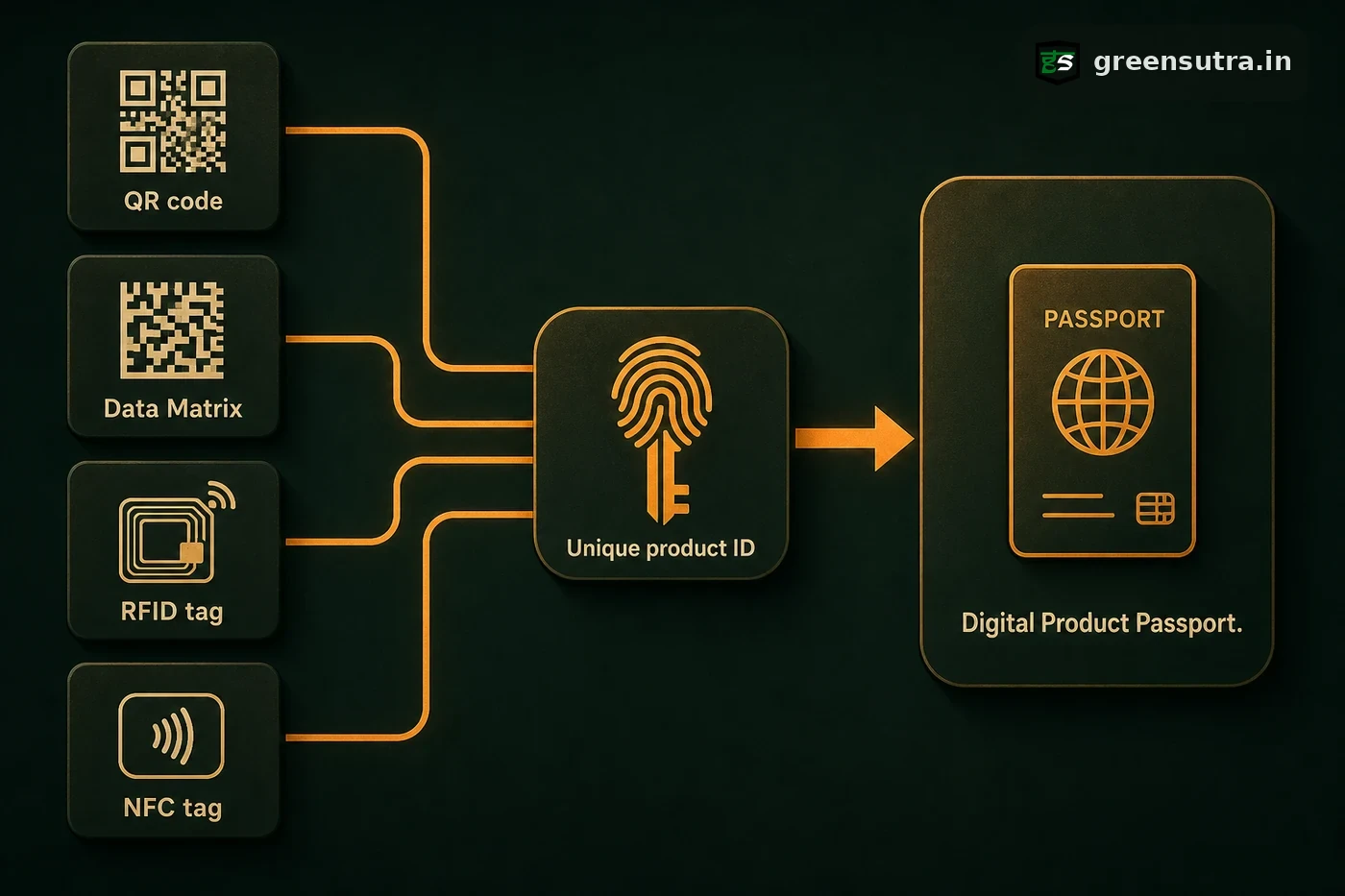
A QR code is the example the EU itself gives, but it has not fixed one type. The data carrier is the tag scanned to open a product’s Digital Product Passport (DPP). It can be a QR code, a Data Matrix code, an RFID or NFC chip, or even a watermark. The rules for each product group will say which one to use and where it goes.
Where does the carrier go?
On the product itself wherever possible, so the passport can still be reached years later when the packaging is long gone. Where that is not possible, it can go on the packaging or the documents that come with the product. Customers, repairers, recyclers and authorities all scan the same carrier; what each then sees depends on their access rights.
How do the options compare?
| Carrier | How it is read | Status in EU rules |
|---|---|---|
| QR code | Camera | Named as an example in the Ecodesign Regulation |
| Data Matrix | Camera or scanner | Allowed where a product group’s rules accept it |
| RFID or NFC tag | Contactless reader | Allowed where a product group’s rules accept it |
Whatever the carrier, it points to the same thing: the product’s unique identifier, which opens the passport.
Which standards apply?
Of the six passport standards the EU cited on 15 July 2026, EN 18219 covers unique identifiers and EN 18220 covers data carriers. Following them means a passport is presumed to comply on those points. Before they were cited, the regulation pointed to the ISO/IEC 15459 identifier standards.
Can an existing barcode number be used?
It can be. GS1 Digital Link turns a product’s existing GS1 number, the GTIN, into a web address. One QR code or Data Matrix can then identify the product and open its passport. The regulation does not name GS1 Digital Link, but the EU passport registry asks for the product identifier as a web address that meets the European standards.
Where this comes from: Ecodesign Regulation (EU) 2024/1781, Articles 10 and 11, recital 37 and Annex III; Implementing Decision (EU) 2026/1736.