


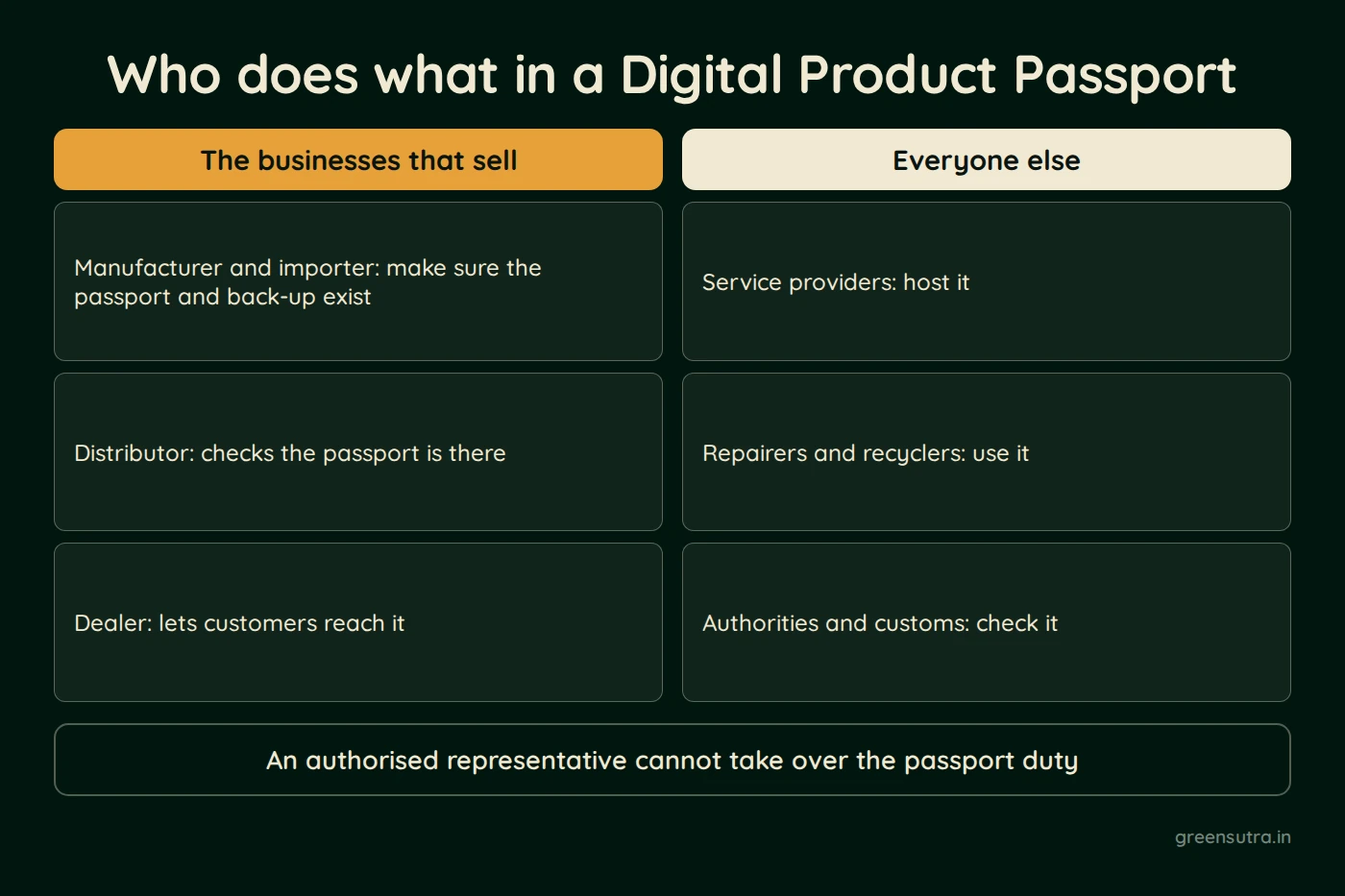
Almost everyone around a product has some part in its Digital Product Passport (DPP), but two businesses carry the main duty. They are the manufacturer and, for goods made outside the EU, the importer, and both must make sure the passport and a back-up copy exist. Sellers pass the passport on, service providers host it, repairers and recyclers use it, and authorities check it.
Which businesses have passport duties?
| Role | Part in the passport |
|---|---|
| Manufacturer | Must make sure the passport and its back-up are available; adds its contact details and digital instructions |
| Importer | Same duty as the manufacturer for goods made outside the EU; adds its contact details |
| Authorised representative | Can act for a manufacturer under a written mandate, but cannot take over the passport duty |
| Distributor | Checks the product is linked to a passport before selling it |
| Dealer, in a shop or online | Makes sure customers can easily reach the passport |
| Online marketplace | Can ask for a copy of the carrier; works with the authorities |
| Fulfilment service provider | Stores and ships without putting compliance at risk; can be the responsible EU business where there is no other |
Who hosts, supplies and uses the data?
- DPP service providers host the back-up copy, and can host the passport itself, for the business that hires them. The EU registry does not hold the passport itself.
- Other businesses and sites named in the passport: where one has no identifier, the business creating or updating the passport requests one for it, after checking none exists.
- Repairers, refurbishers, remanufacturers and recyclers read the data their role allows, and can be verified in the registry.
- Customers get free, easy access to the public part, before they buy.
Who may see or change which data is set by each product group’s rules; see who can access which data.
What do the EU and national authorities do?
- The European Commission writes each product group’s rules, runs the EU registry and must set up a public web portal.
- EU countries appoint a registry administrator by 18 February 2027 and set the penalties.
- Market surveillance authorities and customs use the registry; customs check the registration identifier at the border.
- The European standards bodies CEN, CENELEC and ETSI drafted the technical standards, six of them cited by the EU on 15 July 2026.
Where this comes from: Ecodesign Regulation (EU) 2024/1781, Articles 2, 4, 9 to 15, 27 to 31, 33, 35 and 74; Implementing Regulation (EU) 2026/1778, Articles 5, 7, 12 and 21; Regulation (EU) 2019/1020, Article 4; Implementing Decision (EU) 2026/1736; registry user guide.