

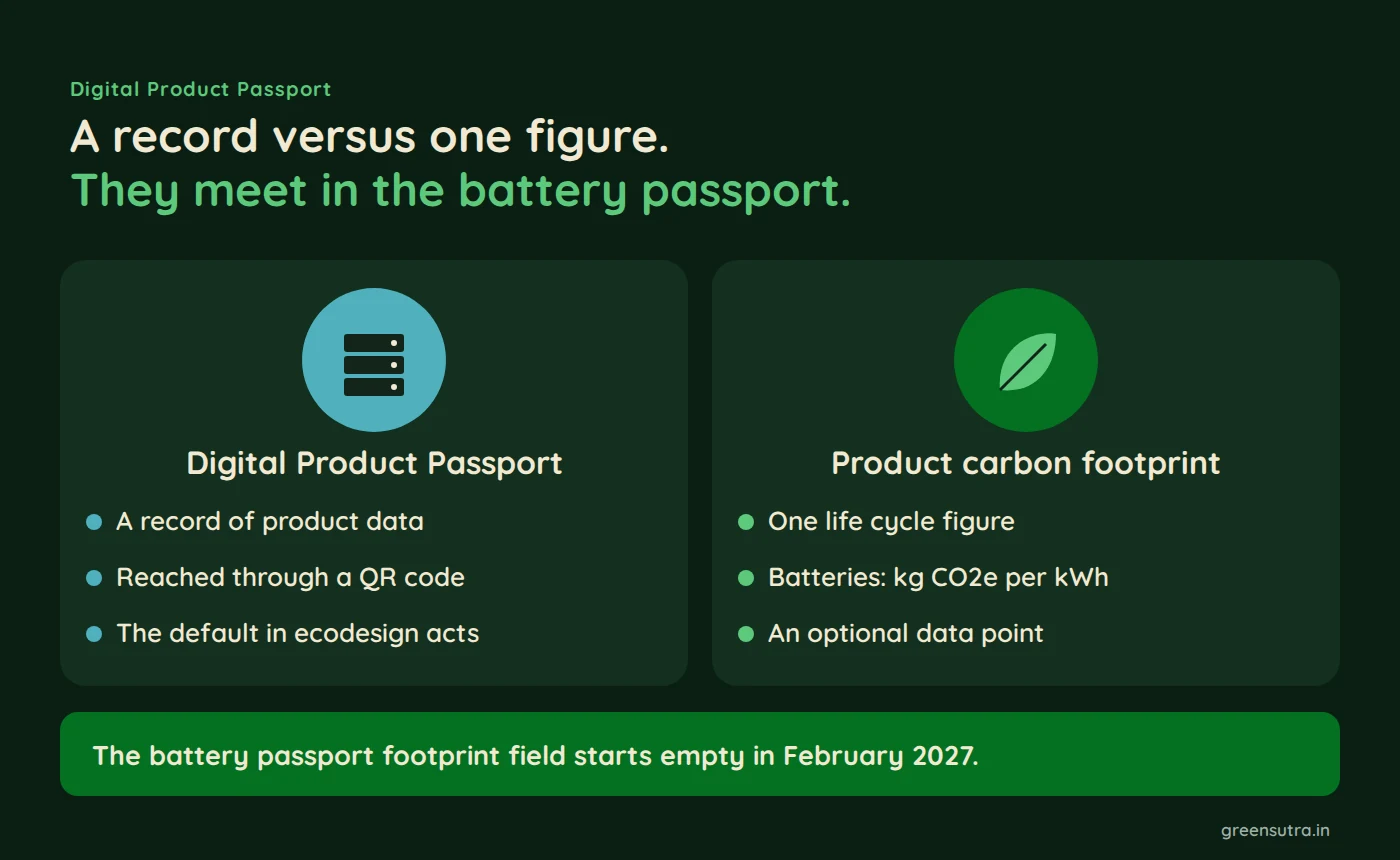
A Digital Product Passport is a record of product data, reached through a QR code or similar carrier. A product carbon footprint is one figure: a product’s life cycle greenhouse gases in CO2 equivalents. In EU ecodesign rules the passport is the default and a footprint is optional. They meet in the battery passport, whose footprint field starts out empty.
How do the two compare?
| Digital Product Passport | Product carbon footprint | |
|---|---|---|
| What it is | A set of data about one product, reached through a data carrier | The sum of emissions and removals across the product’s life cycle, for climate change only |
| In the ecodesign rules | The minimum content of every product-specific act, unless exempted | One of several performance data points an act may add, such as a durability or repairability score |
| Method | Set by each product group’s act | For batteries, the Commission’s Product Environmental Footprint method and its category rules |
| Status today | Applies first to batteries, from 18 February 2027 | No product group has a binding EU carbon footprint declaration applying yet |
Where do they meet in the battery passport?
The public part of the battery passport includes the carbon footprint. The battery figure is declared in kilograms of CO2 equivalent per kWh of total energy delivered over the battery’s life. It is set for each model at each plant, with the use phase left out. The acts that set the method and the format have not been adopted, so the Commission’s data guidance marks the field “Not to be filled/displayed as of February 2027”. Once the declaration applies, it travels with the battery until the passport can carry it.
Can an existing carbon footprint be reused?
Only if it matches the method a future act sets. For batteries that means the Product Environmental Footprint method and category rules, not a free choice of standard. Neither the Ecodesign Regulation nor the Battery Regulation names ISO 14067, the common product footprint standard described in the ISO 14067 answer. A footprint calculated for a customer today is good groundwork, but not yet passport-ready.
Example: when the battery figure starts
Example. Suppose both battery acts enter into force on 1 March 2027. Electric vehicle batteries would then need the declaration 12 months later, from 1 March 2028. Light means of transport batteries would need it from 1 September 2028, the later of 18 August 2028 and 18 months after the acts. The entry-into-force date is hypothetical; the 12 and 18 months come from the regulation.
The first ecodesign group, iron and steel, lists a carbon footprint information requirement as one option in the Commission’s call for evidence. The general basics are in what a product carbon footprint is.
Where this comes from: Ecodesign Regulation (EU) 2024/1781, Articles 2(25), 2(28) and 7(2) and Annex I; Battery Regulation (EU) 2023/1542, Articles 3(1)(21) and 7 and Annexes II and XIII; Commission battery passport data-point guidance.
More on this: Digital Product Passport guide · Digital Product Passport services
Reviewed by Team GreenSutra on 26 October 2026.