


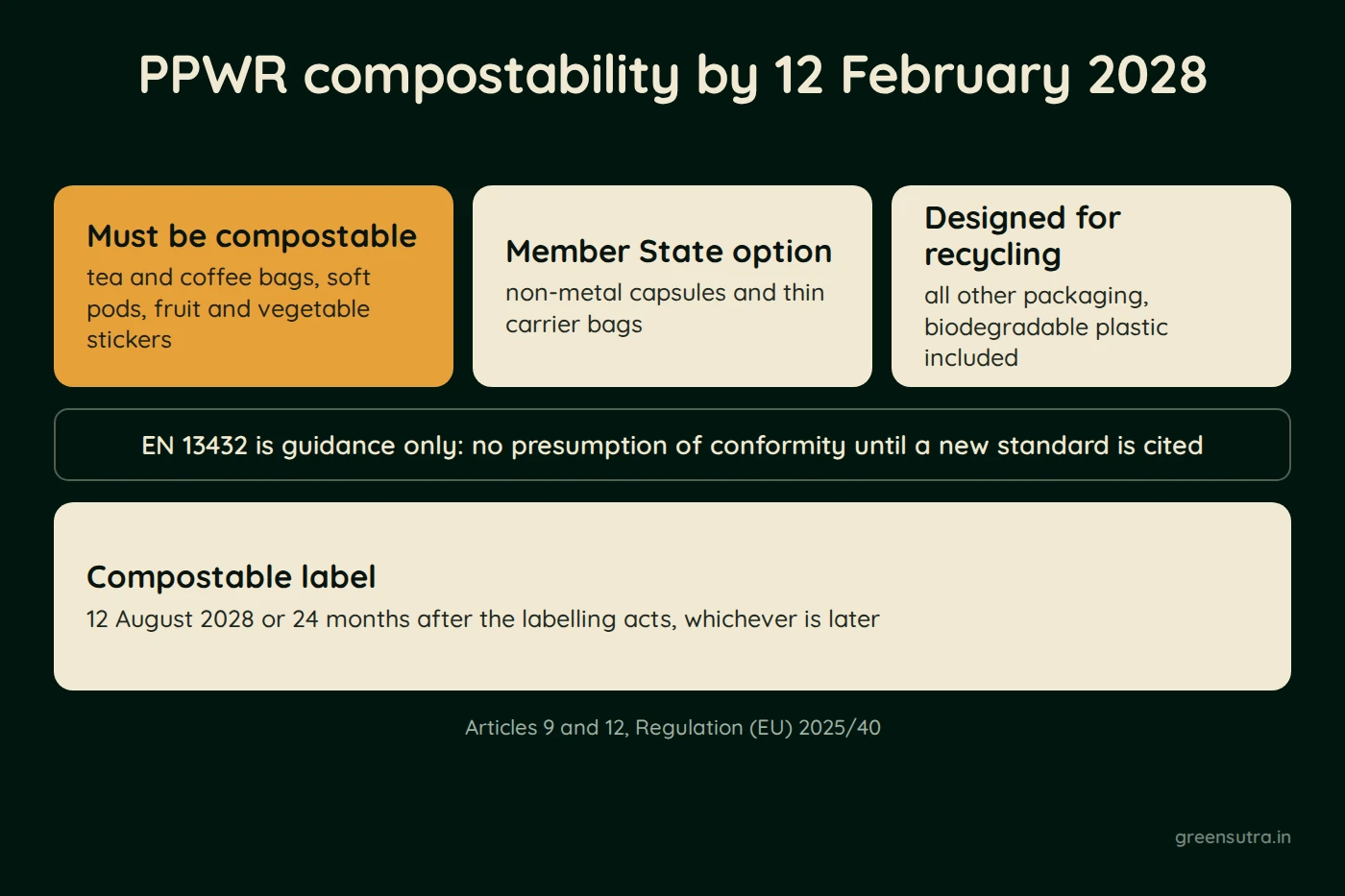
By 12 February 2028, Article 9 of the PPWR requires three formats to be compostable in industrial conditions. They are permeable tea and coffee bags, soft single-serve pods disposed of with the drink, and fruit and vegetable stickers. Non-metal coffee capsules and thin plastic carrier bags are a Member State option. All other packaging must be designed for recycling.
What must be compostable by 12 February 2028?
Three formats, under Article 9(1) of Regulation (EU) 2025/40:
- permeable tea, coffee or other beverage bags;
- soft single-serve units holding tea, coffee or another beverage, used and disposed of with the product;
- sticky labels on fruit and vegetables.
They must be compatible with the standard for composting in “industrially controlled conditions”, and with home composting standards where a Member State requires it. The Commission’s guidance says the rule covers these formats in any material, including paper-based pods. Under Article 3(1)(50), compostable refers to industrial conditions; home compostable is a separate term for conditions outside industrial facilities.
Do coffee capsules have to be compostable?
Not across the EU. Non-permeable capsules for machines fall under a different point, Article 3(1)(1)(g). The Commission’s FAQ says they “are not” mandatorily compostable, though a Member State may require it under Article 9(2). It adds that Member States cannot require compostability for metal capsules.
Do plastic carrier bags have to be compostable?
Only where a Member State chooses. Article 9(2)(a) lets a country require compostable lightweight bags (wall thickness below 50 microns) and very lightweight bags (below 15 microns). That needs bio-waste collection and treatment in place. A Member State may also keep compostability rules it had for other packaging before the PPWR applied. Separately, Annex V restricts very lightweight bags from 1 January 2030, with hygiene and loose food exceptions, as the single-use restrictions answer explains.
Is biodegradable plastic exempt from recycling rules?
No. It must be recyclable like everything else. Article 9(3) says all other packaging, “including packaging made of biodegradable plastic polymers”, must be designed for material recycling by 12 February 2028. The design for recycling answer covers that test.
Does EN 13432 certification prove compliance?
Not with a presumption of conformity. Recital 58 says the current industrial composting standard can be used as guidance until a new or updated harmonised standard exists. The Commission’s guidance says presumption returns only once a new standard is cited in the Official Journal. The Commission’s packaging standardisation initiative 16638 was still at the planning stage on 15 October 2026. Article 9(4) requires the proof to sit in the technical documentation.
What will the compostable label say?
Article 12(1) requires it to say the material is compostable, “not suitable for home composting” and not to be discarded in nature. It applies from 12 August 2028 or 24 months after the labelling implementing acts, whichever is later. Those acts had not been adopted by 18 October 2026. Details are in the labelling answer.
Sources: Regulation (EU) 2025/40 (PPWR), Commission guidance document, C/2026/3084, PPWR Frequently Asked Questions, 2nd edition, Commission initiative 16638, packaging standardisation
A format-by-format check against Article 9 is part of GreenSutra’s PPWR consulting. The EU PPWR guide places the 2028 deadline among the other design rules.