

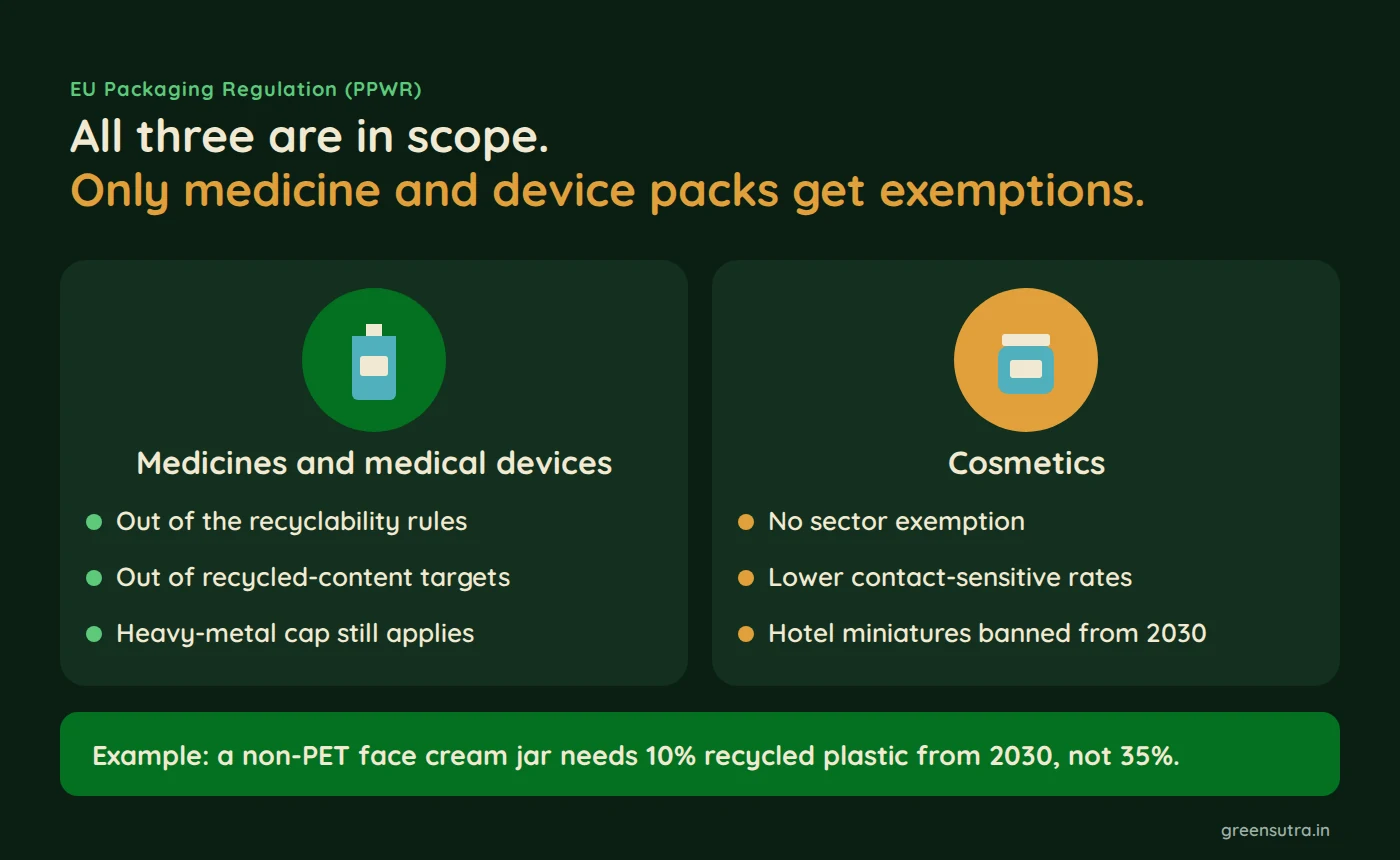
Yes. The EU packaging regulation (PPWR) covers packaging for cosmetics, medicines and medical devices, because it applies to all packaging in every sector. What differs is a short list of exemptions: the immediate packaging of medicines, the contact-sensitive packaging of medical devices and some outer medicine packs are spared the recyclability and recycled-content rules. Cosmetics packaging gets no sector exemption.
Which rules do medicine and device packs escape?
Two design rules carve out the same groups:
- the immediate packaging of human and veterinary medicines;
- the contact-sensitive packaging of medical devices and in vitro diagnostics;
- the outer packaging of medicines where it keeps the product’s quality.
These packs are outside the recyclability rules and the plastic recycled-content targets. The labelling relief is narrower. It applies only where there is no space left after other required labels, or where the label could put the safe use of a medicine at risk.
The other main rules still apply to them: the heavy-metal cap for all packaging, the minimisation rules, the empty-space cap and the reuse targets. The Commission’s guidance adds that IV bags and syringes are not packaging at all, even when sold pre-filled.
Why do cosmetics get no exemption?
The regulation defines contact-sensitive packaging by the product inside, and the Cosmetics Regulation is on that list. So cosmetic plastics are not exempt; they simply take the lower contact-sensitive recycled-content rates. Hotel miniatures of shampoo and lotion are a separate matter. Single-use toiletry packaging for one booking is banned in hotels and other accommodation from 1 January 2030, whatever the material (see single-use formats from 2030).
| Point | Status on 26 October 2026 |
|---|---|
| Whether a device’s outer pack that never touches the device is contact-sensitive | Open, no official answer yet |
| Recyclability criteria that cosmetics packs must meet | Open, due by 1 January 2028 |
Example: a face cream jar
Example. A cosmetics brand sells face cream in a plastic jar that is not PET. From 2030, or three years after the Commission’s calculation rules if those come later, the jar must contain at least 10% recycled plastic. The same jar holding a product that is not contact-sensitive would need 35%, so the cosmetic jar’s target is 25 points lower. From 2040 the cosmetic rate rises to 25%.
Where this comes from: Regulation (EU) 2025/40, Articles 2(1), 3(1)(49), 5(4), 6(11), 7(1), 7(2), 7(4), 12(11) and Annex V point 5; Commission guidance, OJ C/2026/3084, section 1.
More on this: EU PPWR guide · EU PPWR compliance
Reviewed by Team GreenSutra on 26 October 2026.