

The PPWR, Regulation (EU) 2025/40, has no general small-business exemption from extended producer responsibility (EPR). A small producer still registers, pays into the national scheme and reports in each Member State where it is the producer. Below 10 tonnes of packaging a year in a Member State, the yearly report due by 1 June is shorter.
Is there a small-business exemption from PPWR EPR?
No general one. The Commission’s PPWR FAQ says “There is no general exemption for micro-enterprises from EPR obligations in the PPWR or Directive 2008/98/EC”. Every producer answers for packaging it first makes available in a Member State, including registering there and reporting under Article 44.
What changes below 10 tonnes?
Only the yearly report. Article 44(8) applies where a producer first makes available less than 10 tonnes of packaging in a Member State in one calendar year. It counts packaging, including that of packaged goods, per Member State.
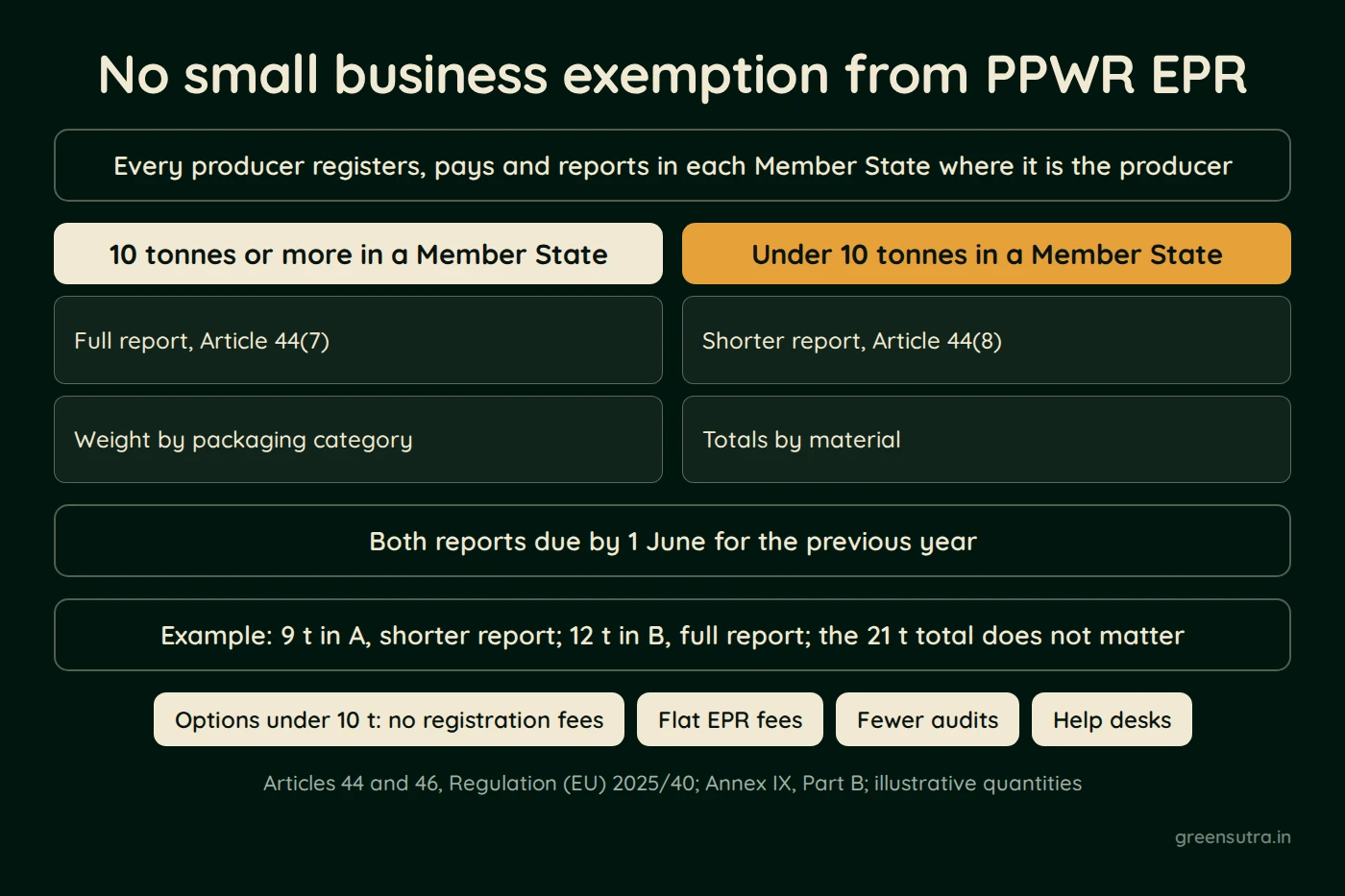
| Annual report | Applies to | Content under Annex IX, Part B |
|---|---|---|
| Full, Article 44(7) | 10 tonnes or more in that Member State | Weight by the packaging categories in Annex II, Table 1 |
| Shorter, Article 44(8) | Under 10 tonnes in that Member State | Totals by material: glass, plastic, paper and cardboard, ferrous metal, aluminium, wood, other, total |
Both are due by 1 June for the previous year. Under Article 44(8) and (9), a Member State may lower the threshold for a year if it lacks accurate data, and may ask for quarterly reports for budgetary reasons. Until the harmonised registers exist, national reporting rules and dates apply.
Example (illustrative quantities): a producer first makes available 9 tonnes of packaging in Member State A and 12 tonnes in Member State B in one year. Its 21-tonne total does not matter. It files the shorter report in A and the full report in B, by 1 June once the harmonised registers apply, and registers and pays the scheme in both.
What can countries and schemes ease?
Fees and paperwork, if they choose. The Commission’s small business page lists options for producers under 10 tonnes. They include no registration fees, flat EPR fees, no duty to update information, fewer audits and help desks. Article 46(5) bars schemes from placing a disproportionate burden on producers of small quantities.
Do micro-enterprises get any carve-out?
A few narrow ones, none of them general. Where a micro-enterprise has packaging made under its own brand by a supplier in the same Member State, Article 3(1)(13)(b) makes the supplier the manufacturer. The Commission’s FAQ says the micro-enterprise is then exempt from its EPR requirements. Micro-enterprises at no more than 1,000 kg in a Member State are also exempt from the re-use targets under Article 29(13).
The EPR authorised representative rule in Article 45(3) has no small-business exemption in force. Council delegations are discussing one; thresholds from 600 kg to 10 tonnes a year were suggested in September 2026.
Sources: Regulation (EU) 2025/40 (PPWR), PPWR FAQ, 2nd edition, Commission small business page, Council note 13583/26
GreenSutra’s PPWR consulting starts with the packaging weight per country and the report each country needs. The EU PPWR guide covers reporting.