

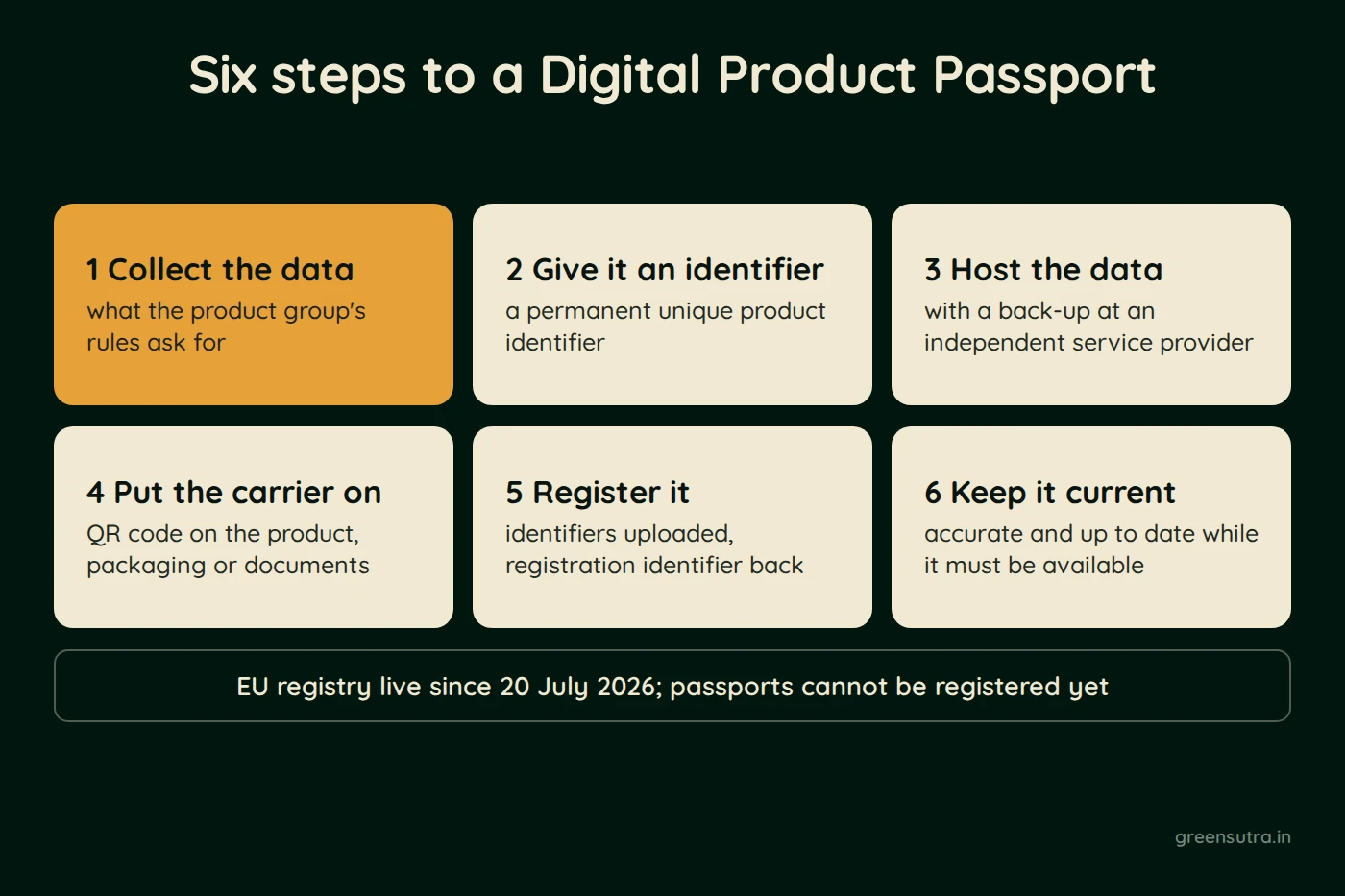
A Digital Product Passport (DPP) is built in roughly six steps. Collect the product data the rules ask for, give the product a unique identifier and host the data with a back-up copy. Then put a QR code or other data carrier on the product, register it with the EU, and keep it up to date. The exact contents depend on each product group’s rules, and as of October 2026 none under the Ecodesign Regulation has been adopted.
What are the steps?
- Collect the data. Each product group’s rules list what the passport must hold, such as materials, substances of concern, repair information, the declaration of conformity and manuals. Much of it comes from suppliers. See what a passport must contain.
- Give the product an identifier. A permanent unique product identifier ties the product to its passport and points to where the data is hosted.
- Host it, with a back-up. The passport can sit on the company’s own systems or with a service provider. A back-up copy has to be held by an independent DPP service provider.
- Put the carrier on the product. A QR code or similar data carrier goes on the product, its packaging or its documents. Each product group’s rules say which.
- Register. The business placing the product on the EU market uploads its identifiers to the EU registry and receives a registration identifier.
- Keep it current. The data has to stay accurate, complete and up to date for as long as the passport must be available.
Who does the work?
The manufacturer is responsible for the passport being there. Who actually builds and updates it is left to each product group’s rules. The new toy law is more direct: the toy’s manufacturer creates the passport itself, before the toy goes on sale.
Can a passport be registered today?
Not yet. The EU registry went live on 20 July 2026, but its user guide says: “Currently, it is not possible to successfully register DPPs.”
No product group under the Ecodesign Regulation has a passport duty yet either; see which products need a passport first.
Example: an e-bike battery
An EU manufacturer sells e-bike batteries from 18 February 2027. It gives each battery a unique identifier and a QR code, fills in the battery passport data and uploads the identifier to the registry. That last step is still waiting: the registry’s user guide says a battery semantic catalogue has to be defined first.
Where this comes from: Ecodesign Regulation (EU) 2024/1781, Articles 9, 10, 13 and 27; Implementing Regulation (EU) 2026/1778, Article 11; Battery Regulation (EU) 2023/1542, Article 77 and Annex XIII; Toy Safety Regulation (EU) 2025/2509, Article 19; registry user guide.