


Only an independent verifier accredited by an EU National Accreditation Body may verify actual emissions data used in an annual CBAM declaration. Default values need no verification. Commission Delegated Regulation (EU) 2025/2551, applying from 1 January 2026, sets the conditions. The accredited verifier then gains CBAM Registry access via a competent authority, and the European Commission publishes the list of verifiers.
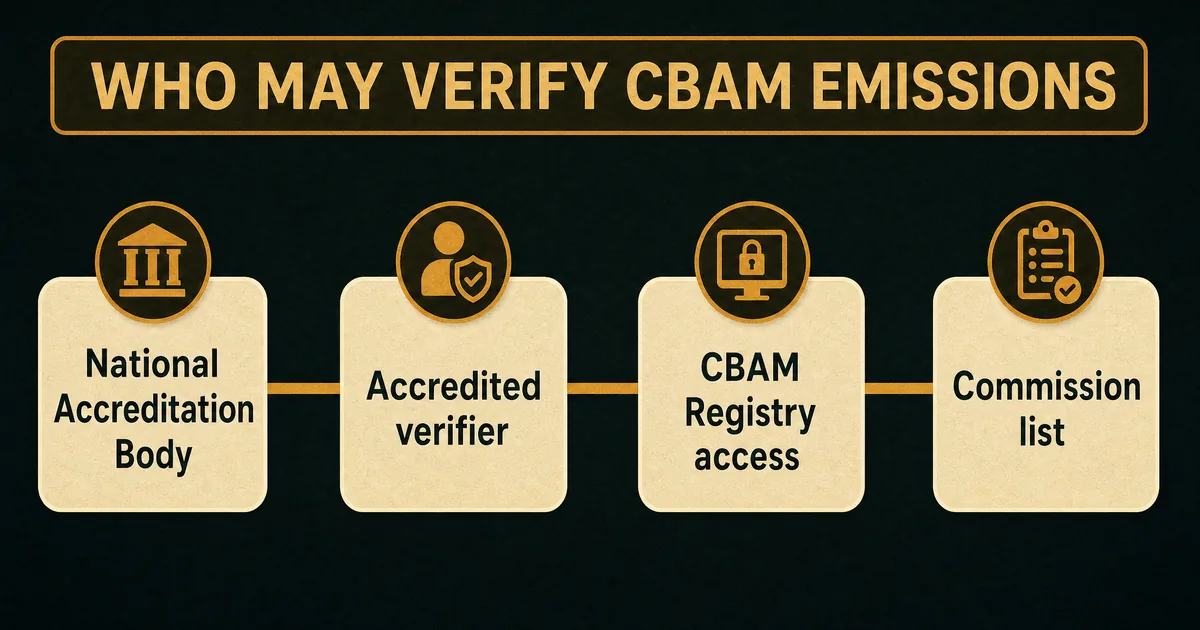
Verification of the embedded emissions behind an annual CBAM declaration is reserved for one actor: an independent verifier accredited by a National Accreditation Body of an EU Member State operating under Regulation (EC) No 765/2008. EEA accreditation bodies join once the CBAM Regulation is incorporated into the EEA Agreement. The conditions a verifier must meet, covering competence, independence and procedures, are set by Commission Delegated Regulation (EU) 2025/2551, which applies from 1 January 2026.
The accreditation chain
The route from candidate body to working verifier runs in three steps:
1. A National Accreditation Body accredits the verifier under Delegated Regulation (EU) 2025/2551. 2. The accredited verifier applies for CBAM Registry access through the competent authority of the Member State where its accreditation body sits, within two months of receiving accreditation and not before 1 September 2026. 3. The European Commission lists the verifier on its Taxation and Customs website. That published list is the working reference for checking whether a body may verify.
The Commission expected the first CBAM verifiers to be accredited around September 2026, and its verification page of 11 October 2026 listed none. As of 7 October 2026, 24 National Accreditation Bodies had agreed to provide CBAM accreditation and 18 were ready to accept applications. Six, including Hungary, Romania and Slovenia, were not yet ready.
Third-country bodies, including Indian ones
A verification body established outside the EU may seek CBAM accreditation from an EU National Accreditation Body that accepts third-country applications; seven did as of 7 October 2026 (France, Greece, Italy, the Netherlands, Poland, Slovakia and Sweden). Assurance under ISO 14065 and ISO/IEC 17029, as accredited by India’s NABCB, strengthens and prepares the data but does not by itself replace EU CBAM verification, which requires EU CBAM accreditation.
Consultants prepare, verifiers verify
The two roles never merge. A consultant such as GreenSutra prepares the file: exposure assessment, embedded-emissions calculation, report preparation and certificate cost planning through CBAM advisory. Verification belongs to the independent accredited verifier, and the verified data feeds the declaration filed by the authorised CBAM declarant. The CBAM guide sets out where verification sits in the annual cycle.
Sources: Delegated Regulation (EU) 2025/2551 · Regulation (EU) 2023/956 · European Commission CBAM
Related: CBAM Monitoring Plan in 2026: Template and What It Must Contain.