

Yes, a customs broker can be the authorised CBAM declarant if it acts as an indirect customs representative and holds the status itself, under Article 5(1a) of Regulation (EU) 2023/956. The representative then carries the importer’s CBAM obligations and penalties for the goods it clears, starting with the declaration due 30 September 2027. A direct representative cannot.
Which kind of customs broker can be the CBAM declarant?
Only an indirect customs representative. “Customs broker” is a trade term; Article 18 of the Union Customs Code sets two kinds of customs representative. A direct representative acts in the importer’s name. An indirect representative acts in its own name on the importer’s behalf. The Commission’s CBAM Q&A says that where an importer appoints a direct representative, “the importer remains the declarant for CBAM purposes”.
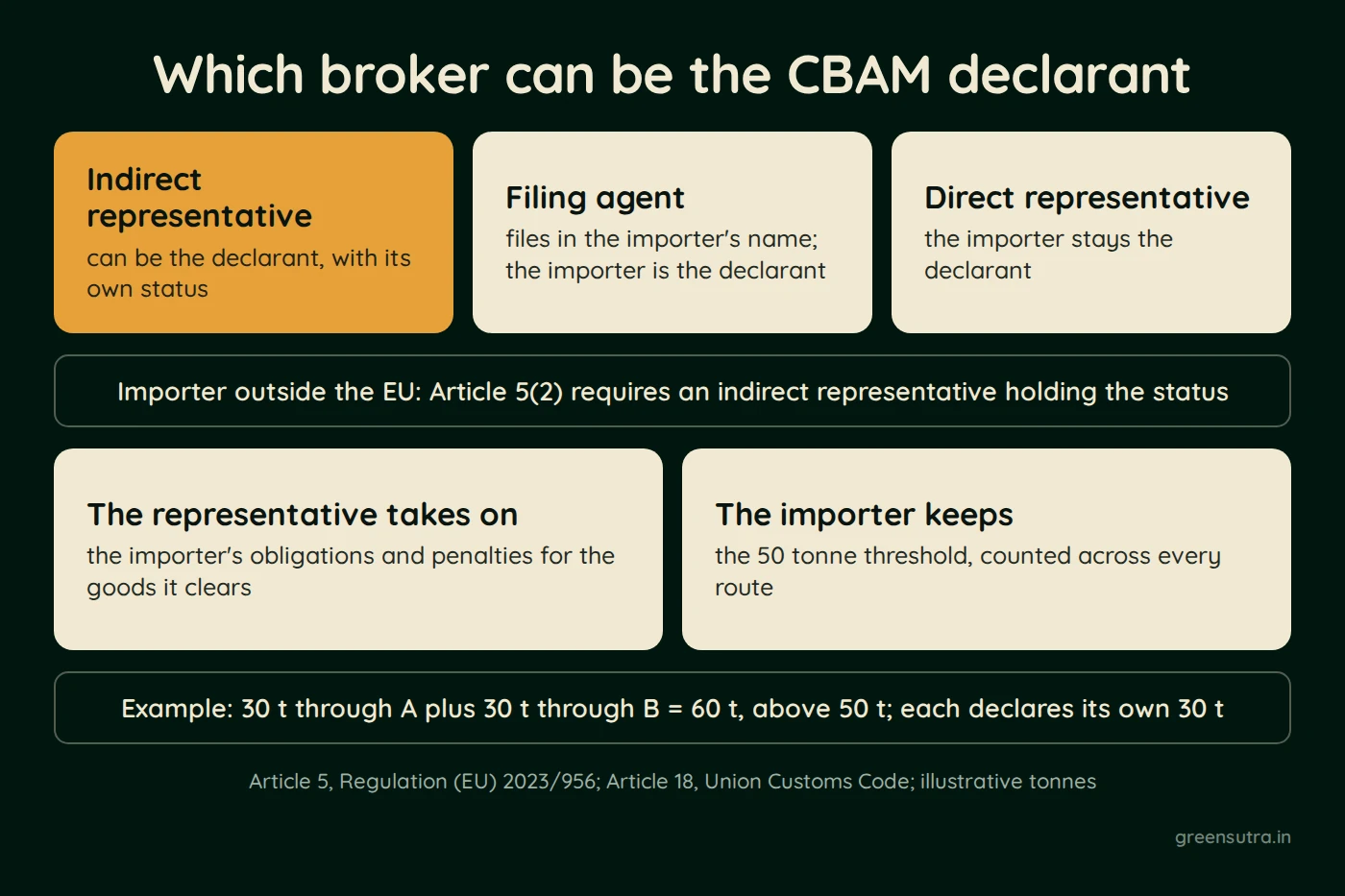
| How the broker works | CBAM declarant | Obligations |
|---|---|---|
| Indirect representative acting as declarant (Article 5(1a)) | The representative | The representative, for the goods it clears |
| Filing agent (Article 5(7a)) | The importer, holding the status | The importer; the agent only files in the importer’s name |
| Direct representative | The importer | The importer |
Does the broker need its own authorisation?
Yes. Article 5(1a) says an indirect customs representative “shall obtain the status of authorised CBAM declarant prior to importing goods”. The competent authority of the EU country where the representative is established grants it under Article 17, as for any authorised CBAM declarant. The broker holds it in its own right and needs it even if every importer it serves stays under the 50 tonne exemption.
When is an indirect representative required?
When the importer is not established in an EU Member State: Article 5(2) then requires the indirect representative to hold the status. For an importer established in the EU, acting as declarant is the representative’s choice. The Commission’s Q&A says a representative that refuses must tell the importer. If no representative agrees, the importer needs the status itself.
What does the representative take on?
Under Article 5(2a), the indirect representative is subject to “the obligations applicable to the importer” for the goods it imports for that importer. The recitals of Regulation (EU) 2025/2083 explain that penalties for non-compliance then fall on the representative. It files one annual declaration covering every importer it serves, surrenders certificates by 30 September and keeps the records. Certificates it buys cannot be transferred or sold to another person, so they never pass to the importer or to a new broker.
What stays with the importer?
The 50 tonne threshold, counted per importer across every route, and the CBAM goods it clears itself or through a direct representative.
Example: an EU importer clears an illustrative 30 tonnes of steel through representative A and 30 tonnes through representative B in 2026. Together that is 60 tonnes, above the threshold. Each representative declares and surrenders certificates for its own 30 tonnes, although neither share alone passes 50 tonnes.
Sources: Regulation (EU) 2023/956, Regulation (EU) 2025/2083, Union Customs Code, Commission CBAM Q&A
GreenSutra’s CBAM service prepares the installation data and records that the declarant and an accredited verifier rely on. It does not file or verify. The CBAM guide covers the declarant’s other duties.