


The annual CBAM declaration reports four totals under Article 6(2) of Regulation (EU) 2023/956: tonnes imported, embedded emissions, certificates to surrender and verification reports. Tonnes are given per type of goods, and verification reports apply only where actual emissions are used. The authorised declarant files it in the CBAM registry by 30 September, first in 2027 for 2026 imports.
What are the four items in a CBAM declaration?
Article 6(2) asks for four yearly totals.
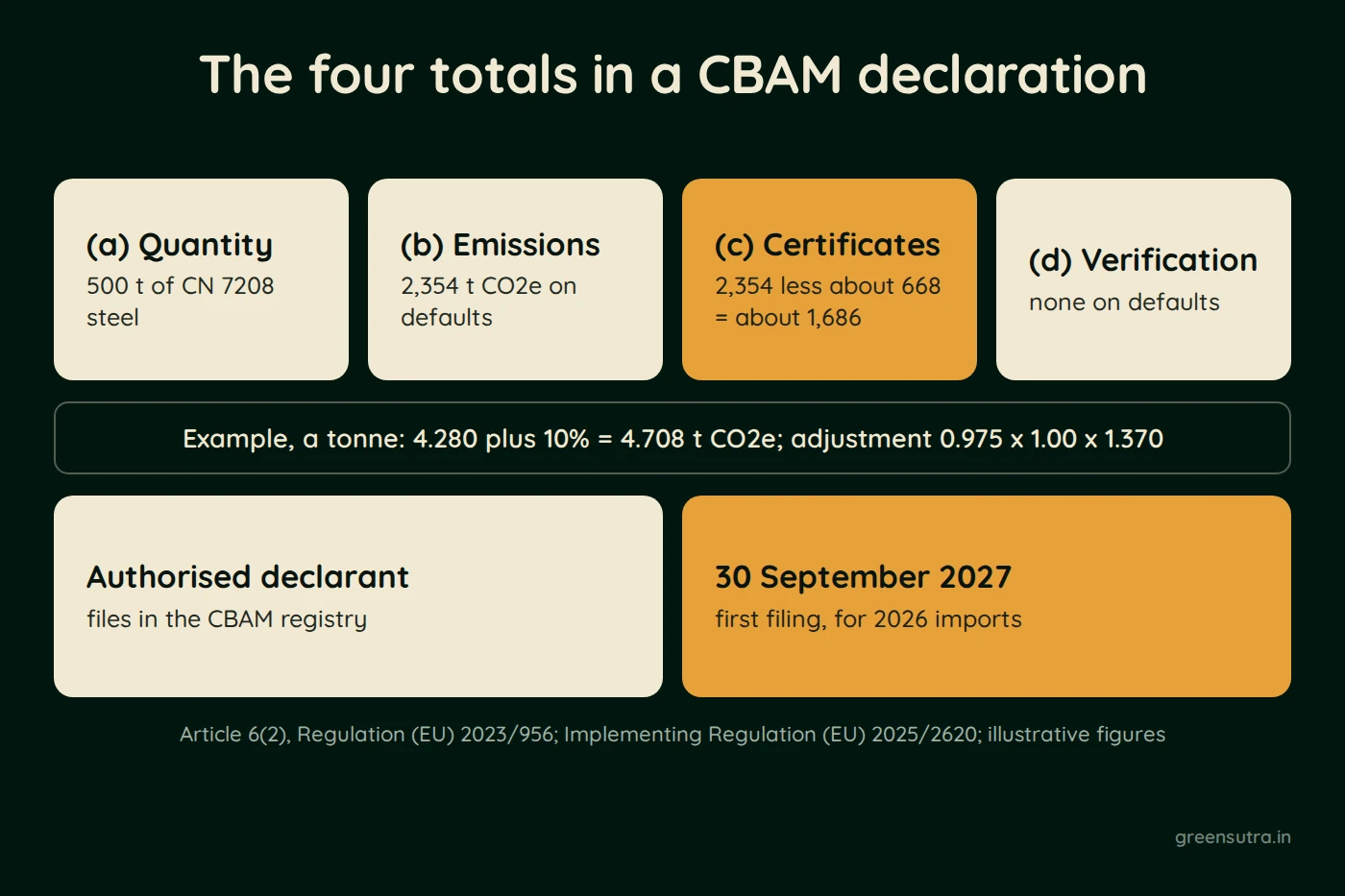
| Item | What it reports | Article 6(2) |
|---|---|---|
| Quantity | Tonnes of each type of goods imported in the year (megawatt-hours for electricity) | (a) |
| Embedded emissions | Tonnes of CO2e, from actual emissions or default values under Article 7 | (b) |
| Certificates | Embedded emissions minus the free allocation adjustment and any carbon price deduction | (c) |
| Verification reports | Reports from accredited verifiers, only for actual emissions | (d) |
Above 50 tonnes net mass a year, all of an importer’s CBAM goods are declared; electricity and hydrogen always are. For most iron and steel goods, aluminium, hydrogen and electricity, only direct emissions count. Cement and fertilisers add indirect emissions.
How is the number of certificates worked out?
The declarant surrenders certificates for the embedded emissions minus the free allocation adjustment, and minus any carbon price deduction, never below zero. Separate answers work through the adjustment, the carbon price deduction and the certificate arithmetic.
Example: an illustrative 500 tonnes of Indian hot-rolled flat steel (CN 7208), imported in the third quarter of 2026, on default values.
- (a) Quantity: 500 tonnes.
- (b) Embedded emissions: the default of 4.280 t CO2e a tonne plus the 10% mark-up gives 4.708, so 2,354 t CO2e.
- (c) Certificates: the adjustment is 0.975 x 1.00 x 1.370, about 1.336 a tonne or 668 in total. That leaves about 1,686 certificates.
- (d) Verification: none, because default values are declared.
No carbon price is deducted: the Commission had published no default carbon prices by 15 October 2026.
Is the declaration format fixed yet?
Not in full. Article 6(2) fixes totals, and Article 6(6) leaves the detailed content, such as figures per installation and country of origin, to an implementing act. None had been adopted by 18 October 2026. The Commission’s Q&A of 15 October 2026 says it will adopt one on the submission procedure “in the coming months”.
Who files it, and by when?
The authorised declarant files it: an importer established in the EU, or an indirect customs representative acting for an importer. Filing and surrender fall on 30 September for the previous year, first on 30 September 2027. The CBAM deadlines for 2026 and 2027 set out the full calendar. Article 5(7a) lets another person file in its name, but the declarant stays responsible. Authorities can review a declaration until the end of the fourth year after the year it was due. The errors that invalidate a declaration are listed separately.
Sources: Regulation (EU) 2023/956, Implementing Regulation (EU) 2026/1740, Implementing Regulation (EU) 2025/2620, Directive 2003/87/EC, consolidated, Implementing Decision (EU) 2026/1862, Commission CBAM Q&A
GreenSutra’s CBAM service prepares the installation data and the records that an accredited verifier checks. It does not verify. The CBAM guide sets out the declarant’s other duties.