

The proposed downstream extension of the Carbon Border Adjustment Mechanism (CBAM), COM(2025) 989 of 17 December 2025, would add 180 steel- and aluminium-intensive products from 1 January 2028. About 94% are industrial goods and 6% household goods. On 15 October 2026 it was still a proposal, with a Council general approach and a Parliament mandate for negotiations.
What the Commission proposed
Proposal COM(2025) 989, procedure 2025/0419(COD), would amend Regulation (EU) 2023/956. The Commission’s press release puts the scope at 180 products. Of these, 94% are industrial supply chain goods with an average 79% steel and aluminium content, such as base metal mountings, cylinders, industrial radiators and casting machines.
The annex adds lines to the iron and steel table, for example stranded wire, fencing, springs and household articles of steel. It also creates a “Combined metal products” table, mostly in chapter 84 of the Combined Nomenclature (CN), with washing machines, refrigerator-freezers, industrial robots, cranes and pumps among the entries. Many lines cover only goods “containing steel or aluminium”. The proposal covers steel and aluminium downstream goods only; downstream goods for cement, fertilisers and hydrogen are not in it.
Today’s coverage is the Annex I list, which already includes some steel and aluminium articles. The CN code answer and the screws, bolts and structures answer set them out.
What else would COM(2025) 989 change?
The proposal’s anti-circumvention rules would work in four ways:
- pre-consumer aluminium and steel scrap would count as a precursor
- delegated acts could demand extra evidence for CN codes and origins with a high risk of abuse
- declarants using actual emissions would have to show the place and time of production
- “artificially adjusting the supply chains to make the goods benefit from lower default values” would become a listed circumvention practice
The same proposal would add Article 27a. It would let the Commission remove a good from Annex I for a time where serious, unforeseen price effects cause severe harm to the internal market.
A companion proposal, COM(2025) 990, would create a Temporary Decarbonisation Fund for EU producers, not for importers.
Where does the proposal stand?
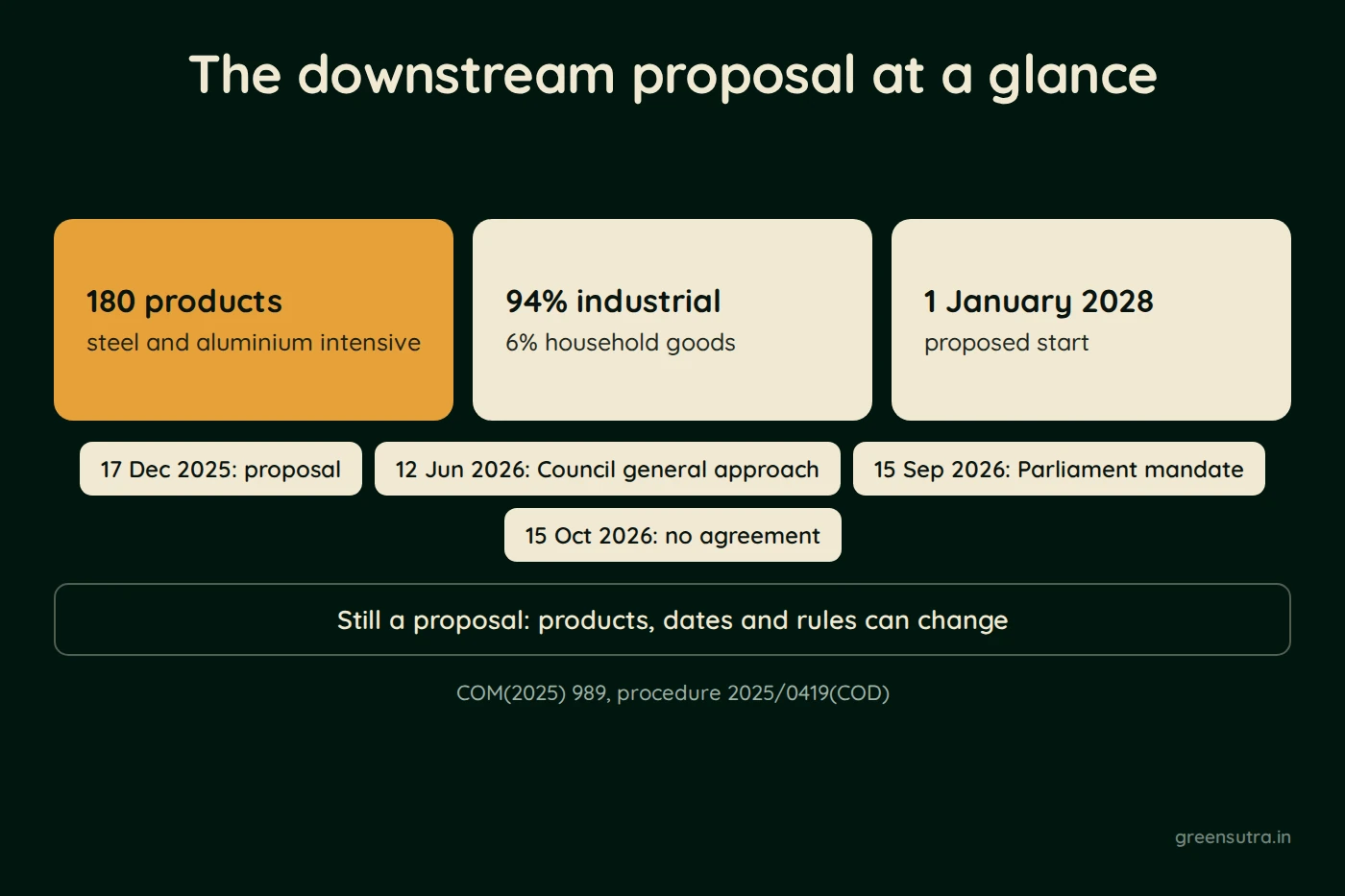
| Date | Step |
|---|---|
| 17 December 2025 | Commission proposal |
| 12 June 2026 | Council agrees its general approach |
| 15 September 2026 | Parliament adopts amendments by 464 votes to 50, with 159 abstentions, as its negotiating mandate |
| 15 October 2026 | No agreement, and no act in the Official Journal |
Parliament’s amendments widen the product list beyond the Commission’s. They replace Article 27a with a way to redirect CBAM revenue to affected sectors, and they drop the Commission’s option to count Paris Agreement Article 6 credits. The Council would also widen the list. The final products, start date and rules can still change, while importer deadlines for today’s goods already apply.
Sources: Proposal COM(2025) 989, European Commission press release IP/25/3088, Legislative Observatory, procedure 2025/0419(COD), Commission welcomes Council agreement, 12 June 2026
Mapping a product range against the proposed CN lines is part of GreenSutra’s CBAM consulting, and the CBAM guide will follow the file through negotiations.