

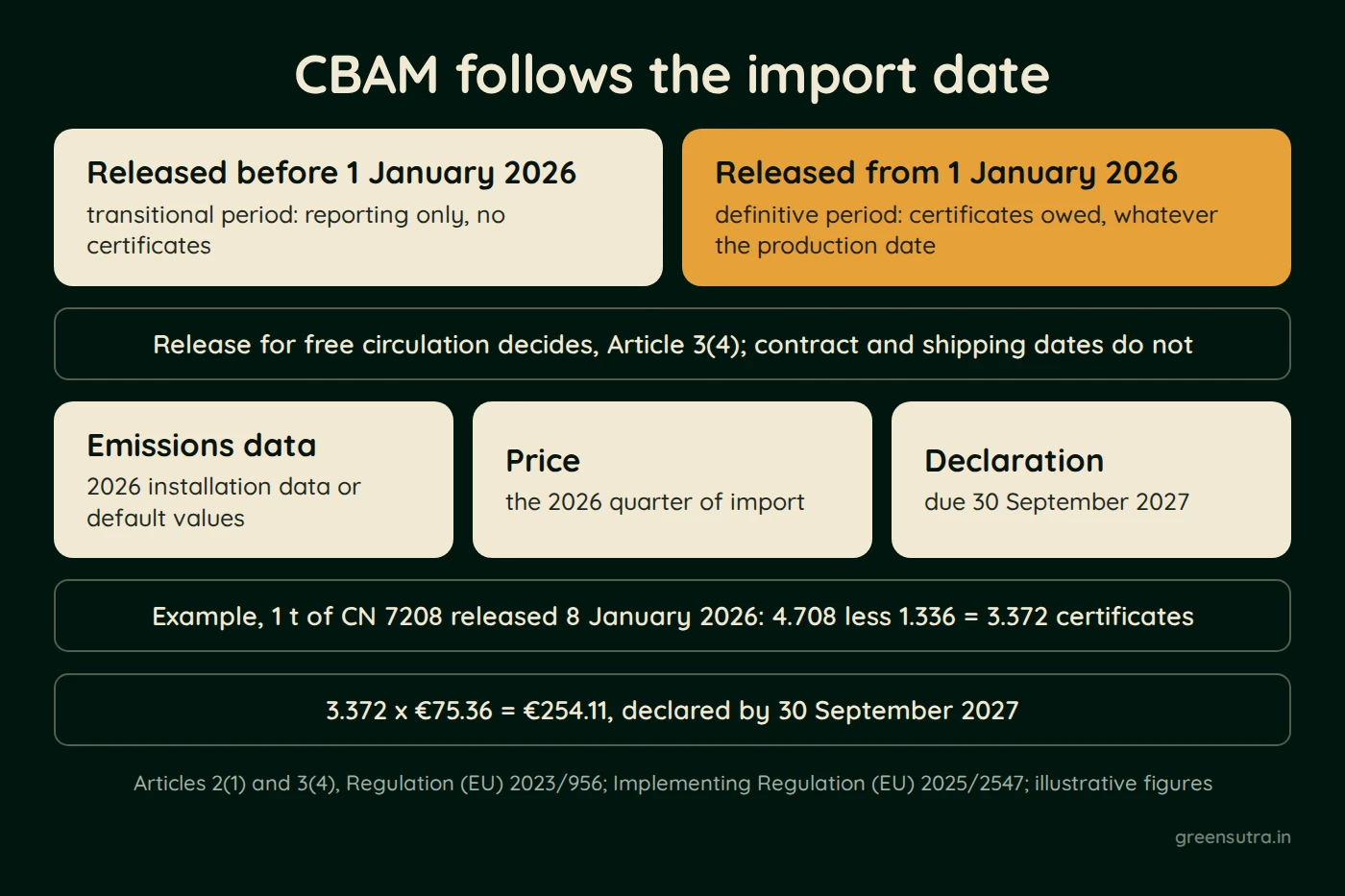
Yes, goods produced in 2025 fall under CBAM if released for free circulation in the EU from 1 January 2026, because Regulation (EU) 2023/956 attaches to the import. The production and contract dates play no part. The declarant uses 2026 installation data or default values and declares the goods by 30 September 2027.
Does the production date or the import date decide?
The import date. Article 2(1) applies CBAM to listed goods “imported into the customs territory of the Union”, and Article 3(4) defines importation as release for free circulation. The Commission’s CBAM Q&A says: “What matters is the moment when the customs declaration releasing the CBAM goods for free circulation is accepted by the customs authorities in an EU Member State.” Neither the sales contract date nor the shipping date decides.
Goods released before 1 January 2026 fell in the transitional period, which carried reporting obligations only. A good released in the fourth quarter of 2025 went into the quarterly report due by 31 January 2026, and no certificates are owed for it.
Can the installation’s 2025 emissions be declared?
No. Article 7(1) of Implementing Regulation (EU) 2025/2547 says: “Where a good was imported during the year 2026, the reporting period shall be the year 2026”. The Commission’s Q&A explains that no emissions data can be given for goods produced before 1 January 2026, because there was no CBAM verification and no accredited verifier then. The declarant therefore uses the installation’s verified 2026 emissions or the default values. Later years follow a different reporting period rule.
Which 2026 rules apply to goods produced in 2025?
All of them.
| Rule | For a 2025-produced good imported in 2026 |
|---|---|
| Annual declaration | Due 30 September 2027 |
| Default value mark-up | 10%, or 1% for fertilisers |
| Free allocation adjustment | CBAM factor 97.5%, correction factor 100% |
| Certificate price | The 2026 certificate price of the quarter of import |
| 50 tonne threshold | Counts towards the 2026 total |
Goods placed under inward processing before 2026 are covered when released in 2026, the Commission’s Guidance Document No. 1 notes. By the same Article 3(4) test, goods held in a customs warehouse since 2025 fall under CBAM once released. Goods in transit stay outside, with the other exclusions.
Example: hot-rolled flat steel (CN 7208) produced in India in October 2025, declared on default values. The dates and the one-tonne quantity are illustrative.
- Released on 8 January 2026: in scope. The default of 4.280 t CO2e with the 10% mark-up gives 4.708. The adjustment is 0.975 x 1.00 x 1.370, or 1.336, leaving 3.372 certificates. At the first-quarter price of €75.36 that is €254.11, declared by 30 September 2027.
- Released on 30 December 2025, the same coil owes no certificates.
Sources: Regulation (EU) 2023/956, Implementing Regulation (EU) 2025/2547, Implementing Regulation (EU) 2026/1740, Implementing Regulation (EU) 2025/2620, Implementing Decision (EU) 2026/1862, Commission CBAM Q&A, Commission price page, Introduction to CBAM concepts
For shipments that straddle 1 January 2026, GreenSutra’s CBAM service prepares the installation’s 2026 data and records that an accredited verifier checks. It does not verify. The CBAM guide covers the definitive period.