


CBAM default values are the European Commission’s figures for the emissions embedded in a tonne of a CBAM good from a given country. The registry adds a mark-up to the published average. For goods other than electricity, declarants may choose them over verified data. The binding tables are in Annex I to Implementing Regulation (EU) 2025/2621, corrected in July 2026.
How is a CBAM default value set?
Each value is a country’s average emission intensity for a good, plus a mark-up, under Annex IV point 4.1 of the CBAM Regulation. Without reliable country data, the value averages the 10 exporting countries with the highest intensities for that good, listed as “Other countries and territories”.
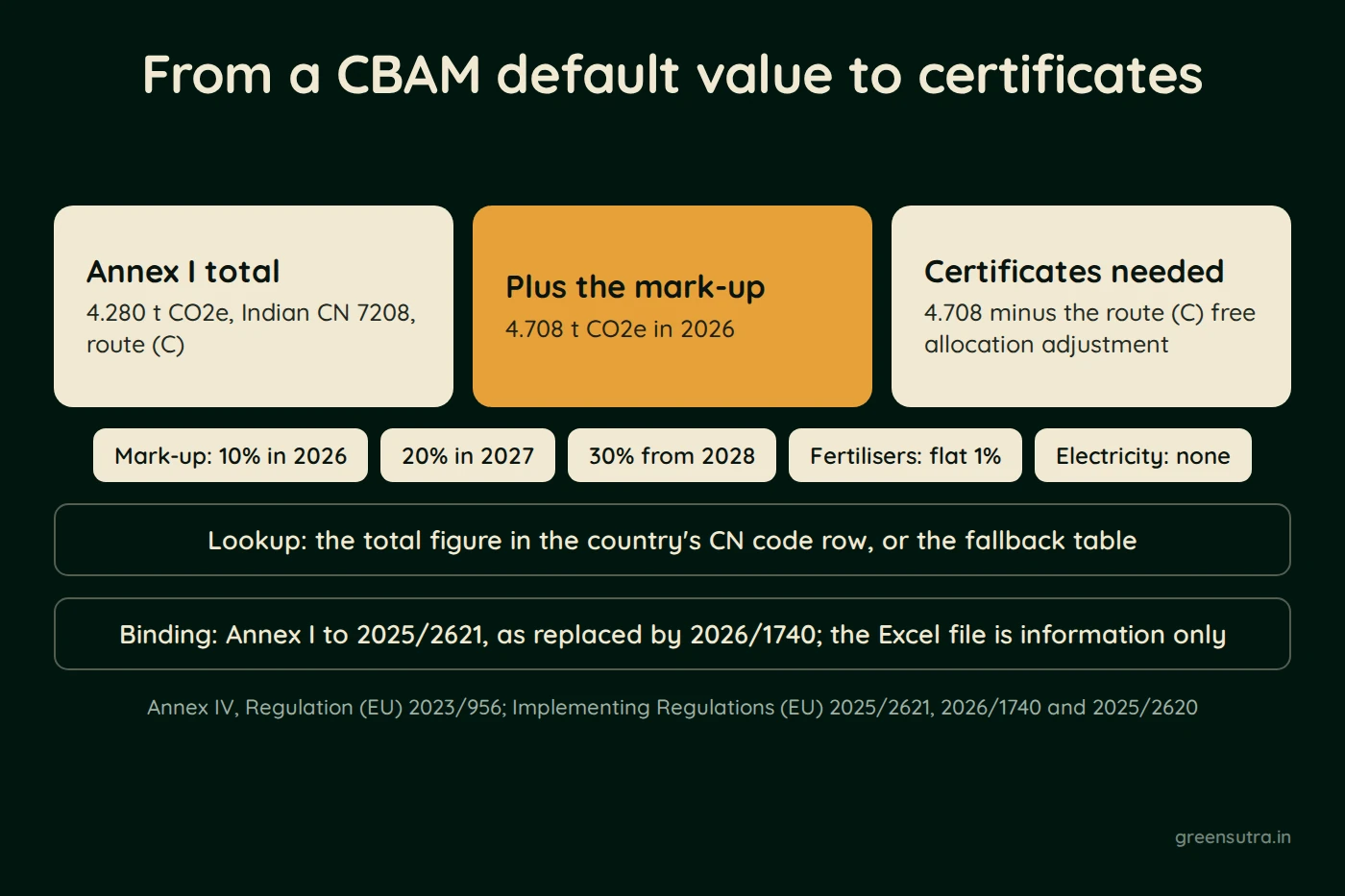
The mark-up is 10% in 2026, 20% in 2027 and 30% from 2028 for cement, iron and steel, aluminium and hydrogen. Fertilisers carry a flat 1%, and electricity none.
Where are the default values published?
The annexes to Implementing Regulation (EU) 2025/2621 hold the binding values.
| Source | Status |
|---|---|
| Annex I to 2025/2621, as replaced by 2026/1740 (31 July 2026) | Legally binding from 1 January 2026 |
| Commission Excel file, posted 10 August 2026 | Information only, without the indirect and electricity factors |
| Annexes II and III of 2025/2621, and Annex IV as replaced by 2026/1740 | Binding grid factors for indirect emissions and electricity, and values for precursors of unknown origin |
How is a value looked up in Annex I?
The value is the total emissions figure in the country’s CN code row. A missing country, an empty field or a dash means the fallback table applies. The 2026/1740 correction deleted the old marked-up columns; the registry applies the mark-up to the total. The direct and indirect columns are for information only. Sector answers give the figures for Indian steel, Türkiye steel, Indian aluminium, cement and fertilisers.
When can a declarant choose default values?
At any time, for goods other than electricity. Since Regulation (EU) 2025/2083, Article 7(2) offers actual emissions or default values as equal options. Defaults need no verification report in the annual declaration, and the free allocation adjustment must use defaults too. On default values, a carbon price deduction needs the yearly default carbon prices, and the Commission had published none by 15 October 2026. Imported electricity uses defaults unless the declarant meets Annex IV point 5.
Are default values the same as default CBAM benchmarks?
No. Default values estimate a good’s emissions; the mark-up raises them. Default CBAM benchmarks, in Implementing Regulation (EU) 2025/2620, set the free allocation adjustment that is deducted. Benchmarks do not vary by country; the production route in the Annex I row picks one.
Example: one tonne of Indian hot-rolled flat steel (CN 7208) on default values. The Annex I total is 4.280 t CO2e, route (C). The 2026 mark-up takes it to 4.708. Deducting the route (C) adjustment, 0.975 x 1.00 x 1.370 or 1.336, leaves 3.372 certificates needed a tonne. Default values are due for revision in 2027 at the latest.
Sources: Regulation (EU) 2023/956, Implementing Regulation (EU) 2025/2621, Implementing Regulation (EU) 2026/1740, Implementing Regulation (EU) 2025/2620, Commission default values
The CBAM cost calculator applies these values to a shipment. For verified data, GreenSutra’s CBAM service prepares the installation data that an accredited verifier checks. It does not verify.