


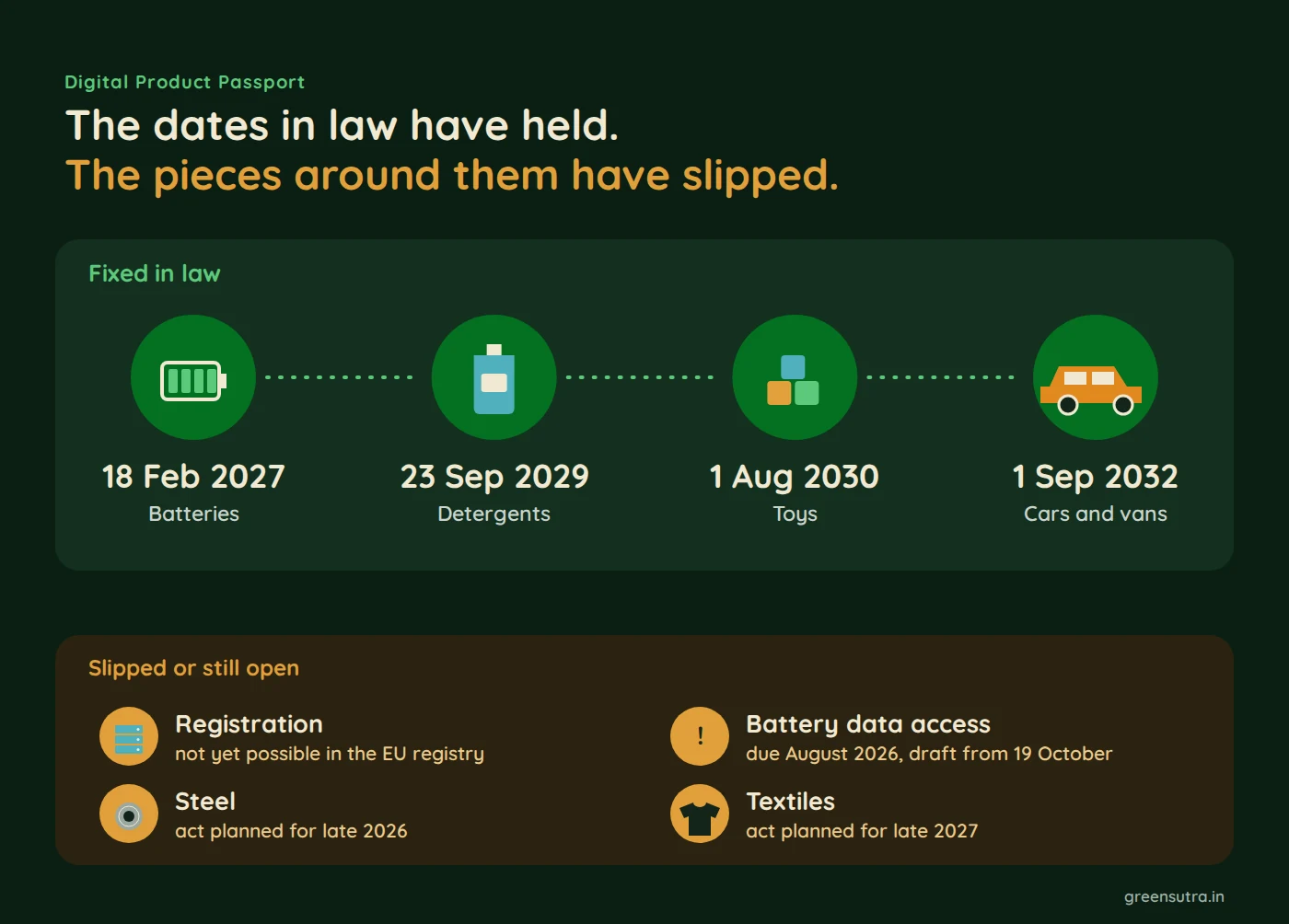
The first fixed date has not moved. The battery passport still applies from 18 February 2027, and the passport dates written into other laws stand too. What has slipped are the supporting pieces. Registration in the EU registry is not yet possible, the act on who may read restricted battery data missed its deadline, and several planned product acts have moved later.
Which dates are fixed in law?
| Date | What applies |
|---|---|
| 18 February 2027 | Battery passport for electric vehicle, light means of transport and larger industrial batteries; QR code on all batteries; national registry administrators in place |
| 18 August 2027 | Battery supply-chain due diligence, moved from 18 August 2025 by an amendment in July 2025 |
| 23 September 2029 | Detergent passport |
| 1 August 2030 | Toy passport |
| 1 September 2032 | Circularity passport for cars and vans |
What has slipped?
- Registration. The EU registry went live on 20 July 2026, but its user guide still says that passports cannot yet be registered successfully, batteries included.
- Battery data access. The act naming who may read restricted battery data was due by 18 August 2026. A draft appeared on 19 October 2026, with feedback open until 16 November 2026.
- Standards. The Commission’s own page moved the decision citing the last two passport standards from September to November 2026.
- Battery carbon footprint. The method act was due for electric vehicle batteries in February 2024 and has not been adopted.
- Product groups. Iron and steel is planned for late 2026, with no draft published. Textiles show the fourth quarter of 2027 on the Commission’s textile page, later than the first quarter of 2027 once shown on its consultation portal.
The Commission calls its timeline indicative.
What is still a proposal?
A simplification package known as Omnibus IV would extend the transition for 19 older energy-related product groups from 31 December 2026 to 31 December 2028. The Parliament’s first-reading vote is expected at the plenary of 23 November 2026. It does not change the battery passport date.
Example: what a late-2026 steel act would mean
Example. Suppose the iron and steel act is adopted in December 2026. The Parliament and Council have two months to object, so it would enter into force around March 2027. Ecodesign acts cannot apply earlier than 18 months after that, unless duly justified, which points to about September 2028 for steel passports at the earliest. Which products need a passport first lists every group.
Where this comes from: Battery Regulation (EU) 2023/1542, Articles 7(1), 13(6) and 77; Regulation (EU) 2025/1561; Ecodesign Regulation (EU) 2024/1781, Articles 4(4), 72 and 79; Implementing Regulation (EU) 2026/1778; Commission Digital Product Passport page; European Parliament procedure 2025/0134(COD)).
More on this: Digital Product Passport guide · Digital Product Passport services
Reviewed by Team GreenSutra on 26 October 2026.