


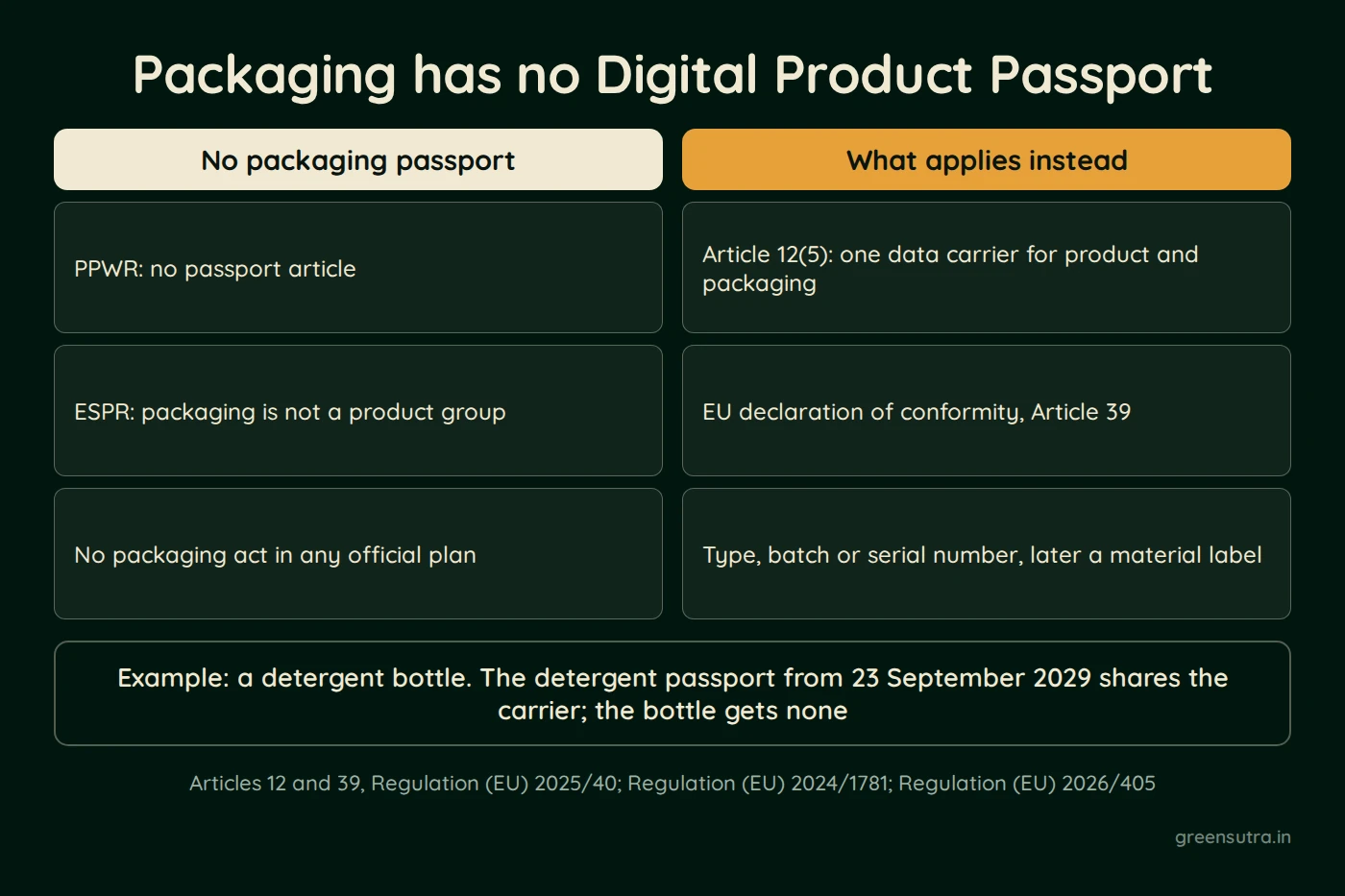
No EU law gives packaging a Digital Product Passport of its own. The Packaging and Packaging Waste Regulation (PPWR), Regulation (EU) 2025/40, has no passport article, and packaging is not an ESPR product group. Where the packed product has a passport, Article 12(5) requires one shared data carrier for the product and packaging information.
Does the PPWR create a packaging passport?
No. The PPWR has applied since 12 August 2026 and contains no passport article. The word appears only in recital 70, which is not binding on its own. Recital 9 says packaging “is not addressed as a specific product category” under the Ecodesign for Sustainable Products Regulation (ESPR), Regulation (EU) 2024/1781.
The Commission’s DPP page lists the PPWR among standalone laws that set passport requirements; no PPWR article sets one up.
Could the ESPR create one later?
The ESPR does not exclude packaging, but no official plan names a packaging group. The Commission’s working plan for 2025 to 2030 lists six priority product groups and two horizontal measures, none of them packaging. Its indicative passport timeline, updated on 15 October 2026, lists no packaging act. On 19 October 2026, no packaging passport is in law or in an official plan.
ESPR recital 25 and Annex I point (j) do let a product’s act set packaging rules, such as the product-to-packaging ratio.
What if the packed product has a passport?
One data carrier for both, under PPWR Article 12(5). Where Union law requires product information by data carrier, “a single data carrier shall be used for providing the information required for the packaged product and for the packaging, and both shall be easily distinguishable.” Recital 70 adds that the product’s passport “should also be used for providing the relevant information under this Regulation.”
Under ESPR Article 10(1)(b), the data carrier may sit on the product, its packaging or accompanying documents. A carrier printed on a box leads to the product’s passport.
Example: a detergent sold in a bottle. From 23 September 2029, Regulation (EU) 2026/405 requires a detergent passport, with its carrier on the label or packaging. Once the PPWR label applies, any packaging information given by data carrier uses that same carrier, kept distinct from the product data. The bottle gets no passport.
What does packaging need instead?
An EU declaration of conformity under PPWR Article 39. The manufacturer states in it that the requirements of Articles 5 to 12 that apply to the packaging have been demonstrated. Where packaging and the packed product fall under several acts, one single declaration is drawn up where appropriate. Packaging also carries a type, batch or serial number and the manufacturer’s contact details, and later a material label. The PPWR labelling requirements cover those marks and dates.
The PPWR does not require entry in the EU passport registry set up by Implementing Regulation (EU) 2026/1778.
Sources: Regulation (EU) 2025/40 (PPWR), ESPR, Regulation (EU) 2024/1781, Working Plan COM(2025) 187, Regulation (EU) 2026/405, Implementing Regulation (EU) 2026/1778, Digital Product Passport page
For a business that packs products with a passport, GreenSutra’s DPP consulting first sorts each data point into product passport or packaging label. The DPP guide lists which laws set passports.