

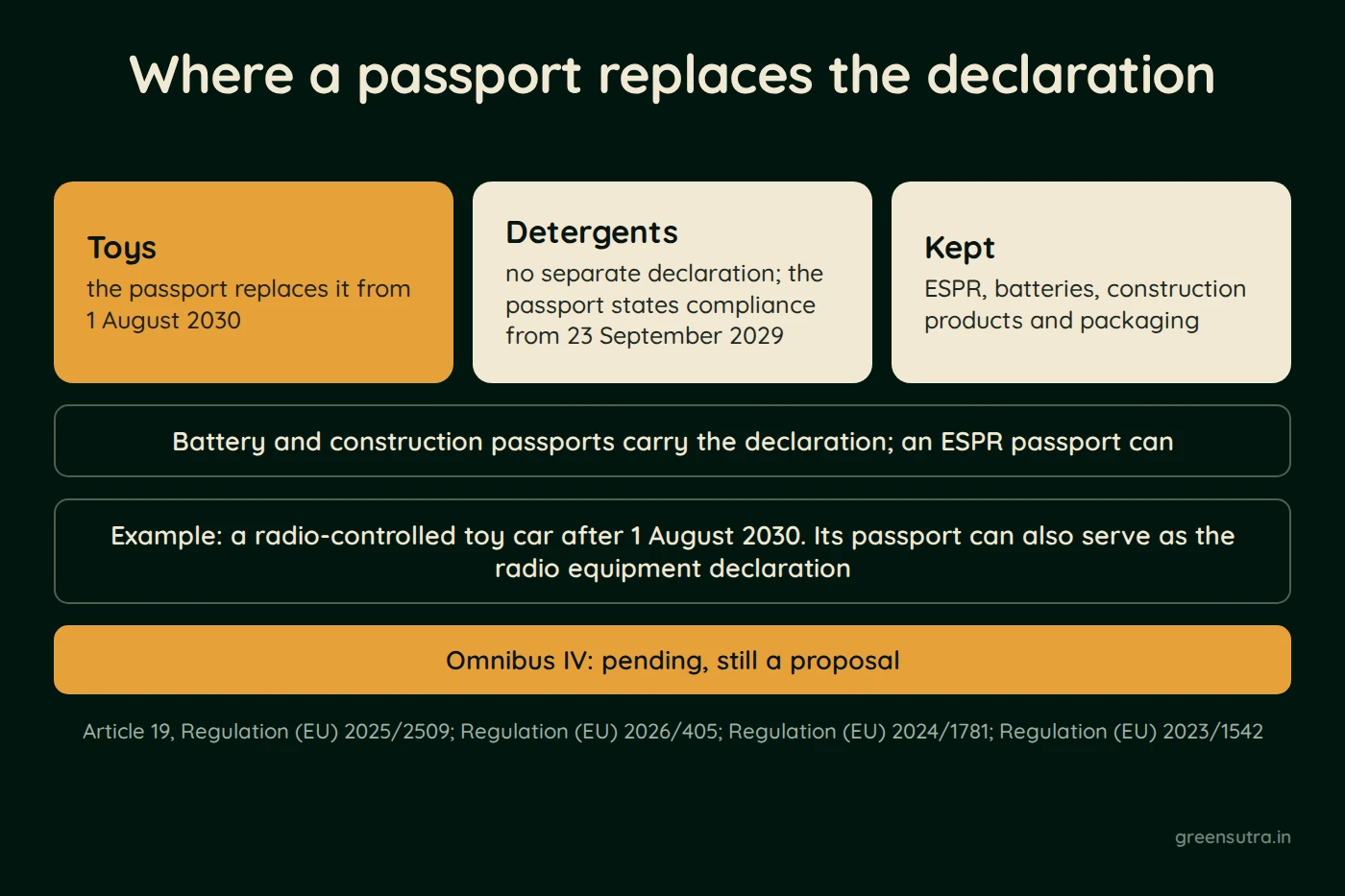
The Digital Product Passport replaces the EU declaration of conformity only for toys, from 1 August 2030, under Regulation (EU) 2025/2509. The Detergents Regulation asks for no separate declaration, because its passport, required from 23 September 2029, states compliance. Elsewhere the declaration stays: battery and construction passports carry it, and an ESPR passport can.
Which laws keep the declaration?
Four of the six laws below keep it.
| Law | Declaration | Passport’s role |
|---|---|---|
| ESPR, Regulation (EU) 2024/1781 | Kept: Article 27(2), held 10 years under Article 27(3) | Can carry it, Annex III (e) |
| Batteries, Regulation (EU) 2023/1542 | Kept: Article 18, electronic, paper on request | Carries it from 18 February 2027, Annex XIII point 1(r) |
| Construction products, Regulation (EU) 2024/3110 | Kept: declaration of performance and conformity (DoPC), Article 13 | Carries it, Article 76(2)(a)(i); no passport date yet |
| Packaging, Regulation (EU) 2025/40 | Kept: Article 39 | No packaging passport |
| Detergents, Regulation (EU) 2026/405 | No separate declaration | States compliance from 23 September 2029 |
| Toys, Regulation (EU) 2025/2509 | Replaced | Replaces it from 1 August 2030 |
Each ESPR product act decides whether the passport carries the declaration as Annex III data. The construction passport carries the DoPC, but under CPR Article 91(2) an end-user can still ask for it on paper, free of charge, at purchase.
How does the toy passport replace the declaration?
Article 19(4) of the toy safety Regulation reads “By creating the digital product passport, the manufacturer shall assume responsibility for the compliance of the toy with this Regulation”. Under Article 19(5)(a), the toy passport can also stand in for declarations under the AI Act, the Cyber Resilience Act, RoHS, EMC, low voltage, radio equipment and drone rules. It must hold all their information, and Article 19(6) requires a statement that it replaces them.
Example: a radio-controlled toy car placed on the EU market after 1 August 2030. Its toy passport can also serve as its radio equipment declaration, if complete and so marked. A cordless garden tool under a future ESPR act would still need its own declaration.
What does the detergent passport do instead?
Before placing a detergent on the market, the manufacturer creates its passport under Article 8(2)(a). The detergent passport must state that compliance “has been demonstrated” and that it is issued under the manufacturer’s sole responsibility.
Will more passports replace declarations?
Not yet; Omnibus IV is still a proposal.
The Omnibus IV texts agreed in June 2026 would require the declaration to be drawn up only in electronic form, including for batteries. Where another law requires a declaration in a passport, its information “shall be provided only in that digital product passport”. That rule would cover machinery, cableways, personal protective equipment, gas appliances and 13 directives, among them RoHS and radio equipment. Most changes would apply 30 months after entry into force. On 19 October 2026, the texts awaited Parliament’s first-reading position, with its plenary indicatively set for 23 November 2026.
Sources: Regulation (EU) 2025/2509, Regulation (EU) 2026/405, ESPR, Regulation (EU) 2024/1781, Regulation (EU) 2023/1542, Regulation (EU) 2024/3110, Council document 10980/26, Procedure 2025/0134(COD))
For a manufacturer, GreenSutra’s DPP consulting first maps each product’s declarations against its passport duties. The DPP guide lists each law’s dates.