


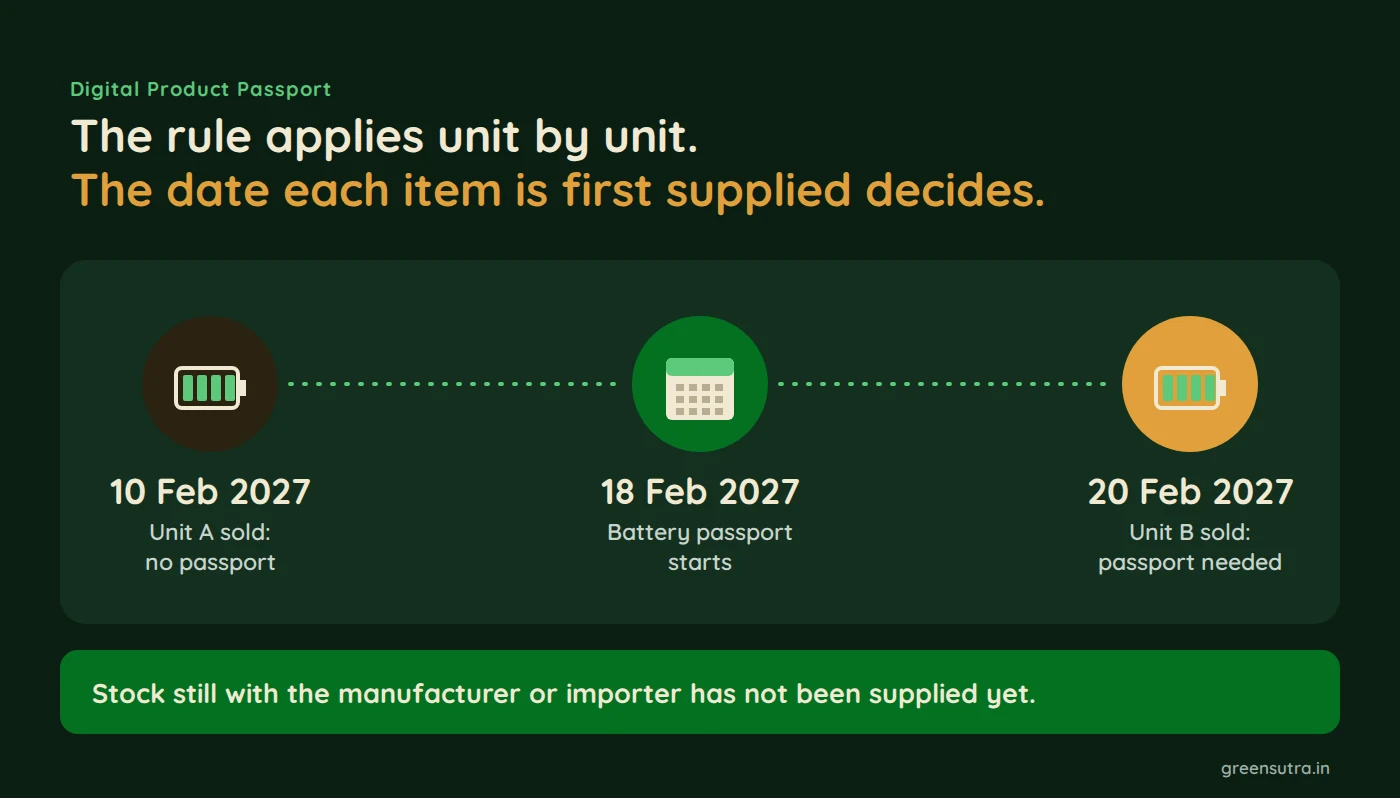
No, for units already sold into the EU market. Digital Product Passport rules apply unit by unit, when each item is first supplied in the EU. Units supplied before a start date need no passport and can keep being sold; later units of the same model need one. Stock still held by the manufacturer or importer has not been supplied yet.
How does the per-unit rule work?
The Commission’s Blue Guide on EU product rules applies them to each individual item, not the model, and the Battery Regulation itself speaks of each battery placed on the market. Under the guide, units of a model placed on the market after new requirements apply must meet them. It adds that goods still in the stock of the manufacturer or importer, not yet supplied, have not been placed on the market. For products covered by the Ecodesign Regulation, the Commission’s FAQ says the passport must be active and registered at that moment of first supply.
Example: two identical e-bike batteries
Example. An importer brings in two batteries of the same model. Unit A is sold to a distributor on 10 February 2027 and needs no passport; the distributor can keep selling it. Unit B stays in the importer’s warehouse and is sold on 20 February 2027, after the battery passport starts on 18 February 2027, so it needs one.
Does any law add a sell-through period?
| Product group | Position |
|---|---|
| Batteries | None. Units placed from 18 February 2027 need a passport, and every battery needs a QR code from that date |
| Detergents | Products placed before 23 September 2029 under the old rules may be sold indefinitely; those placed in the following year under the old rules, until 23 September 2030 |
| Toys | Toys placed under the old directive before 1 August 2030 may stay on sale |
| Ecodesign product groups | Each group’s act sets its own date, no earlier than 18 months after it enters into force, unless duly justified |
A pending EU simplification package, called Omnibus IV, would add a 30-month stock clause, but only for its own digital changes, not for passport start dates. The Parliament’s vote is expected at the plenary of 23 November 2026.
What can a business do now?
Keep a dated record of when each unit is first supplied, because that date decides the duty. Battery importers and manufacturers should plan for every unit still in their own stock on 18 February 2027 to need a passport when it is sold. The full list of product dates is in which products need a passport first.
Where this comes from: Ecodesign Regulation (EU) 2024/1781, Articles 2(40), 4(4) and 9(1); Battery Regulation (EU) 2023/1542, Articles 13(6) and 77(1); Detergents Regulation (EU) 2026/405, Articles 36 and 37; Toy Safety Regulation (EU) 2025/2509, Article 57; Blue Guide 2022), section 2.3.
More on this: Digital Product Passport guide · Digital Product Passport services
Reviewed by Team GreenSutra on 26 October 2026.