


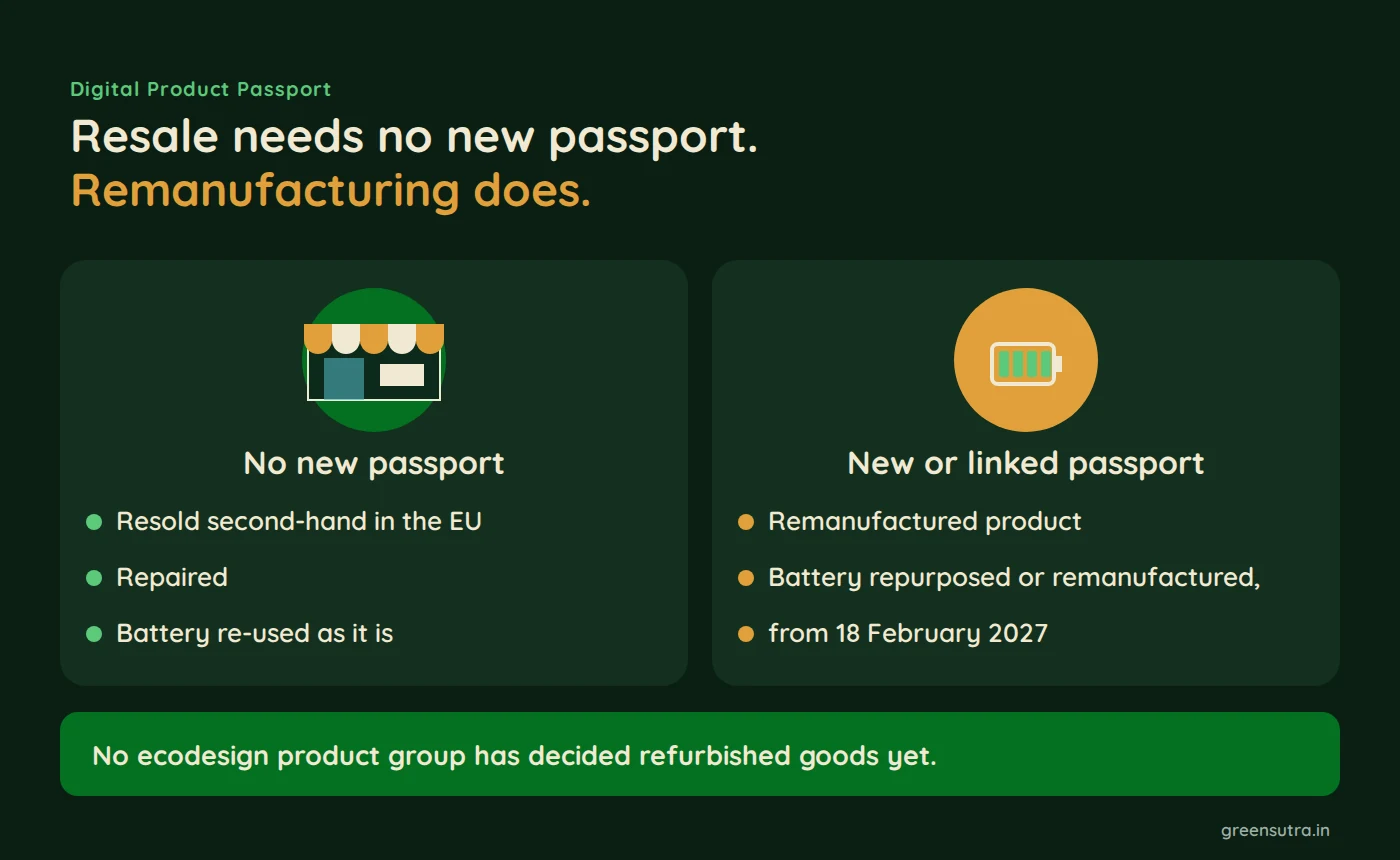
Whether a used product needs a Digital Product Passport depends on what was done to it. Second-hand and repaired goods resold inside the EU are not new products, so they need no new passport. Remanufactured products count as new. From 18 February 2027, a repurposed or remanufactured battery gets a new passport linked to the original.
Why does resale not trigger a passport?
The Ecodesign Regulation ties the passport to placing on the market, which means the first time a product is supplied in the EU. Every later sale is only making available. The regulation’s explanatory text adds that second-hand goods from within the EU, including refurbished or repaired ones, are not new products. They can circulate without meeting product rules adopted after they were first sold.
When does a used product count as new?
Remanufacturing turns it into a new product: a change that substantially affects its safety, performance, purpose or type. A distributor or importer that modifies a product in a way that affects its compliance is treated as its manufacturer. Imported second-hand goods are a separate case. The Commission’s Blue Guide on EU product rules says EU rules reach used goods brought in from outside the EU when they first enter it. Read together with the Ecodesign Regulation, an imported used product in a covered group would need a passport on entry.
What is already decided for batteries?
| What happens to the battery | Passport from 18 February 2027 |
|---|---|
| Re-used as it is | Keeps its existing passport |
| Simple repair | No new passport, according to the Commission’s battery FAQ |
| Prepared for re-use or repurposing, repurposed or remanufactured | New passport linked to the original; the business that places it becomes responsible |
| Recycled | The passport ends |
The passport also records the battery’s status: original, repurposed, re-used, remanufactured or waste.
Example: a remanufactured car battery
Example. An electric car battery was first sold in the EU in 2025, before passports began, so it has none. In 2028 a business takes it apart, checks every cell and module and uses new, used or recovered cells where needed. It restores the battery to at least 90% of its original rated capacity, with all cells within 3% of each other in state of health, for the same purpose. That is remanufacturing in the Battery Regulation’s terms, so the battery is placed on the market anew and needs a passport.
What is still open?
No product group under the Ecodesign Regulation has its own rules yet, so how refurbished goods are handled in each passport is undecided. For batteries, a draft act published on 19 October 2026 would let repairers, remanufacturers and repurposers read the restricted data; feedback is open until 16 November 2026. The answer on repairers and recyclers covers what they can see today.
Where this comes from: Ecodesign Regulation (EU) 2024/1781, Articles 2(16), 2(39), 2(40), 9(2) and 34 and recital 17; Battery Regulation (EU) 2023/1542, Articles 3(1)(32) and 77 and Annex XIII; Blue Guide 2022), section 2.1; Commission battery passport FAQ.
More on this: Digital Product Passport guide · Digital Product Passport services
Reviewed by Team GreenSutra on 26 October 2026.