


The passport data their role allows, free of charge. The EU’s Ecodesign Regulation gives professional repairers, refurbishers, remanufacturers and recyclers free and easy access to a product’s Digital Product Passport (DPP). They see the data their role needs, not everything. Exactly what each can see will be set by each product group’s rules, and as of October 2026, none had been adopted.
What might they see?
The Commission’s FAQ gives examples of what product group rules could open up:
| Who | Example data |
|---|---|
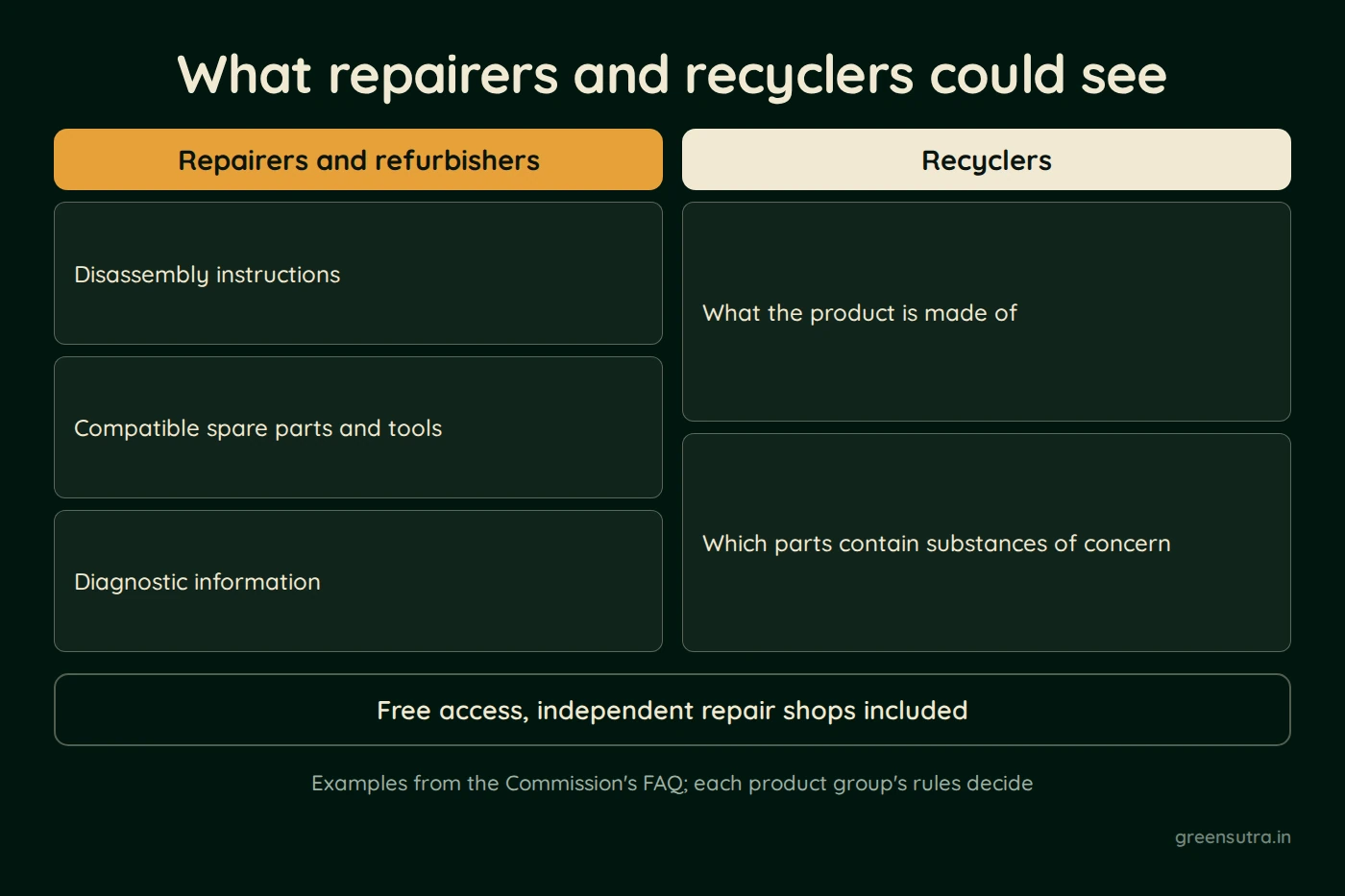
| Repairers and refurbishers | Step-by-step disassembly instructions, compatible spare parts and tools, diagnostic information for finding faults |
| Recyclers | What the product is made of, and which parts contain substances of concern |
These are examples, not rules. See who can access which data for how access is split.
Does an independent repair shop qualify?
Yes. The regulation also lists independent operators among those with free and easy access, a term that covers repairers, refurbishers and waste management businesses that are independent of the manufacturer. A repair shop does not need to be part of the brand’s network.
Can they use the EU registry?
Only once they are verified. The registry rules treat repairers, refurbishers, remanufacturers and recyclers as value chain actors. Once verified, they can enter the EU registry, and they act there only where EU law provides for it. Where applicable, a registered passport can also pass to such a business, which then takes over the duties.
What happens after a product is remanufactured?
Where a new passport is created, for example after remanufacturing, it must link to the original. For a remanufactured or repurposed battery, the business placing it back on the market is responsible for that new passport. More in who can update a passport.
What about battery passports?
From 18 February 2027, the EU battery passport opens part of its data to people with a “legitimate interest”. For repairers and recyclers, their purpose must concern both dismantling and the battery model’s detailed composition, and it must be essential to their work. The Commission was due to define who qualifies by 18 August 2026, and as of October 2026 it had not done so.
Where this comes from: Ecodesign Regulation (EU) 2024/1781, Articles 2(47) and (48), 9(2)(f) and 11; Implementing Regulation (EU) 2026/1778, Articles 2(6), 5(3) and 6a; Battery Regulation (EU) 2023/1542, Article 77; Commission DPP FAQ.