


The battery passport is written into law and starts on 18 February 2027, with its data, access tiers and QR code fixed. The textile Digital Product Passport does not exist yet. The Ecodesign Regulation sets only the framework. The textile act is planned for late 2027 and can apply only 18 months or more after it enters into force, unless duly justified.
How do they compare point by point?
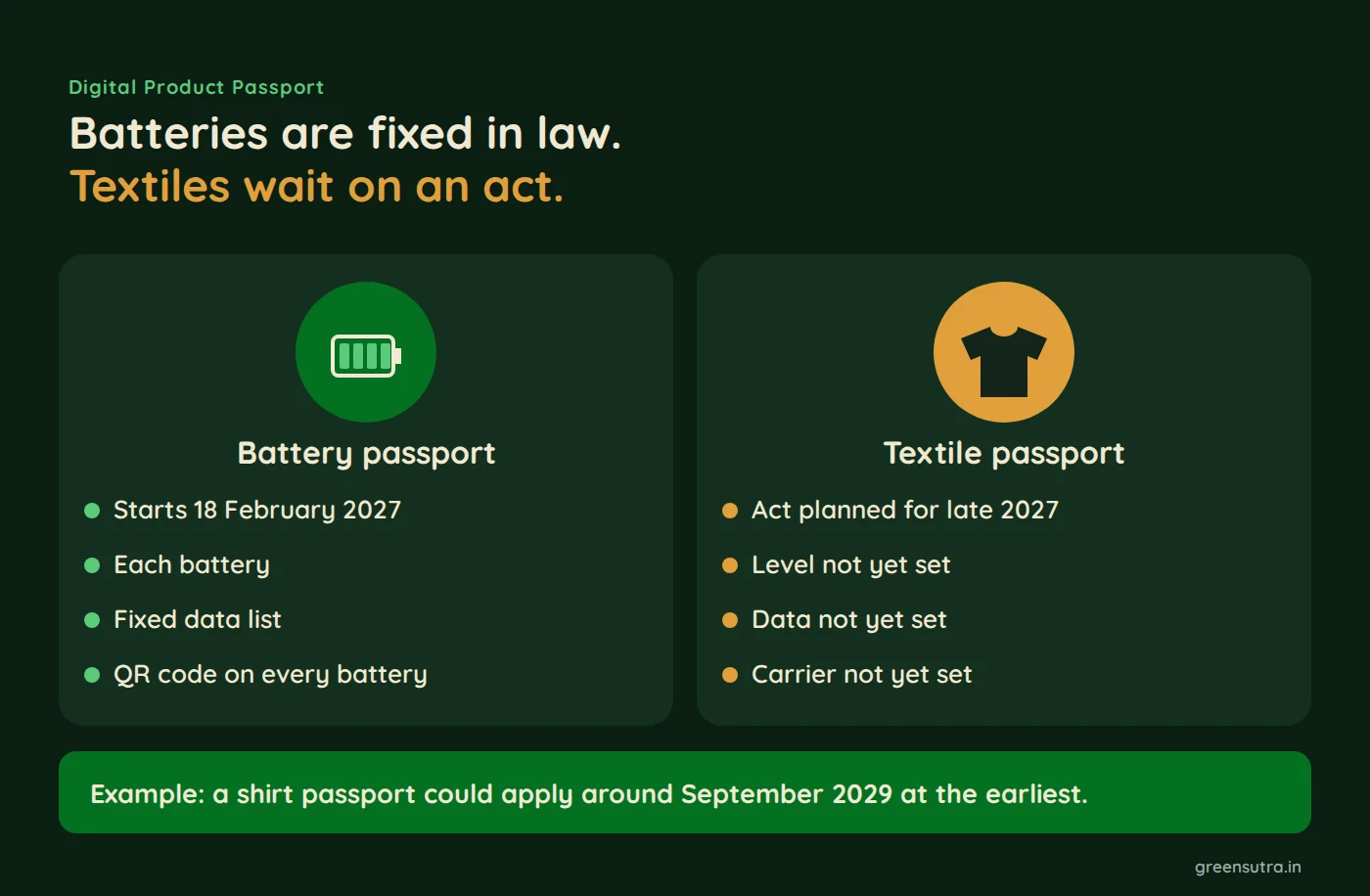
| Point | Battery passport | Textile passport |
|---|---|---|
| Legal basis | Battery Regulation, in force | Ecodesign Regulation plus a textile act not yet adopted |
| Start | 18 February 2027 | No date; the act is planned for late 2027 |
| Scope | Electric vehicle, light means of transport and industrial batteries over 2 kWh | Apparel textiles first; footwear goes to a study due by the end of 2027 |
| Level | Each individual battery | Model, batch or item, left to the textile act |
| Data | A fixed list, with 19 public items | Not yet set; the Commission lists fibre composition and origin among data that may be included |
| Access | Four tiers, from the public to authorities; who has a legitimate interest is still a draft | Open |
| Carrier | A QR code on every battery | Not yet set; the Commission mentions a QR code on the product |
| Back-up copy | No back-up rule, but the passport must stay available if the business closes | Required, with a passport service provider |
| How long | Until the battery is recycled | At least the product’s expected lifetime |
What is the same?
Both passports must be registered in the EU registry, which went live on 20 July 2026. Registration is not yet possible for either. Any textile act must also include tracking of substances of concern, the minimum for every product-specific ecodesign act. The answer on access tiers explains the access levels in more detail.
Example: the gap in practice
Example. A battery sold into the EU on 18 February 2027 needs its passport that day. For a shirt, take the Commission’s late-2027 target. If the act is adopted in December 2027, it would enter into force around March 2028 after the two-month objection period. The 18-month minimum then puts the textile passport duty at about September 2029 at the earliest, some two and a half years after batteries.
What can each sector do now?
Manufacturers and importers placing batteries on the market have a fixed duty: prepare the required data and QR codes and use the registry’s test environment. Textile companies have nothing binding yet. Fibre composition, already required on labels, and data on substances of concern are both likely to be needed. The answer for Indian textile exporters covers preparation in more detail.
Where this comes from: Battery Regulation (EU) 2023/1542, Articles 13(6), 77 and 78 and Annex XIII; Ecodesign Regulation (EU) 2024/1781, Articles 4(4), 7, 9, 10 and 18(5); Commission textile apparel passport page.
More on this: Digital Product Passport guide · Digital Product Passport services
Reviewed by Team GreenSutra on 26 October 2026.